
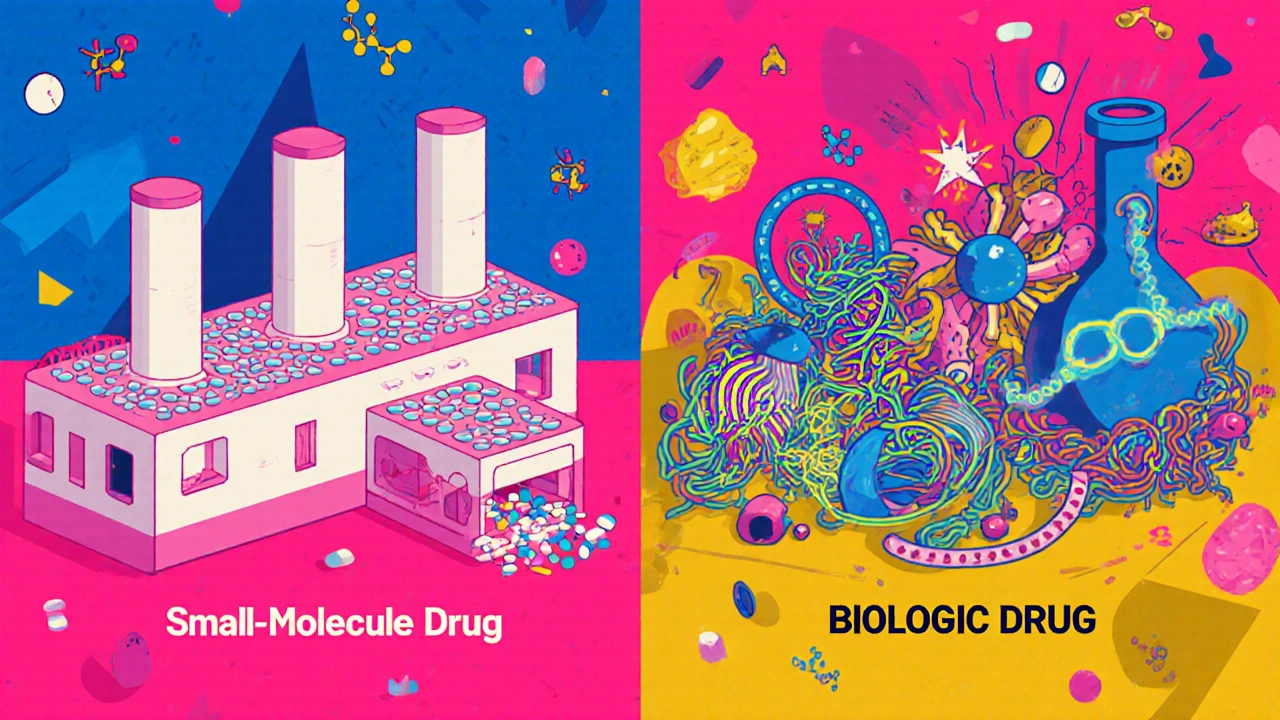
When you pick up a prescription for a pill like metformin or lisinopril, you expect every batch to be identical. That’s because small-molecule drugs are made through chemical reactions - mix these ingredients, heat it, filter it, and you get the same molecule every time. But biologic drugs? They’re not made that way. They’re grown. In living cells. And that changes everything.
What Makes Biologic Drugs So Different?
Biologic drugs are made from living organisms - bacteria, yeast, or mammalian cells engineered to produce proteins like antibodies or hormones. Think of Humira for arthritis, Ozempic for diabetes, or Herceptin for breast cancer. These aren’t tiny molecules. They’re huge, complex structures - up to 1,000 times larger than a typical pill. And because they come from living systems, they’re never perfectly identical from one batch to the next.
That’s not a flaw. It’s a fact of biology. Even under the tightest controls, tiny variations happen. A cell might fold a protein slightly differently. A nutrient level might shift by 0.1%. A temperature fluctuation of half a degree can change the final product. The FDA calls this inherent variability. It’s normal. It’s expected. And it’s why you can’t just copy a biologic like you copy aspirin.
How Are Biologics Actually Made?
Creating a biologic isn’t like mixing chemicals in a lab. It’s more like farming. First, scientists insert human genes into host cells - usually Chinese hamster ovary cells - to turn them into protein factories. These cells are then placed in giant stainless-steel tanks called bioreactors, where they’re fed nutrients, kept at 36.5°C, and gently stirred for 10 to 14 days. During that time, the cells multiply and pump out the therapeutic protein.
Then comes the hard part: purification. The protein has to be pulled out of the soup of dead cells, waste, and other proteins. That’s done through multiple rounds of chromatography - often using expensive protein A resin - followed by viral filtration and ultrafiltration. Each step removes impurities but also risks damaging the delicate protein structure. The whole process takes 3 to 6 months. Compare that to a generic pill, which can be made in days.
And it’s expensive. Quality control alone makes up 30-40% of the total cost. For a small-molecule drug? That number is 5-10%. Why? Because with biologics, you’re not just checking for purity. You’re testing for structure, folding, glycosylation patterns, charge variants - hundreds of tiny details that could affect how the drug works in your body.
Why There Are No Exact Copies
Generics are copies. They contain the exact same active ingredient, in the exact same amount, with the same chemical structure. That’s possible because small molecules are simple. You can analyze them fully. You can replicate them perfectly.
Biologics? You can’t. Even the manufacturer who invented the drug can’t make two batches that are 100% identical. The FDA says it outright: “Slight modifications… are expected as a natural process of manufacturing.” That’s not a failure. It’s how biology works.
So when a company tries to make a copy, they’re not copying a molecule. They’re trying to replicate a whole living system - the cell line, the feeding process, the temperature control, the purification method - all of which influence the final product. Even if they use the same cell line, the way they grow it, the water quality, the air pressure in the cleanroom - all of it changes the outcome.
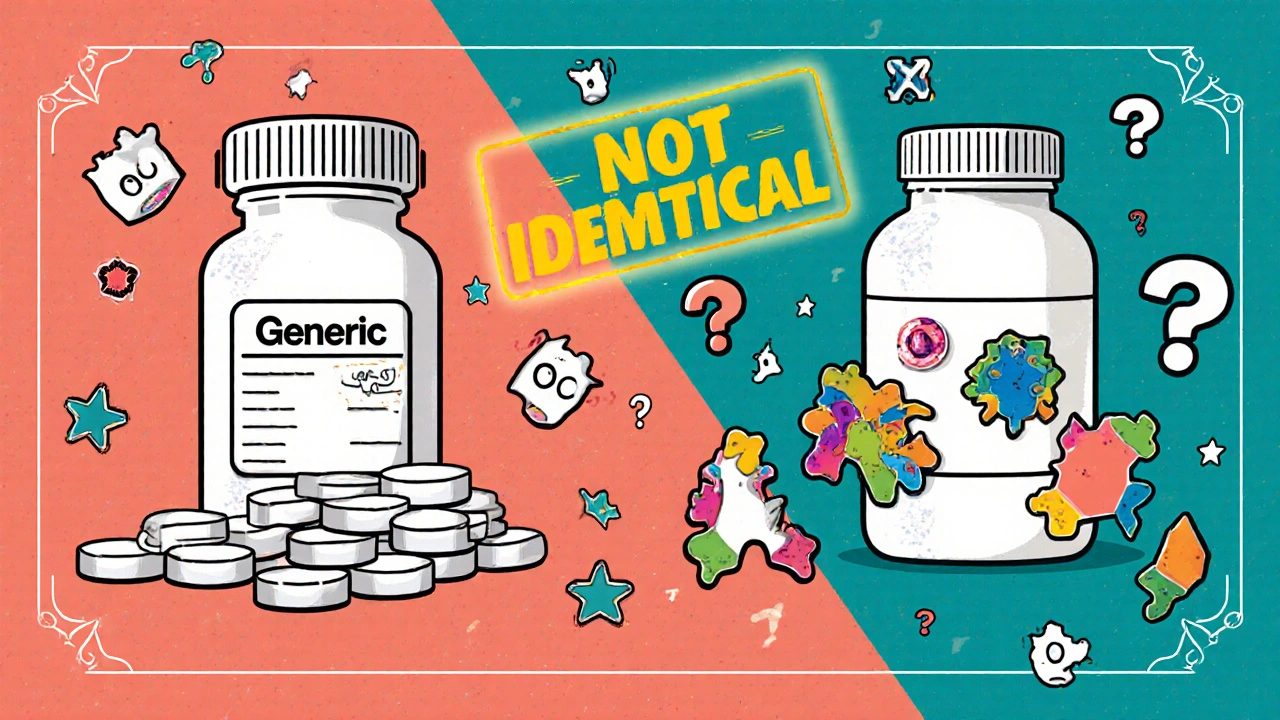
This is why the FDA doesn’t approve “copies” of biologics. Instead, they approve biosimilars. These are highly similar, but not identical. They have to prove they work the same way in the body, have the same safety profile, and cause the same immune response. But they’re not exact replicas. And that’s okay - as long as they’re safe and effective.
Biosimilars vs. Generics: The Real Difference
Let’s say you’re on Humira. Your doctor switches you to a biosimilar. You might wonder: is this the same thing? The answer is: almost, but not quite - and that’s by design.
Generics are approved through a simple process. The company just proves they have the same active ingredient, dissolve at the same rate, and get absorbed the same way. No clinical trials needed.
Biosimilars? They need to go through a whole different level of proof. They must show:
- Extensive analytical data proving structural and functional similarity
- Identical pharmacokinetics (how the body absorbs and processes the drug)
- Comparable safety and immunogenicity in clinical trials
- No clinically meaningful differences in effectiveness
That’s why a biosimilar can cost 15-35% less than the original - not 80% like a generic. The development process takes 7-10 years and costs $100-$200 million. That’s a fraction of the original $2 billion it took to develop Humira, but still far more than the $1-$5 million it takes to make a generic.
And here’s the kicker: even the original manufacturer can’t make two batches of Humira that are exactly the same. So if the original isn’t perfectly consistent, how could a copy ever be?
Manufacturing Risks and Real-World Failures
Biologics manufacturing is fragile. One contaminated filter. One power outage. One mislabeled tank. And a $500,000 batch is gone. According to BioPlan Associates, contamination causes 35% of batch failures. One engineer on LinkedIn described switching from a 2,000-liter to a 15,000-liter bioreactor - it took 17 months and $22 million in lost revenue just to get it right.
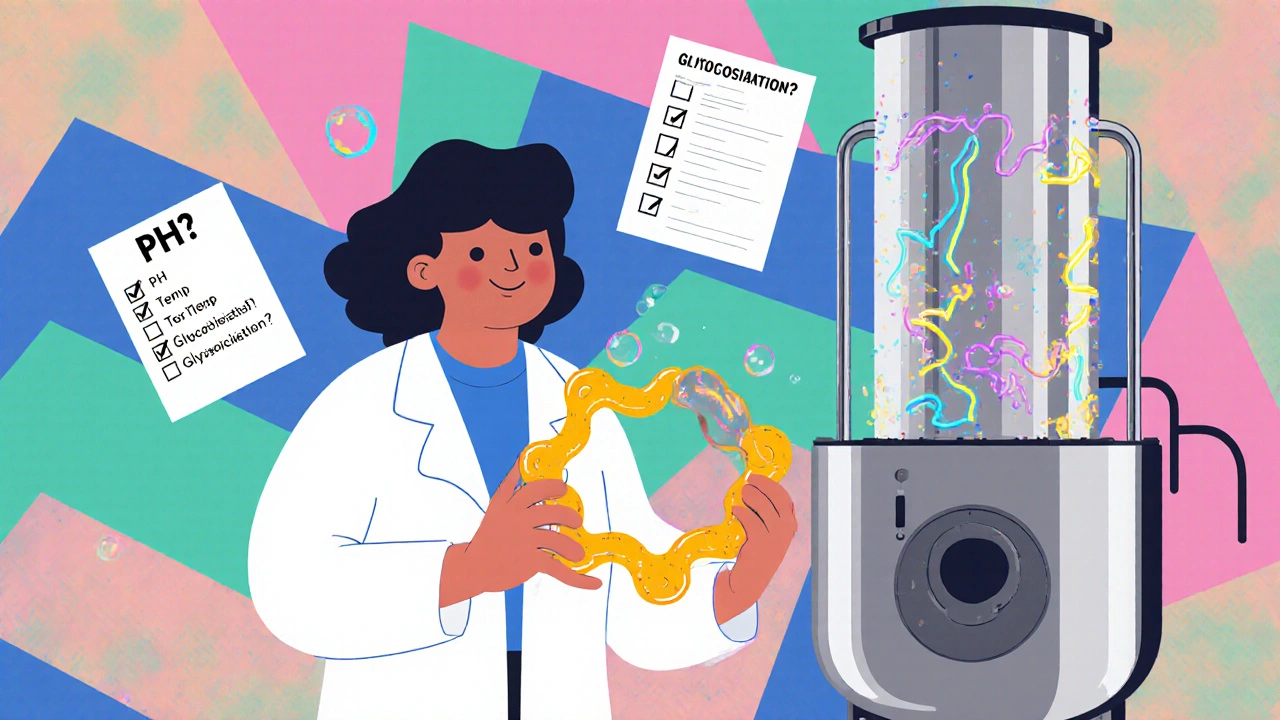
Even small changes matter. A shift in oxygen levels by 2% can alter how proteins fold. A different type of sugar in the growth medium can change glycosylation - a tiny sugar chain attached to the protein that affects how well it works in your body. And you can’t even fully measure all of it. Experts say current tools can only characterize 60-70% of a monoclonal antibody’s structure. The rest? We infer it.
That’s why companies invest in single-use bioreactors - plastic bags instead of steel tanks - to cut contamination risk. But they’re more expensive. And they’re not a magic fix. They just reduce one kind of risk.
The Future: Faster, Smarter, But Still Complex
Manufacturers are trying to make things better. Some are using AI to predict how changes in temperature or pH will affect the product. Others are moving to continuous manufacturing - where the process runs nonstop instead of in batches - cutting production time by 20-30%. The FDA is encouraging this through its Emerging Technology Program.
By 2030, most new biologics facilities will likely use modular, flexible systems built with single-use tech. That could drop capital costs by 25-30%. But even with all this innovation, the core truth won’t change: biologics are made by living cells. And living systems are messy.
The environmental cost is also rising. Producing one dose of a biologic uses 10-15 times more water than a small-molecule drug. That’s a growing concern as climate pressures increase.
What This Means for Patients
If you’re prescribed a biologic, you’re getting a powerful, life-changing medicine. But you’re also getting something that’s inherently variable - and that’s not a bad thing. It’s just biology.
Biosimilars give you more options. They’re not cheaper because they’re easier to make. They’re cheaper because the original patent expired, and competition finally entered the market. They’re safe. They’re effective. But they’re not identical. And that’s okay.
Don’t confuse biosimilars with generics. They’re not the same. And that’s not a loophole - it’s a necessary reality of modern medicine. The science is too complex for simple copies. But we’ve learned how to work with that complexity. We don’t need perfect copies. We need safe, effective, and accessible treatments. And biosimilars deliver that.
As the biologics market grows - projected to hit $685 billion by 2030 - we’ll see more biosimilars, better manufacturing, and lower prices. But we’ll never see a true copy. And that’s not a failure. It’s the price of progress.
Can biosimilars be substituted for the original biologic without a doctor’s approval?
In most countries, including the U.S. and Australia, biosimilars are not automatically interchangeable like generics. Even if a biosimilar is approved as "biosimilar," switching from the original drug usually requires a doctor’s explicit order. This is because while biosimilars are highly similar, they are not identical, and regulators want to ensure patient safety through controlled transitions. Some states in the U.S. allow substitution under specific conditions, but it’s still rare and requires documentation.
Why are biosimilars still so expensive if they’re "copies"?
Biosimilars aren’t copies - they’re highly complex replicas of a living product. Developing one requires years of research, thousands of tests, and massive manufacturing infrastructure. Unlike generics, which can be made in a standard chemical plant, biosimilars need cleanrooms, bioreactors, and specialized analytical tools. The R&D cost is $100-200 million, and the manufacturing process is 10 times longer than for small-molecule drugs. That’s why they’re 15-35% cheaper, not 80%.
Are biosimilars as safe as the original biologic?
Yes. Regulatory agencies like the FDA and EMA require biosimilars to undergo the same rigorous testing as the original drug - including clinical trials - to prove they have no meaningful difference in safety or effectiveness. Millions of patients worldwide have received biosimilars for conditions like rheumatoid arthritis and cancer, with safety profiles matching the originator drug. The slight variations in structure don’t affect clinical outcomes when properly controlled.
Why can’t we just use the same cell line to make an exact copy?
Even if you use the same cell line, the manufacturing environment changes everything. The water quality, air filtration, nutrient mix, bioreactor design, and even the way the tank is stirred can alter how the protein folds or gets modified. These factors are part of the product’s identity. The original manufacturer spent years optimizing their process - and even they can’t make two batches that are 100% identical. A copycat company can’t replicate that exact environment, so they can’t make an exact copy.
Do biosimilars work for all conditions the original biologic treats?
Biosimilars are approved for the same uses as the original, but only after proving effectiveness in each condition. For example, a biosimilar to Humira might be approved for rheumatoid arthritis, Crohn’s disease, and psoriasis - but only if clinical trials show it works equally well in each. Sometimes, a biosimilar is approved for fewer indications at first, and additional approvals come later as more data is gathered. Always check the approved label.

8 Comments
Debbie Naquin
November 29, 2025 AT 00:33Biologics aren't drugs-they're emergent biological systems with stochastic folding dynamics and glycosylation landscapes that defy deterministic replication. The FDA's 'highly similar' standard isn't a compromise-it's an epistemological admission that reductionist chemistry fails at macromolecular complexity. You can't QC what you can't fully characterize. We're managing uncertainty, not manufacturing purity.
Karandeep Singh
November 30, 2025 AT 09:15so biosimilars are like knockoff sneakers but for your immune system??
elizabeth muzichuk
December 1, 2025 AT 18:02And yet people still think this is just Big Pharma protecting profits. How many times do we have to explain that you can't replicate a living cell's environment like you replicate a recipe? This isn't about money-it's about not killing people because someone cut corners on a bioreactor filter. If you don't understand biology, maybe don't comment on it.
Alexander Williams
December 2, 2025 AT 23:22The glycosylation heterogeneity alone makes exact replication impossible. Even with cryo-EM and LC-MS/MS, we're characterizing 60-70% of the structural landscape. The rest is inferred from functional assays. Biosimilars aren't copies-they're functional analogs validated through comparative immunogenicity profiles. The regulatory framework reflects biological reality, not corporate greed.
Mary Ngo
December 4, 2025 AT 13:12Have you ever wondered who really controls the bioreactor data? The FDA doesn't inspect every single batch. The proprietary cell line conditions, the exact nutrient feed profiles, the unreported pH drifts-these are trade secrets guarded by multinational conglomerates. And now, biosimilar manufacturers are forced to reverse-engineer them under the guise of 'comparability.' Is this medicine-or industrial espionage disguised as science?
Kenny Leow
December 5, 2025 AT 12:49Interesting read. As someone from Singapore who's seen biosimilars used in public hospitals, I can say the cost savings are real-without safety tradeoffs. The tech is complex, yes, but the outcome? Patients get life-saving meds at half the price. 🙏
Also, the water usage stat? That’s the real elephant in the room. We need greener biomanufacturing ASAP.
James Allen
December 7, 2025 AT 10:02Let’s be real-America spends more on biologics than the rest of the world combined. And now you want to tell me we can’t make a cheaper version because ‘biology is messy’? Come on. We build rockets, we split atoms, we put satellites in orbit. But we can’t replicate a protein? That’s not biology-it’s corporate laziness wrapped in jargon. The real reason? Patent extensions and shareholder pressure. Stop hiding behind science.
Kelly Essenpreis
December 9, 2025 AT 05:29So if the original can't even make two identical batches then how is anyone supposed to copy it?? This whole biosimilar thing is just a scam to make people think they're getting a deal when really the original is just inconsistent as hell