
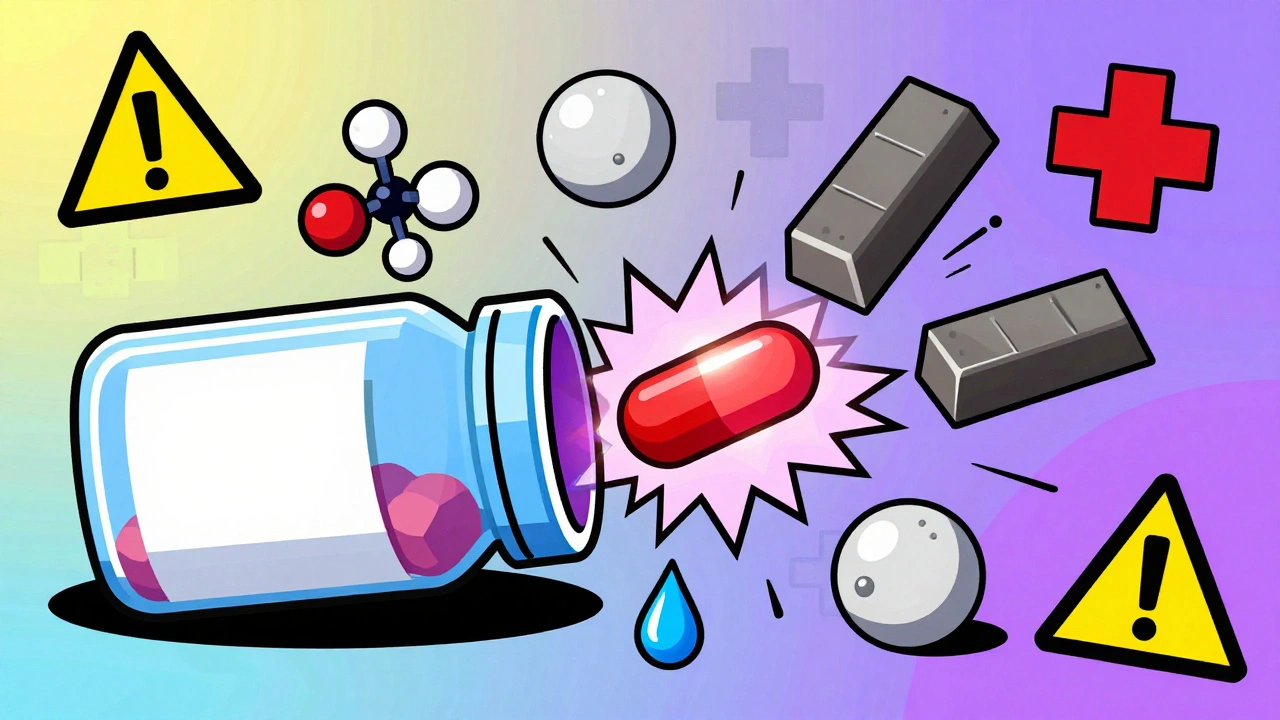
When you take a pill, you expect it to help. Not to kill you. But in the world of counterfeit drugs, that’s exactly what many people are risking - not because the medicine doesn’t work, but because it’s laced with poison.
Counterfeit drugs aren’t just weak or ineffective. They’re dangerous in ways most people don’t realize. The real threat isn’t just that they don’t contain the right active ingredient. It’s what they do contain: chemicals, metals, industrial solvents, and even deadly synthetic opioids like fentanyl. These aren’t accidents. They’re deliberate additions - cheap, toxic, and often lethal.
What’s Really in Those Fake Pills?
Think of counterfeit pills as a Russian roulette game where the bullets are hidden in plain sight. In 2023, the U.S. FDA seized over 9 million fake pills in a single operation. Most of them looked like oxycodone or Xanax. But lab tests showed that 6 out of every 10 contained enough fentanyl to kill an adult. A single pill with just 2 milligrams of fentanyl can stop your breathing. That’s not a typo. Two milligrams. A lethal dose for most people.
But fentanyl isn’t the only killer. In 2022, 66 children in the Gambia died after drinking cough syrup that contained diethylene glycol - a chemical used in antifreeze. It’s not a drug. It’s not even meant for humans. But it was in the syrup because it’s cheap, and the manufacturers didn’t care. The same toxin was found in fake acetaminophen syrups in Nigeria, India, and Panama over the past decade.
Weight-loss pills? Often packed with heavy metals. Lead. Mercury. Arsenic. One study found counterfeit slimming pills with lead levels 120 times higher than what the World Health Organization considers safe. That’s not just a bad side effect. That’s slow poisoning. It damages your kidneys, your brain, your nerves. And you might not feel it until it’s too late.
More Than Just Poison: Hidden Drugs and Invisible Threats
Some counterfeit drugs don’t just contain toxins - they contain other drugs you didn’t ask for. Erectile dysfunction pills sold online often include sildenafil analogues at doses between 80 and 220 milligrams. The approved dose? 25 to 100. People taking these pills have ended up in emergency rooms with priapism - a painful, hours-long erection that can permanently damage penile tissue. Over 1,200 cases were documented between 2020 and 2022.
And then there’s the stuff you can’t even see. Fake cancer drugs? Some contain talc or chalk as fillers. When injected, those particles get trapped in your lungs and organs, triggering granulomatous disease - a condition where your body tries to wall off the foreign material, causing scarring and organ failure. At least 89 cases were linked to these fake medications.
Even diabetes has been linked to fake weight-loss products. In 2022, patients across 32 countries developed new-onset diabetes after taking pills that secretly contained thiazolidinediones - powerful diabetes drugs that can cause heart failure and liver damage. No one told them. No label warned them. They just took a pill hoping to lose weight - and ended up with a lifelong condition.
How Contaminants Spread: The Online Trap
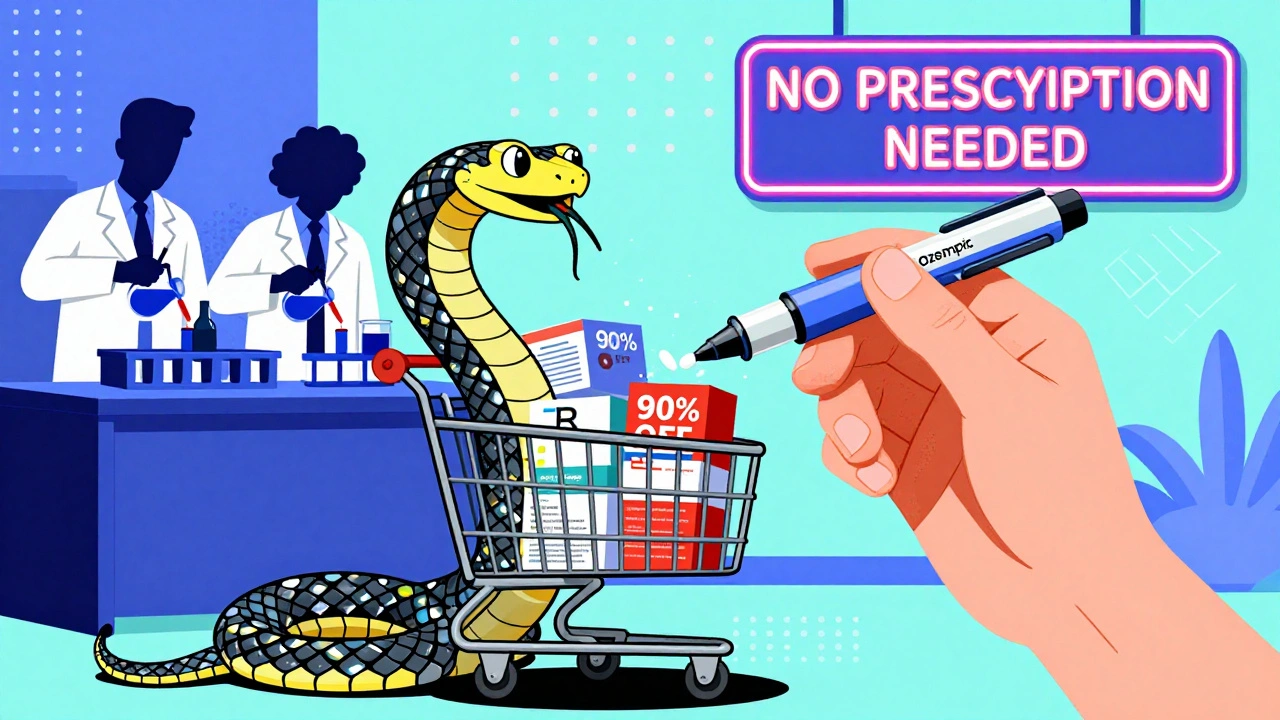
Most of these fake drugs come from the internet. The FDA says 96% of websites selling prescription drugs are illegal. They look real. They have professional designs, fake certifications, and even customer reviews. But they’re run by criminals who ship from warehouses in China, India, or Eastern Europe.
People think they’re saving money. They’re not. A fake Ozempic pen might cost $50 online. The real one costs $1,000. But the fake one? It might contain insulin glargine instead of semaglutide. That’s a completely different drug. One lowers blood sugar. The other doesn’t. In October 2023, 147 people in Europe ended up in emergency rooms with dangerously low blood sugar after using fake Ozempic. One woman lost consciousness. Another had a seizure.
And it’s not just developing countries. The EUROPOL report showed counterfeit drug seizures containing deadly contaminants jumped 317% in Europe between 2018 and 2022. In the U.S., 73,838 people died from drug overdoses in 2022 - and most of those were from fake pills sold as oxycodone or Xanax. You don’t need to be a drug user to be at risk. These pills are sold to people with anxiety, chronic pain, or diabetes. They think they’re getting help. They’re getting a death sentence.
How to Spot a Fake - Before It’s Too Late
You can’t always tell by looking. But there are warning signs.
- Check the packaging. Is the font slightly off? Are the colors duller than you remember? Are there misspellings? Even a small error can mean it’s fake.
- Buy only from licensed pharmacies. If a website doesn’t require a prescription for a controlled drug, it’s illegal. Period.
- Look for the VIPPS seal (Verified Internet Pharmacy Practice Sites). Only about 6,300 out of nearly 40,000 online pharmacies have it.
- Don’t trust social media ads. If someone posts a testimonial about a miracle weight-loss pill, it’s likely laced with toxins.
- If your pills look, taste, or feel different from what you’ve taken before - stop. Call your pharmacist.
Pharmacists can often spot counterfeits just by checking the shape, color, or imprint. Some use handheld Raman spectrometers - devices that scan the chemical makeup of a pill in seconds. They’re expensive, but they catch 94% of fakes. Hospitals and clinics are starting to use them. You can’t, but your pharmacist can.
The Bigger Picture: Why This Keeps Getting Worse
The counterfeit drug market is now worth $200 billion - up from $75 billion in 2010. Why? Because it’s easy. People are desperate. Prices are high. Regulations are patchy. And the penalties for selling fake drugs are often laughably light.
Worse, these drugs aren’t just harming individuals. They’re fueling drug resistance. In Cambodia, counterfeit antimalarials with too little artemisinin have helped create drug-resistant strains of malaria. Now, the disease is harder to treat for everyone.
And the trend is accelerating. The CDC predicts over 105,000 fentanyl-related deaths in 2024 - and 68% of those will come from counterfeit pills. Without global cooperation, that number will keep rising.
There’s hope, though. New detection tools like the FDA’s Counterfeit Drug Sensor (CDS-1) can identify 97% of chemical contaminants in seconds. Blockchain tracking is cutting fake drug infiltration by over 70% in pilot programs. But these tools won’t help if people keep buying pills from shady websites.
What You Can Do Right Now
Don’t wait for a crisis. Protect yourself.
- Always get prescriptions filled at a licensed pharmacy - not an online store you found on Google.
- Ask your pharmacist to check the packaging if something looks off.
- If you bought medicine online and feel sick after taking it, report it to your country’s health authority.
- Don’t share pills. Never take someone else’s medication - even if it looks the same.
- Teach your parents, grandparents, or anyone who buys medicine online. They’re the most vulnerable.
Counterfeit drugs aren’t a distant problem. They’re in your neighborhood, your city, your inbox. The next fake pill you see might be the one that kills someone you know. Don’t ignore it. Don’t assume it’s someone else’s problem. It’s everyone’s problem.
Can fake pills really kill you even if you don’t use drugs?
Yes. Fake pills sold as painkillers, anxiety meds, or weight-loss supplements are often laced with fentanyl, heavy metals, or industrial chemicals. You don’t need to be a drug user to be at risk. Many people buy these pills thinking they’re treating a medical condition - and end up in the hospital or worse.
How do I know if my medicine is fake?
Check the packaging for misspellings, odd colors, or poor print quality. Compare the pill’s shape, size, and imprint to the official version from your pharmacy. If you bought it online without a prescription, it’s almost certainly fake. Always verify your pharmacy’s license and avoid websites that don’t require one.
Are counterfeit drugs only a problem in poor countries?
No. While low-income countries face higher rates, counterfeit drugs are a global issue. In 2022, the EU reported a 317% increase in seizures of fake drugs containing toxins like fentanyl and methamphetamine. In the U.S., over 70,000 overdose deaths in 2022 were linked to counterfeit pills. Online sales make it easy for these drugs to reach anyone, anywhere.
What should I do if I think I took a fake pill?
Stop taking it immediately. Contact your doctor or go to the nearest emergency room. Report the product to your country’s health agency - like the FDA’s MedWatch system in the U.S. Save the packaging and any remaining pills as evidence. Early intervention can save your life.
Is there a way to test pills at home?
There are no reliable home tests for fentanyl or heavy metals. Drug-checking kits sold online are often inaccurate and can give false reassurance. The only safe way to know is to get your medicine from a licensed pharmacy. If you’re concerned, ask your pharmacist to check the product using professional tools.
If you’re buying medicine online, you’re playing Russian roulette with your life. There’s no safe way to gamble with your health. Don’t risk it.

13 Comments
Martyn Stuart
December 4, 2025 AT 08:20Let me be clear: this isn’t just about fake pills-it’s about systemic failure in global pharmaceutical oversight. The FDA seizes millions, but the supply chain is a sieve. We need mandatory blockchain tracking for every batch, from manufacturer to pharmacy, with real-time public verification. No exceptions. And pharmacists? They need handheld spectrometers in every corner of the country-not just in urban hospitals. This is a public health emergency, not a niche concern. We’re talking about people buying insulin or anxiety meds online because they can’t afford the real thing. The system is punishing the sick for being poor.
Chad Handy
December 6, 2025 AT 05:56The real horror isn’t even the fentanyl or the lead-it’s that people are dying from things that should’ve been preventable with basic regulation. We’ve got labs in China pumping out pills that look identical to Xanax, but contain enough neurotoxin to kill a horse. And yet, we treat this like a criminal justice issue instead of a public health catastrophe. The same people who scream about drug dealers are silent when the poison comes in a bottle labeled ‘Oxycodone 30mg’ with a fake DEA code. This isn’t about morality. It’s about infrastructure collapse. We’ve outsourced safety to the dark web and now we’re surprised when people die.
And don’t get me started on the social media ads. My aunt bought ‘weight-loss tea’ that turned out to have mercury. She didn’t even know what mercury was. She thought it was a ‘natural detox.’ That’s not ignorance. That’s predatory capitalism dressed up as wellness.
There’s no such thing as a ‘safe’ online pharmacy unless it’s tied to your insurance provider. And even then, they’re not always vetting the suppliers. The FDA’s website has a list of verified pharmacies-but most people don’t know it exists. We need a public awareness campaign that doesn’t sound like a government brochure. Something that hits like a horror movie trailer.
I’ve seen people in my neighborhood buy fake Ozempic because their insurance won’t cover it. They’re diabetic. They’re losing weight. They think they’re getting help. They’re getting a death sentence with a receipt.
And no, there’s no home test that works. Those fentanyl strips? They’re useless if the pill’s coated in something else. You can’t test for arsenic with a strip. You need a lab. And most people don’t have access to one.
We’re not talking about addicts here. We’re talking about grandmas buying arthritis pills off Instagram. Teenagers taking ‘study aids’ that are actually meth. Diabetics getting pills that contain insulin glargine instead of semaglutide. One pill. One decision. One death. And the corporations that profit from this? They’re still on the stock market.
The only solution is to make counterfeit drug trafficking a federal capital offense. No more fines. No more probation. Life without parole. Because right now, the penalty for killing someone with a fake pill is less than the penalty for stealing a car.
Augusta Barlow
December 7, 2025 AT 12:30Everyone’s talking about fentanyl, but nobody’s asking who’s really behind this. The Chinese government? The U.S. pharmaceutical industry? Big Pharma is creating fake versions of their own drugs to drive people to the real ones-then blaming the cartels. It’s a classic false flag. They know people can’t afford $1,000 Ozempic pens, so they let the fakes flood the market, then scare people into buying the expensive version. It’s not a coincidence that the FDA’s crackdowns always happen right after a new drug patent expires. The ‘toxins’? They’re just cover for profit.
And don’t believe the ‘licensed pharmacy’ nonsense. I worked at a chain pharmacy in Ohio. We got shipments from ‘approved distributors’ that had the wrong imprint, wrong color, wrong shape. We reported it. They told us to ‘ignore it’ because the ‘batch was cleared.’ That’s not a glitch. That’s policy.
They’re lying to you. All of them. The FDA. The doctors. The influencers. The pharmacists. They want you scared enough to pay, but not scared enough to revolt.
jagdish kumar
December 8, 2025 AT 09:31Life is a pill. Some are real. Most are not.
Benjamin Sedler
December 8, 2025 AT 14:49Okay but what if the real drugs are just as dangerous? You think Ozempic is safe? It’s a GLP-1 agonist that causes pancreatitis, gallbladder disease, and suicidal ideation in 12% of users. Meanwhile, the fake ones? At least you know what you’re getting-something that’ll kill you fast instead of slowly. Maybe the real villains are the ones selling you the illusion of safety. The FDA doesn’t care about you. They care about liability. You’re a line item in their quarterly report.
zac grant
December 8, 2025 AT 23:18From a pharmacovigilance standpoint, this is a textbook example of supply chain fragmentation and regulatory arbitrage. The global counterfeit market thrives on asymmetric information-patients can’t distinguish between authentic and adulterated products because the perceptual fidelity of counterfeits has reached near-perfect levels. The real bottleneck isn’t detection-it’s access. We need decentralized, low-cost Raman spectroscopy units deployed at community pharmacies, paired with AI-driven batch verification via QR codes. The tech exists. The will doesn’t. Until we treat this like we treat cybersecurity-with proactive, embedded defense-we’re just rearranging deck chairs on the Titanic.
michael booth
December 10, 2025 AT 11:35Thank you for sharing this vital information. It is critical that we all understand the risks associated with unregulated pharmaceutical sources. I urge everyone to consult with a licensed pharmacist before purchasing any medication online. Your health is not a gamble. Always verify the source. Safety first. Always.
Carolyn Ford
December 11, 2025 AT 23:15Oh please. You think the FDA is your hero? They approved the opioid crisis. They approved the tainted heparin in 2008. They approved the fake cancer drugs in 2020. You’re not saving lives by trusting them-you’re trusting the same people who let Big Pharma poison you with pills that cost $1,000 a month. And now you want me to believe they’re suddenly the guardians of truth? Wake up. The system is the disease.
And don’t tell me to go to a ‘licensed pharmacy.’ My local CVS sold me fake insulin last year. The batch number matched. The label was perfect. The pharmacist didn’t even blink. So don’t preach to me about trust. I’ve seen the inside of the machine. It’s rotten.
Heidi Thomas
December 13, 2025 AT 04:05You’re all overreacting. Most people who die from fake pills are drug addicts who don’t know what they’re taking. If you’re taking pills you got off the internet, you’re already dumb. Stop blaming the system and take responsibility. No one forced you to buy it. You chose to gamble. Now you’re mad you lost? Grow up.
Alex Piddington
December 13, 2025 AT 18:07This is heartbreaking. I’ve seen too many patients come in with lead poisoning from fake weight-loss pills. One woman, 72, thought she was taking a ‘natural supplement’ from a Facebook ad. Her kidneys failed. She needed dialysis. She didn’t even know what lead was. We need community outreach. We need school programs. We need to teach people how to read a pill imprint. This isn’t just about drugs-it’s about dignity. Everyone deserves to be safe, no matter their income.
Libby Rees
December 15, 2025 AT 13:31Counterfeit drugs are a global issue that requires global solutions. The fact that children died in Gambia from antifreeze in cough syrup shows that regulatory gaps are not confined by borders. We must support international health organizations in enforcing quality standards, and we must pressure manufacturers to adopt transparent sourcing. The technology exists. The political will is the missing ingredient.
Ashley Elliott
December 17, 2025 AT 03:30I’ve been a nurse for 22 years. I’ve seen this happen too many times. Last month, a 68-year-old man came in with acute kidney failure. He’d been taking ‘arthritis pills’ from a website for $15 a bottle. Turned out they had mercury. He didn’t even know he was sick until he couldn’t walk. He didn’t know what to do. No one told him to check. No one warned him. I wish I could say this was rare. It’s not. It’s happening every day. We need to talk about this-not just in hospitals, but in churches, in barbershops, on the bus. People need to know. Not because they’re stupid. Because they’re trusting.
Martyn Stuart
December 17, 2025 AT 19:56That’s why I’m pushing for community pharmacy verification kiosks-simple, low-cost devices that scan the pill’s chemical signature and give you a green/red light. No internet needed. No training required. Just point, press, know. I’ve got a prototype. We’re testing it in rural clinics. It’s not perfect, but it’s better than nothing. If we can make this accessible, we can save thousands. The real cost isn’t the device-it’s the silence.