
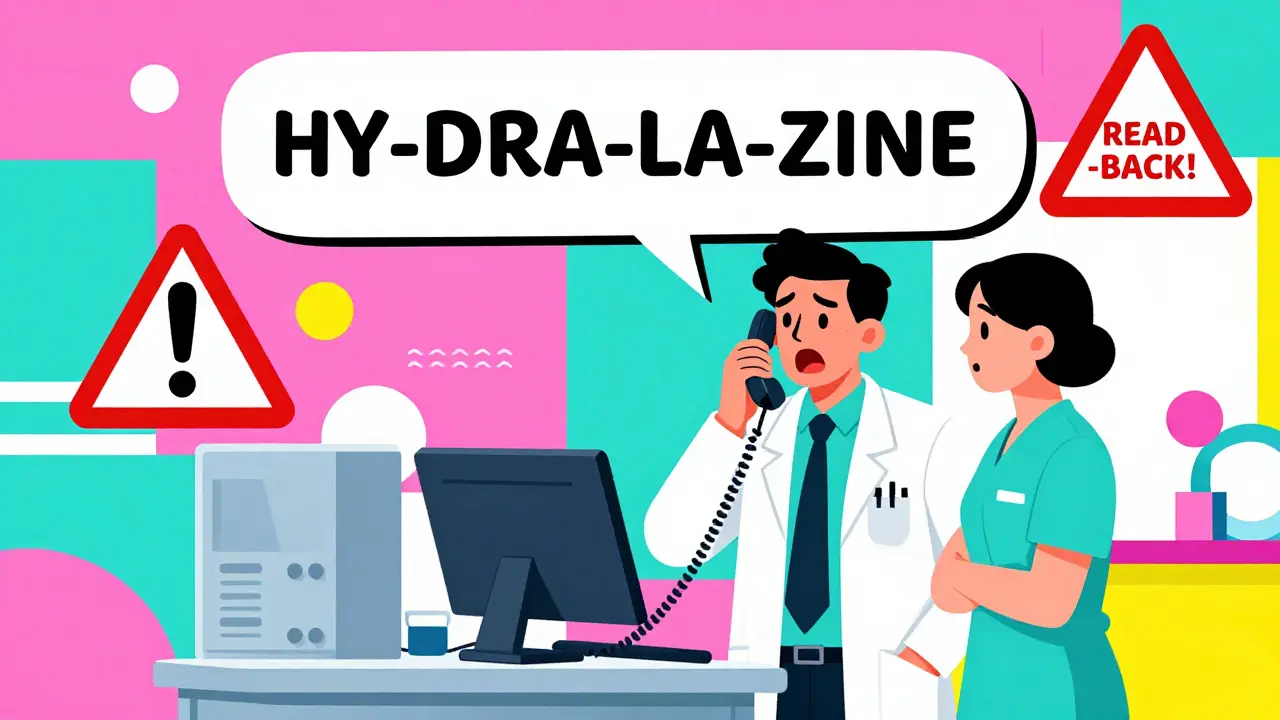
When a doctor says "give five milligrams of hydralazine" over the phone, and the nurse hears "hydroxyzine," the difference isn’t just a typo - it’s a potential overdose, a near-fatal mistake, or worse. Verbal prescriptions still happen every day in hospitals, clinics, and emergency rooms. Even with all the technology we have, there are moments - during code blues, surgeries, or shift changes - when writing something down just isn’t fast enough. But that speed comes at a cost. Studies show up to 50% of verbal orders contain errors. The good news? With clear rules and disciplined habits, you can cut those risks in half.
Why Verbal Prescriptions Still Exist
Electronic prescribing systems (CPOE) have cut down on verbal orders dramatically. In 2006, nearly 22% of all medication orders in hospitals were given verbally. By 2023, that number dropped to 10-15%. But they haven’t disappeared. Why? Because sometimes, seconds matter.
Think about a trauma patient bleeding out in the ER. Waiting to log into a computer, type the order, and hit send could cost a life. Or picture a surgeon in the middle of an operation, gloved and sterile, needing to adjust a drip of heparin. They can’t walk out to a terminal. In those moments, a quick verbal order is the only option.
But here’s the catch: when you skip the paper trail, you’re relying on memory. The Institute for Safe Medication Practices says it plainly: "The only real record of a verbal order is in the memories of those involved." And human memory? It’s unreliable. Especially under stress, noise, or fatigue.
The Top 5 Errors That Happen
Not all mistakes are the same. Some are obvious. Others are sneaky. Here are the five most common ways verbal prescriptions go wrong:
- Sound-alike drug names - "Celebrex" vs. "Celexa." "Zyprexa" vs. "Zyrtec." "Hydralazine" vs. "Hydroxyzine." These pairs sound almost identical. A 2006 study found 25% of verbal order errors came from this alone. A 2021 Medscape survey showed 68% of nurses had at least one near-miss per month because of unclear pronunciation.
- Confusing numbers - Saying "15 mg" as "fifteen" instead of "one-five" can lead to a tenfold dosing error. One nurse in Melbourne recalled a case where "5 mg" was misheard as "50 mg" - the patient nearly died.
- Missing units - "Insulin 10" could mean 10 units, 10 mL, or 10 mg. Units are non-negotiable. Always say "units," "milligrams," or "micrograms." Never assume.
- Abbreviations - "BID" for twice daily? "QHS" for at bedtime? These are banned for a reason. They’re ambiguous. Always say "twice daily," "every night," or "four times a day."
- Multiple orders at once - Giving two or more medications in one breath is asking for disaster. A 2006 NICU incident in Pennsylvania involved a premature infant getting the wrong antibiotics because two orders were given back-to-back. One was for ampicillin, the other for gentamicin. Both were misunderstood.
The Read-Back Rule: Your Lifesaver
The single most effective tool to prevent errors? Read-back.
It’s simple: the person receiving the order repeats it back, word for word. The prescriber confirms it’s correct. Done right, this cuts errors by up to 50%, according to The Joint Commission’s 2006 National Patient Safety Goal. And it’s not optional anymore. Since 2006, every hospital accredited by The Joint Commission must use read-back for all verbal orders.
But here’s the problem: many nurses say read-back doesn’t always happen. A 2020 survey found 63% of nurses reported prescribers resist it - either because they’re rushed, annoyed, or think it’s "too slow."
That’s why scripts matter. Train your team to say: "I’m going to read this back to you to make sure we’re on the same page." It sounds professional, not confrontational. And if the prescriber says "no, it’s fine," insist. Because when it comes to medication, there’s no such thing as "fine."
How to Say It Right: The Exact Protocol
It’s not enough to just repeat the order. You have to say it the right way. Here’s the full checklist:
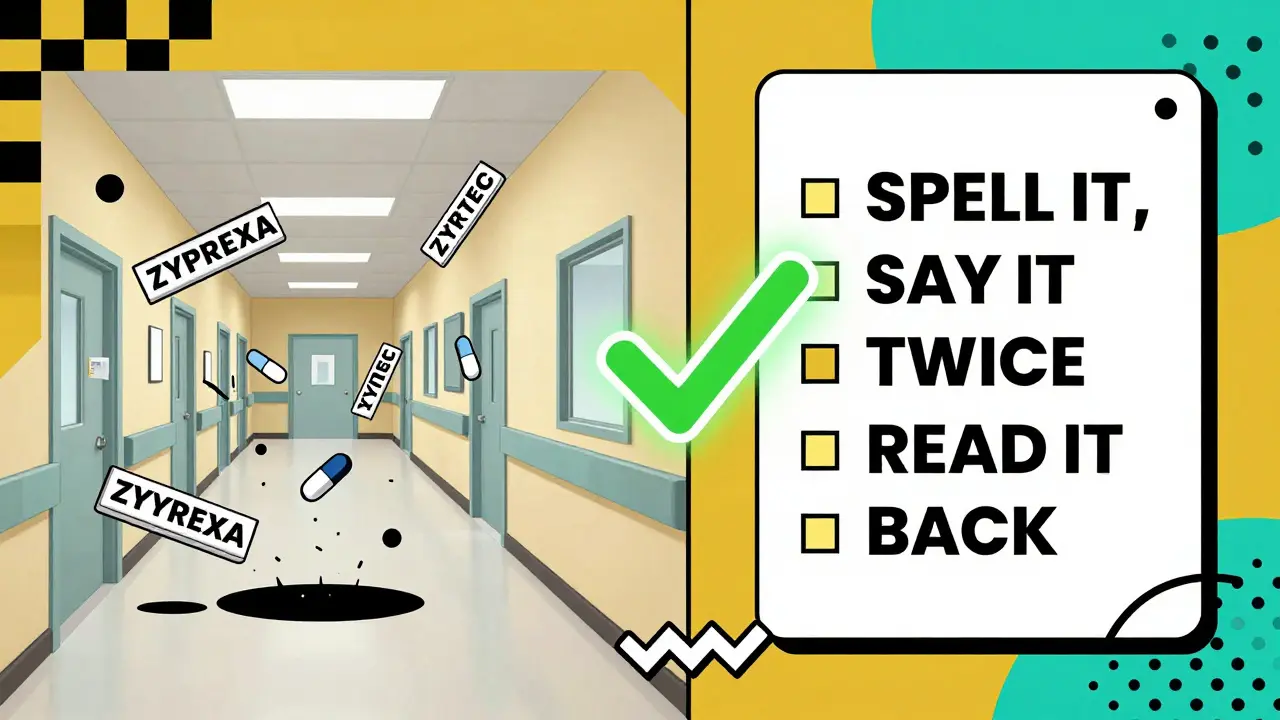
- Spell out drug names phonetically. Don’t say "Lisinopril." Say, "L-I-S-I-N-O-P-R-I-L." That’s how you avoid confusion with "Lisinopril" and "Lisinopril-HCTZ."
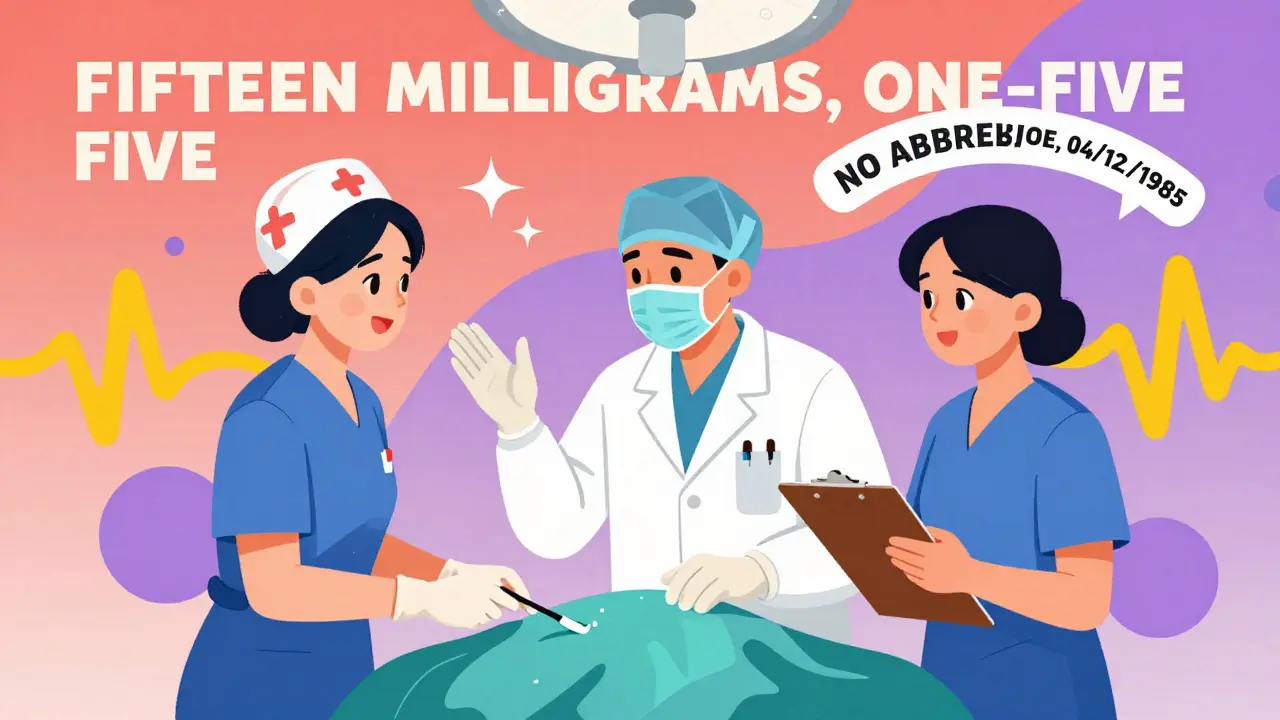
- State numbers twice. For "15 mg," say, "fifteen milligrams, one-five milligrams." This prevents mishearing "15" as "50" or "5."
- Never use abbreviations. "PO" becomes "by mouth." "IV" becomes "intravenous." "BID" becomes "twice daily." "QID" becomes "four times a day."
- Include the indication. Don’t just say "give metoprolol." Say, "metoprolol 25 milligrams by mouth twice daily for atrial fibrillation." Why? Because if the dose is wrong, the indication helps someone catch it.
- Confirm patient identity. Always state the full name and date of birth. Never assume the patient is in bed 4. Always verify.
These aren’t suggestions. They’re standards backed by The Joint Commission, CMS, and the Institute for Safe Medication Practices. And in 42 states, they’re now part of state licensing rules.
High-Risk Medications: When Verbal Orders Are Forbidden
Some drugs are too dangerous to give over the phone - unless it’s a true emergency.
The Pennsylvania Patient Safety Authority bans verbal orders for chemotherapy except to hold or discontinue treatment. Insulin, heparin, and opioids? Many hospitals restrict verbal orders for these unless the patient is crashing. Even then, read-back is mandatory, and the order must be documented immediately.
Why? Because one mistake with insulin can mean coma. With heparin, it can mean internal bleeding. With opioids, it can mean respiratory arrest. The margin for error is zero. That’s why Johns Hopkins, Mayo Clinic, and Kaiser Permanente all have strict policies: if it’s high-alert, it’s written - or it’s not given.
Documentation: The Paper Trail That Saves Lives
Verbal orders aren’t valid until they’re written down - and written down correctly.
Every order must include:
- Patient’s full name and date of birth
- Exact medication name (phonetically spelled)
- Dose with units (e.g., "25 milligrams")
- Route (e.g., "intravenous" not "IV")
- Frequency (e.g., "twice daily" not "BID")
- Indication (e.g., "for hypertension")
- Name and credentials of the prescriber
- Time and date the order was given
- Time and date it was authenticated
CMS requires authentication within 48 hours. But leading hospitals like Cleveland Clinic and Stanford require it within the same shift. Why? Because if a nurse transcribes an order at 3 a.m. and the doctor doesn’t sign off until noon, who’s responsible if something goes wrong? The answer: both.
What to Do When Things Go Wrong
Even with perfect protocols, mistakes happen. When they do, don’t hide. Don’t blame. Do this:
- Stop immediately. If you suspect an error, don’t give the medication. Confirm with the prescriber.
- Report it. Use your facility’s near-miss reporting system. These reports help hospitals improve.
- Document everything. Write down what was said, what was heard, what was given, and what was caught.
- Follow up. Check on the patient. If they received the wrong dose, monitor them closely.
One nurse in Perth told a story about a patient who was supposed to get 5 mg of hydralazine. The prescriber said "five," but the nurse heard "fifty." She paused. Asked for clarification. The prescriber said, "Oh, I meant five." The patient was fine. That pause? That’s what safety looks like.
The Future: Less Verbal, But Never Zero
Technology is making verbal orders rarer. Voice recognition systems are improving. CPOE is becoming faster. KLAS Research predicts verbal orders will drop to 5-8% by 2025.
But Dr. Robert Wachter at NEJM Catalyst says something important: "Certain clinical scenarios will always require verbal communication."
That means the protocols we use today - read-back, phonetic spelling, no abbreviations - aren’t temporary fixes. They’re permanent standards. Because even if we have robots and AI, there will always be a moment when a doctor has to speak into a phone during a code. And someone has to hear it right.
Are verbal prescriptions legal?
Yes, verbal prescriptions are legal under CMS and The Joint Commission regulations. However, they must follow strict safety rules, including read-back verification and immediate documentation. State laws may add additional restrictions, especially for high-alert medications like insulin or opioids.
Can nurses take verbal orders?
Yes, licensed nurses are authorized to receive verbal orders from prescribers. But they must verify the order using read-back, document it immediately, and ensure the prescriber authenticates it within the time frame required by their facility - usually within the same shift.
What’s the biggest danger in verbal prescriptions?
The biggest danger is sound-alike drug names. Drugs like hydralazine and hydroxyzine, or zyprexa and zyrtec, sound nearly identical. When spoken quickly - especially over a bad phone line - they’re easily confused. This accounts for over a third of verbal order errors, according to the Institute for Safe Medication Practices.
Do I need to spell out every drug name?
Yes. Always spell out the full drug name phonetically. For example, say "A-M-P-I-C-I-L-L-I-N" instead of just "ampicillin." This prevents confusion with similar-sounding drugs and is required by The Joint Commission and ISMP Canada guidelines.
Why can’t we just use electronic orders all the time?
We try to. But in emergencies - like cardiac arrest, trauma, or surgery - there’s no time to log in, type, and submit. Verbal orders fill that gap. They’re not ideal, but they’re necessary. The goal isn’t to eliminate them entirely - it’s to make them as safe as possible when they’re unavoidable.

12 Comments
Bridget Verwey
March 6, 2026 AT 17:22I've seen so many near-misses because someone said 'Zyrtec' and the nurse heard 'Zyprexa'. 😅 We're not robots. We're humans talking over static phones during 3 a.m. codes. Read-back isn't optional-it's the difference between a chart note and a coroner's report. Train like your life depends on it. Because it does.
Andrew Poulin
March 8, 2026 AT 07:07Stop overcomplicating it. Spell the drug. Say the dose twice. Confirm. Done. No drama. No PowerPoint. Just do your job.
Ferdinand Aton
March 8, 2026 AT 07:33I get the protocol but honestly? I’ve taken a verbal order for 'Lisinopril' and the doc said 'Lis-in-oh-pril' like he was spelling 'Lisbon'. I still gave it. Patient was fine. Maybe we’re over-engineering safety?
William Minks
March 8, 2026 AT 18:35This is why I love nursing 😊 The read-back rule saved my butt last week. Doc said '50 mg of heparin' - I said 'fifty units?' and he went 'oh THANK YOU'. We all make mistakes. The system catches them. 🙌
Jeff Mirisola
March 10, 2026 AT 16:40I work in a rural ER. We still use verbal orders because the EHR takes 12 minutes to load. But we do read-back. Always. And we say 'milligrams' out loud. No shortcuts. I’ve seen too many lives saved by a pause and a question.
Susan Purney Mark
March 11, 2026 AT 23:30I had a patient almost get 100 units of insulin because the doc said 'ten' and I heard 'one-zero'. I stopped. Asked again. He said 'ten units'. We’re all human. But the protocol? Non-negotiable. 🙏
Ian Kiplagat
March 13, 2026 AT 20:15In the UK we’re stricter. Verbal orders for high-alert meds? Almost never. We’ve got voice-to-CPOE now. But I get it - sometimes you need speed. Still, phonetic spelling is gospel here. No exceptions.
Amina Aminkhuslen
March 14, 2026 AT 16:57This whole thing is a glorified band-aid on a hemorrhage. We’re still letting doctors bark orders like it’s 1998 while nurses scramble to write it down. Why not just mandate that every hospital has a voice-activated CPOE with auto-verification? We’ve got AI. Use it. Stop pretending 'read-back' is enough.
amber carrillo
March 16, 2026 AT 07:10The protocols outlined here are evidence-based and necessary. Consistency in communication reduces error rates significantly. I appreciate the clarity and structure of this guidance.
Aaron Pace
March 16, 2026 AT 19:19Bro I just had a doc say 'give 5 of the blue one' and I was like 'uhhh which blue one??' 😅 We need to stop being cool and start being clear. Also, why do we still say 'IV' instead of 'intravenous'? Just say it right.
Joey Pearson
March 18, 2026 AT 17:11You’re right - we need to stop treating this like a suggestion. Read-back is the bare minimum. I train new nurses with real examples. Last month? A '5 mg' turned into '50 mg' because no one paused. We’re not just following rules. We’re saving people.
Roland Silber
March 20, 2026 AT 11:10I’m curious - has anyone tracked how often the prescriber corrects the read-back? I’ve seen cases where the nurse reads back 'hydralazine 5 mg' and the doc says 'no, it’s hydroxyzine' - and we still give it because 'he’s the doctor.' That’s not safety. That’s hierarchy. We need to empower nurses to say 'wait, that’s wrong' without fear.