

When you start taking opioids for chronic pain, you’re told about the risks: drowsiness, nausea, addiction. But one of the most common and persistent side effects rarely gets mentioned until it’s already wrecking your life: opioid-induced constipation. It’s not just a minor inconvenience. For up to 95% of people on long-term opioid therapy, it becomes a daily struggle - and it’s often ignored by doctors and patients alike.
Unlike nausea or dizziness, which fade after a few weeks, constipation doesn’t go away. It gets worse. And if you’re not managing it properly, you might end up reducing your pain medication - not because your pain is better, but because going to the bathroom feels impossible.
Why Opioid Constipation Is Different From Regular Constipation
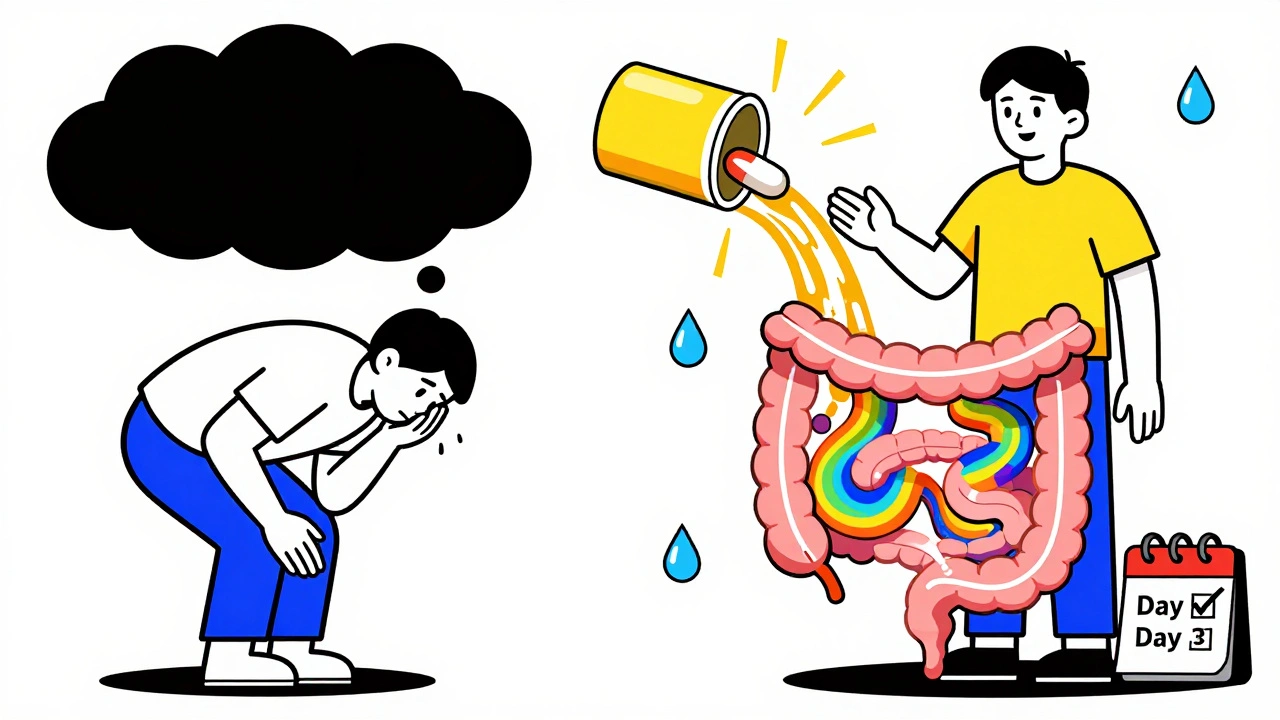
Opioids don’t just slow down your gut - they shut it down. They bind to receptors in your intestines, stopping the normal muscle contractions that move stool along. At the same time, they reduce fluid secretion and pull more water out of your stool, making it hard, dry, and stuck.
This isn’t the same as general constipation from low fiber or dehydration. Standard advice like “eat more fiber” can actually make it worse. Fiber ferments in a sluggish gut, causing bloating, gas, and even fecal impaction. A 2021 review in the Journal of Neurogastroenterology and Motility confirmed that up to 40% of opioid users who increase their fiber intake see their symptoms get more severe.
That’s why treating opioid-induced constipation (OIC) isn’t about just pushing more roughage down. It needs a targeted approach - one that addresses the root cause, not just the symptom.
First-Line Treatments: What Actually Works
Most doctors start with over-the-counter laxatives. But here’s the catch: they work for only about 25-50% of OIC patients. The rest are stuck in a cycle of trying one after another - senna, bisacodyl, magnesium citrate - without relief.
The most effective first-line option? Polyethylene glycol (PEG), also known as macrogol. Brands like Miralax are widely available, and studies show 17-34 grams daily significantly improves bowel movements in opioid users. Unlike stimulant laxatives (which can irritate the gut over time), PEG works by drawing water into the colon, softening stool naturally without triggering cramps.
Stimulant laxatives like senna (8.6-17.2 mg daily) or bisacodyl (5-15 mg) are also used, but they’re better for short-term use. Long-term reliance can lead to dependency or electrolyte imbalances. Still, for many, they’re the only thing that gets things moving when PEG alone isn’t enough.
Here’s what you need to do from day one:
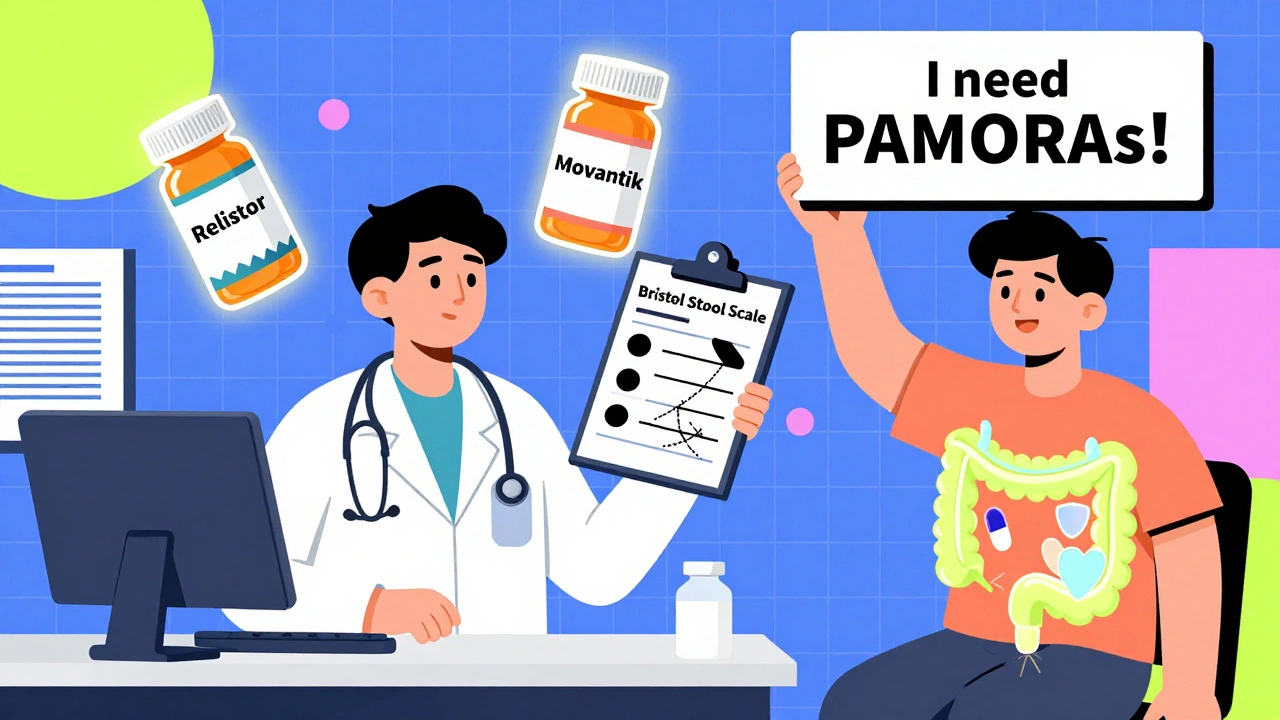
- Before starting opioids, ask your doctor to assess your bowel function using the Bristol Stool Form Scale or an OIC Severity Scale.
- Start a daily PEG regimen immediately - don’t wait for constipation to begin.
- Drink at least 2 liters of water daily. Without enough fluid, laxatives won’t work.
- Avoid high-fiber supplements unless your doctor specifically approves them - and even then, start low.
When OTC Laxatives Fail: Prescription Options
If you’ve tried PEG, senna, and bisacodyl for weeks with no real improvement, it’s time to consider prescription medications designed specifically for OIC. These aren’t just stronger laxatives - they’re targeted therapies that block opioids from affecting your gut while leaving their pain-relieving effects intact.
The most common class is called peripherally acting μ-opioid receptor antagonists, or PAMORAs. They work by blocking opioid receptors in the intestines but can’t cross the blood-brain barrier, so they don’t interfere with pain control.
Here are the three main ones:
- Methylnaltrexone (Relistor®): Given as a daily injection under the skin. Works in as little as 30 minutes. Approved for people with advanced illness or palliative care. About 32% of users report relief within 4 hours. But it’s expensive - $800-$1,200 per month - and injection-site reactions (redness, pain) happen in nearly half of users.
- Naloxegol (Movantik®): A daily pill. Approved for chronic non-cancer pain. Works within 24-48 hours. Side effects include abdominal pain and diarrhea. Around 59% of users report moderate to significant improvement.
- Naldemedine (Symcorza®): Also a daily pill. Approved for both adults and children (since March 2023). Has the highest patient satisfaction rating among PAMORAs at 6.8/10. Common side effect: mild abdominal pain in 38% of users.
Another option is lubiprostone (Amitiza®). It’s not a PAMORA - it’s a chloride channel activator that increases fluid secretion in the small intestine. It’s FDA-approved for OIC since 2013. But it comes with a catch: it causes nausea in about 30% of users and diarrhea in 15-20%. It was originally approved only for women due to limited male trial data, but later studies confirmed it works just as well in men.
Why So Many People Don’t Get Proper Treatment
Here’s the uncomfortable truth: most people with OIC aren’t treated at all. A 2023 American Medical Association survey found only 22-35% of community doctors follow official guidelines for OIC prevention. Even in hospitals, only 45% use standardized assessment tools.
Why? Because many clinicians still think OIC is “just constipation.” They don’t realize it’s a unique condition requiring specific tools. Patients, too, often feel embarrassed to bring it up. Or they assume it’s normal - “everyone gets constipated on pain meds.”
But the consequences are serious. A 2023 JAMA Internal Medicine review found that 30-40% of patients reduce or stop their opioid dose not because their pain improved, but because constipation became unbearable. That means they’re sacrificing pain control for bowel function - and that’s not a trade-off anyone should have to make.
What Patients Are Really Saying
On Reddit’s r/ChronicPain forum, a thread from October 2023 with over 140 comments revealed a pattern: 68% of users adjust their laxative doses on their own because what’s prescribed doesn’t work. Miralax was mentioned in 89 of those comments - often doubled or tripled without medical advice.
On Drugs.com, methylnaltrexone has a 5.6/10 rating. People love how fast it works - but hate the cost and the shots. Naldemedine scores higher at 6.8/10, but users still complain about stomach pain.
One user wrote: “I tried everything. PEG, senna, enemas. Nothing stuck. Then my doctor finally prescribed naldemedine. First day, I had a normal bowel movement. Second day, I felt human again. It’s not cheap, but it’s worth every penny.”
Another said: “My doctor said ‘just take Miralax.’ I did. For six months. Nothing changed. Then I found a pain specialist who knew about PAMORAs. Game-changer.”
How to Talk to Your Doctor About OIC
If you’re on opioids and struggling with constipation, don’t wait. Don’t assume it’s normal. Don’t be shy. Here’s exactly what to say:
- “I’ve been taking [opioid name] for [time period], and I haven’t had a normal bowel movement in [X] days/weeks.”
- “I’ve tried Miralax and senna, but they’re not working. I’ve heard there are medications made specifically for opioid constipation. Can we talk about those?”
- “Can we use the Bristol Stool Scale to track my bowel function? I want to make sure we’re measuring progress.”
- “I don’t want to reduce my pain medication. Is there a way to fix the constipation without touching my opioids?”
Bring printed guidelines if you need to. The American Gastroenterological Association and the International Foundation for Gastrointestinal Disorders both have clear, downloadable protocols. You’re not being pushy - you’re being informed.
What’s Coming Next
The future of OIC treatment is looking better. A fixed-dose combination of naloxone and polyethylene glycol is in Phase III trials and could be approved by mid-2024. It would combine the benefits of a laxative with a gut-specific opioid blocker in one pill - potentially lowering cost and improving adherence.
Also, in 2023, naldemedine was approved for children with OIC - opening treatment to an estimated 1.2 million new patients. And while insurers still require step therapy (trying cheaper options first), the number of plans covering PAMORAs is rising.
The market for OIC treatments is projected to hit $3.4 billion by 2028. That’s not just business - it’s recognition that this condition matters. It’s not a side effect. It’s a medical issue that deserves its own solutions.
Bottom Line: You Don’t Have to Suffer
Opioid-induced constipation isn’t something you just have to live with. It’s treatable. But you have to speak up. Start with PEG daily, drink plenty of water, and avoid high-fiber supplements unless your doctor says otherwise. If that doesn’t work after 2-3 weeks, ask about PAMORAs. Don’t settle for half-solutions. Your pain control and your quality of life are worth fighting for.
There’s no shame in needing help with your bowels. What’s shameful is letting preventable suffering stop you from living well.

10 Comments
Ignacio Pacheco
December 3, 2025 AT 13:22So let me get this straight - we’ve got a class of drugs that turn your colon into a desert wasteland, and the medical community’s solution is to hand you a bottle of Miralax like it’s a magic fairy dust? And we’re surprised people start doubling the dose? I mean, I get it - opioids are great for pain, but they also turn your guts into a slow-motion horror movie. Why isn’t this in every patient info pamphlet? Like, right next to ‘may cause euphoria and death’? It’s 2024. We’ve got apps that track your poop. Let’s use them.
Jim Schultz
December 3, 2025 AT 15:00Let’s be brutally honest: the fact that OIC is still treated as an afterthought is a catastrophic failure of medical education, pharmaceutical marketing, and systemic negligence. PEG is not a ‘first-line treatment’ - it’s a Band-Aid on a severed artery. The real solution - PAMORAs - are underutilized because of insurance gatekeeping and physician ignorance. Methylnaltrexone? It’s a godsend. But at $1,200/month? That’s not healthcare - that’s a luxury for the wealthy or the terminally ill. And let’s not even start on the fact that Lubiprostone was initially approved only for women because the trials were sexist garbage. We’re still treating women as ‘special cases’ in pharmacology? This isn’t science - it’s institutional laziness with a white coat.
Kidar Saleh
December 4, 2025 AT 16:34Having lived with chronic pain for over a decade - and the accompanying constipation that felt like my insides were made of concrete - I can say this: the moment my specialist prescribed naldemedine, I felt like I’d been given back my dignity. No more hiding. No more dread before leaving the house. No more feeling like a broken machine. It’s not perfect - yes, the stomach cramps are real - but it’s the first thing that didn’t make me feel like I was fighting my own body. If you’re on opioids and suffering silently, please - don’t wait for your doctor to bring it up. Bring it up yourself. You’re not being dramatic. You’re being human.
Charles Moore
December 4, 2025 AT 20:44I appreciate how thorough this is - seriously. A lot of people don’t realize that opioid constipation isn’t just ‘eating too little fiber’ - it’s a pharmacological siege on your GI tract. I’ve seen patients reduce their pain meds because they couldn’t poop, and then their pain got worse. It’s a vicious loop. The key is early intervention. Start PEG on day one. Hydrate like your life depends on it - because it kind of does. And if your doctor looks at you like you’re asking for a unicorn, print out the AGA guidelines and hand them the link. Knowledge is power - and in this case, it’s also bowel freedom.
bobby chandra
December 6, 2025 AT 04:41Let me just say this - if you’re still using senna like it’s 1998, you’re doing it wrong. Miralax? Fine. But if you’re on opioids long-term, you need a PAMORA. Period. Naloxegol? Naldemedine? They’re not ‘expensive luxuries’ - they’re precision tools. Think of it like this: you wouldn’t use duct tape to fix a jet engine. So why use laxatives to fix a pharmacological blockade? And yes, the side effects exist - but so does the alternative: living like a prisoner in your own colon. I’ve been there. It’s not ‘just constipation.’ It’s a full-body betrayal. And you deserve better.
Rashmin Patel
December 7, 2025 AT 23:48As someone who’s been on opioids for 8 years after a spinal injury, I can confirm everything here - and I’ve tried EVERYTHING. Enemas, castor oil (don’t), psyllium husk (made me bloated like a balloon), even acupuncture. Nothing worked until I found a pain specialist who actually knew about PAMORAs. Naldemedine changed my life - I go to the bathroom like a normal person now. I even started hiking again. 😊 But here’s the thing: most doctors in India (and even in the US) have never heard of it. Insurance won’t cover it unless you’ve tried 5 OTC options first. So I had to pay out of pocket for 3 months. Worth every rupee. If you’re reading this and suffering - don’t give up. Find a specialist. Bring this article. Be loud. Your bowels deserve respect too 💪
sagar bhute
December 9, 2025 AT 00:45Wow. Another whiny article from the opioid-dependent crowd. You took a drug that’s designed to slow down your system - and now you’re surprised your bowels stopped? That’s not a medical crisis. That’s basic biology. If you want to avoid constipation, don’t take opioids. Simple. No one forced you to get addicted to painkillers. Now you want a magic pill to undo the damage? Sorry. Your body is telling you to stop. Listen to it. Stop whining and get off the drugs. Or at least stop pretending this is some conspiracy. It’s called cause and effect.
Cindy Lopez
December 9, 2025 AT 00:45Interesting. But you didn’t mention the fact that PEG can cause electrolyte imbalances if used long-term without monitoring. Also, naldemedine’s approval for children is based on a 12-week trial with 87 participants. That’s not exactly robust data. And why is there no mention of the FDA’s 2022 warning about increased risk of opioid withdrawal with PAMORAs in patients with opioid tolerance? This feels like a sponsored post disguised as medical advice.
James Kerr
December 9, 2025 AT 07:16Man, this is the kind of stuff I wish I knew before I started my meds. I was so scared to say anything to my doc - thought I was being ‘dramatic.’ Turns out, my GI doc was like, ‘Oh, we always do this.’ Just started me on PEG + water. No drama. No panic. I’m pooping like a champ now. 🙌 Don’t be shy. Just say it. Your doc’s seen it a hundred times. And if they haven’t? Give ‘em this article. Seriously. It’s a game-changer.
shalini vaishnav
December 10, 2025 AT 23:31How can you even write this without mentioning how Western medicine exploits patients? In India, we have Ayurvedic herbs like Triphala that have been used for thousands of years to treat constipation - no $1,200 pills needed. But no, you Americans need a patent, a brand name, and a pharmaceutical ad campaign to fix your own laziness. PEG? Miralax? These are just repackaged versions of ancient remedies. Stop buying into corporate medicine. Go back to nature. Your body doesn’t need a billion-dollar drug to function.