
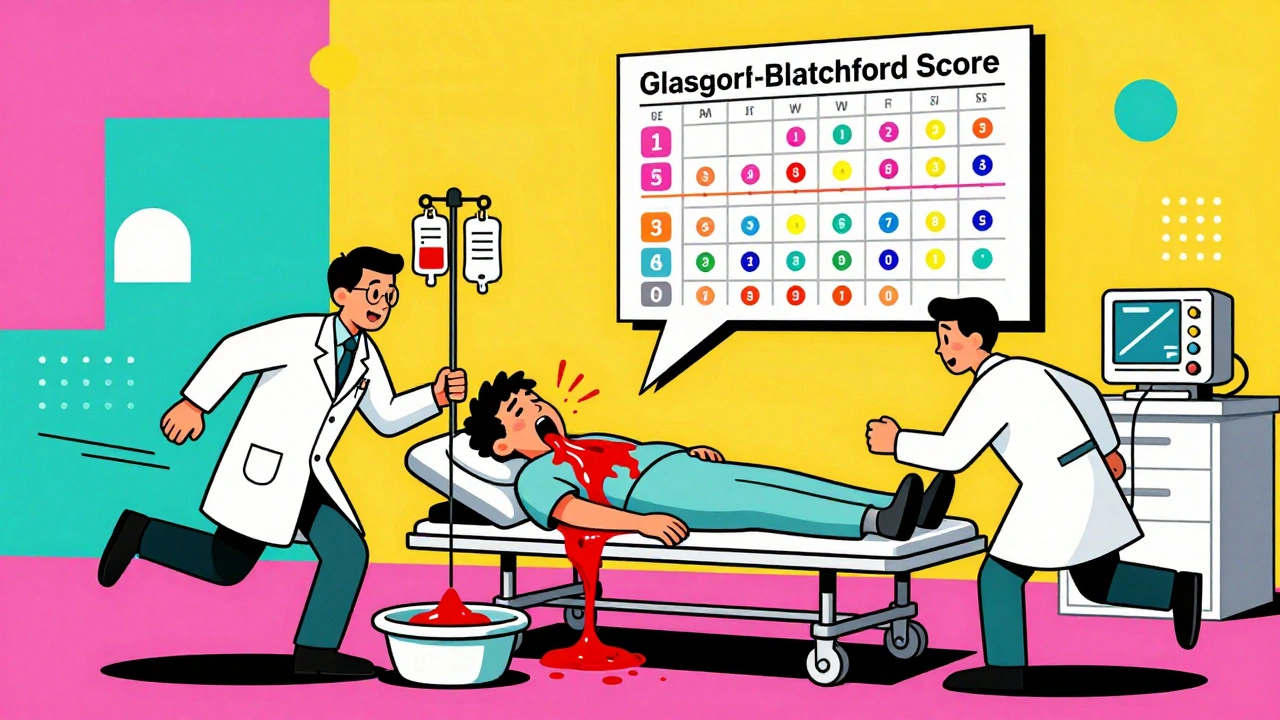
When someone vomits blood or passes black, tarry stools, it’s not just unpleasant-it’s a medical emergency. Upper gastrointestinal (GI) bleeding can happen suddenly, often without warning, and it kills about 1 in 10 people who experience it. The most common causes? Peptic ulcers, esophageal varices, and other damage to the lining of the esophagus, stomach, or duodenum. But knowing what’s causing it is only half the battle. The real key to survival is rapid, smart stabilization-and that’s where most people get it wrong.
What Exactly Is Upper GI Bleeding?
Upper GI bleeding means blood is coming from anywhere from your esophagus down to the first part of your small intestine, right before the ligament of Treitz. It’s not just a stomach upset. It’s active bleeding, and it shows up in clear, terrifying ways: vomiting bright red blood, or coffee-ground-looking material (that’s digested blood), or passing black, sticky stools that smell like tar. In massive bleeds, you might even see maroon-colored stools-this means blood is moving fast through your system. About 100 out of every 100,000 adults in the U.S. face this each year. That’s roughly 300,000 hospitalizations annually. The cost? Around $15,200 per stay. And if you rebleed? That jumps to over $25,000. Older adults are at highest risk-rates jump from 50 per 100,000 under age 50 to 300 per 100,000 over 80. Why? Longer exposure to NSAIDs, blood thinners, and liver disease.The Big Three Causes: Ulcers, Varices, and More
Peptic ulcers are behind 40-50% of all upper GI bleeds. These are open sores in the stomach or duodenum, often caused by H. pylori infection or long-term use of NSAIDs like ibuprofen or aspirin. Duodenal ulcers bleed more often than gastric ones-about 70-80% of ulcer bleeds come from the duodenum. The good news? Most ulcers heal with the right treatment. The bad news? Many people ignore early symptoms like burning pain after meals or nausea until they start vomiting blood. Esophageal varices, the second major cause, are swollen veins in the esophagus. They’re almost always tied to advanced liver disease, especially cirrhosis. When the liver scars, blood backs up into smaller veins, making them bulge and thin out. One rupture can dump a liter of blood into the stomach in minutes. Mortality within six weeks? Around 20%. These aren’t just risky-they’re deadly without immediate treatment. Other common culprits include:- Erosive gastritis (15-20%): Inflammation and erosion of the stomach lining, often from alcohol, stress, or medications.
- Mallory-Weiss tears (5-10%): Tears at the junction of the esophagus and stomach, usually from violent vomiting or retching.
- Esophagitis (5-10%): Often from acid reflux or infections like candida in immunocompromised people.
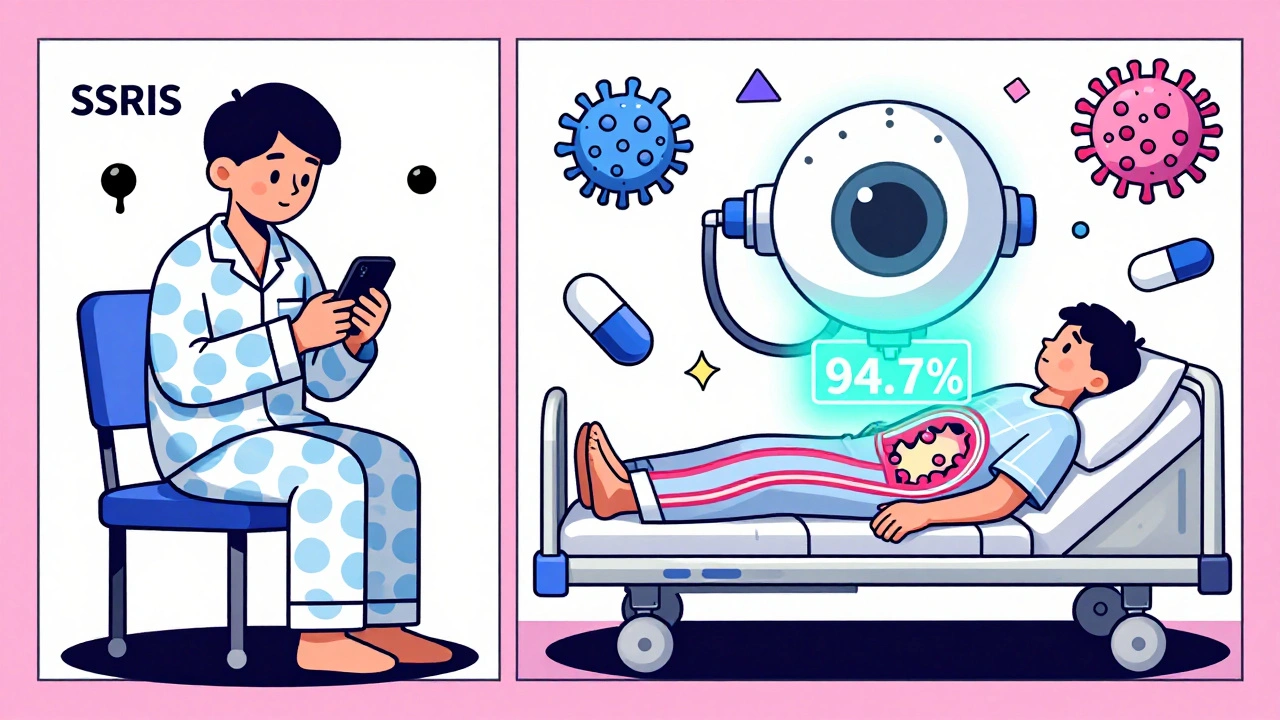
- SSRIs: Antidepressants like fluoxetine or sertraline double the risk of upper GI bleeding, according to a 2022 JAMA study of half a million patients.
How Doctors Know It’s Serious: The Glasgow-Blatchford Score
Not every case needs an ICU. The trick is figuring out who’s in danger. That’s where the Glasgow-Blatchford score comes in. Developed in 2000 and updated in 2019, it uses simple, measurable data to predict who needs urgent care. The score adds up points for:- Hemoglobin level (below 12.9 g/dL for men, 11.9 for women)
- Systolic blood pressure below 100 mmHg
- Pulse over 100 beats per minute
- Presence of melena
- History of syncope (fainting)
- Liver disease or heart failure
Stabilization: The First 30 Minutes Save Lives
The moment someone walks in with signs of upper GI bleeding, the clock starts. The first goal? Keep them alive. That means stabilizing blood pressure, heart rate, and oxygen levels. Doctors start with:- Two large IV lines
- Oxygen if oxygen levels are low
- Fluids to replace lost volume
- Lab tests: CBC, INR, BUN, creatinine

Endoscopy: The Most Important Test
All major guidelines say: get an esophagogastroduodenoscopy (EGD) within 24 hours. But the best outcomes? That happens when endoscopy is done within 12 hours. Studies show this cuts mortality by 25% in high-risk patients. During the procedure, doctors use the Forrest classification to rate bleeding risk:- Class Ia: Spurting blood. 90% chance of rebleeding without treatment.
- Class Ib: Oozing. 50% rebleeding risk.
- Class IIa: Visible vessel. Also 50% risk.
- Class IIb: Adherent clot. 20-30% risk.
- Class III: Clean base. Less than 5% risk.
Treatment: What Works for Ulcers vs. Varices
Treatment depends entirely on the cause. For peptic ulcers:- Start with an 80mg IV bolus of a proton pump inhibitor (PPI), then 8mg/hour infusion. The COBALT trial showed this cuts rebleeding from 22.6% to 11.6%.
- Endoscopic therapy: Inject epinephrine, then use clips or heat to seal the vessel. Success rate? 90-95%.
- Give vasoactive drugs immediately: Terlipressin or octreotide.
- Start antibiotics: Ceftriaxone 1g IV daily. This cuts infection-related deaths by 30%.
- Band ligation is the gold standard. It reduces rebleeding from 60% to 25%.
What Not to Do
Many patients get treated wrong. Here’s what to avoid:- Don’t give PPIs without endoscopy. A 2023 study found 30% of low-risk patients get unnecessary PPIs because doctors assume it’s an ulcer. But if it’s a variceal bleed, PPIs do nothing.
- Don’t delay endoscopy. Waiting 24 hours instead of 12 increases death risk.
- Don’t ignore warning signs. A Reddit user, u/StomachSOS, had black stools dismissed as “iron supplements” for two weeks-until they collapsed. Hemoglobin was 5.8. That’s life-threatening.
- Don’t restart NSAIDs. 31% of patients stop them on their own after a bleed, but many don’t talk to their doctor about alternatives. That’s dangerous.
What’s New in 2025
The field is changing fast. In 2023, the FDA approved Hemospray, a powder that clings to bleeding sites and forms a barrier. It’s not a first-line treatment, but for stubborn bleeds where clips or heat won’t stick, it works in 92% of cases. Even bigger: AI-assisted endoscopy. A 2023 trial showed AI systems spot bleeding signs with 94.7% accuracy-way better than human eyes at 78.3%. But there’s a catch: current AI models are trained mostly on data from white patients. Accuracy drops 15% in Black and Hispanic patients. That’s a serious equity gap. The NIH is now running the UGIB-360 study, tracking 10,000 patients to build personalized risk models using genetics, gut bacteria, and clinical history. Results are due late 2025. This could mean future treatments aren’t one-size-fits-all-they’re built for you.What Happens After You Leave the Hospital
Surviving the bleed is only the first step. A 2022 study found 68% of patients feel anxious about it happening again. Many change their diet-cutting out alcohol, caffeine, spicy food. Some quit NSAIDs cold turkey, which can be risky if they’re on them for arthritis or heart disease. Follow-up is critical. Hospitals with a formal “Upper GI Bleed Bundle” see 30-day mortality drop from 8.7% to 5.3%. That bundle includes:- Assessment within 30 minutes
- Glasgow-Blatchford score done on arrival
- PPI given within 1 hour
- Endoscopy within 12 hours
- Follow-up with GI specialist within 72 hours
What are the first signs of upper GI bleeding?
The most common signs are vomiting blood-either bright red or looking like coffee grounds-and passing black, tarry stools (melena). Some people feel dizzy, have a fast heartbeat, or feel faint. In severe cases, stools may be maroon or bright red, meaning the bleed is very rapid. If you experience any of these, seek emergency care immediately.
Can stress cause upper GI bleeding?
Stress alone doesn’t cause bleeding, but it can trigger erosive gastritis or worsen existing ulcers. Critical illness, major trauma, or prolonged ICU stays can lead to stress ulcers. For most people, everyday stress won’t cause bleeding-but if you’re already on NSAIDs or have H. pylori, stress can push you over the edge.
Do I need to stop my blood thinners after a GI bleed?
It depends. For patients with heart conditions or atrial fibrillation, stopping blood thinners like warfarin or apixaban can be more dangerous than continuing them. Current guidelines say to restart anticoagulants within 7 days if the bleed was controlled and the risk of clotting is high. This decision must be made with your doctor-never on your own.
Is upper GI bleeding more common in certain countries?
Yes. East Asia has the highest rates-150 cases per 100,000 people-mostly due to high rates of H. pylori infection (70-80% of the population). In North America and Europe, rates are lower (95-100 per 100,000), but rising with aging populations and increased use of NSAIDs and SSRIs.
Can I prevent upper GI bleeding?
You can reduce your risk. Test for and treat H. pylori if you have ulcers. Avoid long-term NSAID use-use acetaminophen instead if possible. If you’re on SSRIs and have a history of ulcers, ask your doctor about adding a PPI. Limit alcohol. Get screened for liver disease if you drink heavily. And never ignore black stools or vomiting blood-early action saves lives.

10 Comments
Saurabh Tiwari
December 3, 2025 AT 10:19bro this is wild 🤯 i had a buddy vomit coffee grounds last year and the ER doc just said "drink milk and chill"... turns out he had a bleeding ulcer from 3 years of ibuprofen for his back. never ignore black stools. my bad for not pushing harder.
Saket Modi
December 5, 2025 AT 00:02why do people even take NSAIDs anymore? just take tylenol. also SSRIs causing bleeds? no way. that's just pharma fearmongering.
Chris Wallace
December 5, 2025 AT 16:04I've seen this play out in the ER a few times, and honestly, the biggest issue isn't the diagnosis-it's the delay. People wait days because they think it's "just indigestion" or they're embarrassed. I had a patient last month who came in with a hemoglobin of 4.2 after ignoring symptoms for 17 days. He didn't even know what melena meant. We need way more public awareness, not just for doctors but for families too. This isn't rare. It's silent until it's not.
John Webber
December 6, 2025 AT 15:41ppl think ppi's fix everything but nope. if its varices ppi does jack. i saw a guy get pumped full of omeprazole for 2 days before they finally did endoscopy and found 3 ruptured veins. total waste of time. dont assume its an ulcer!
Shubham Pandey
December 7, 2025 AT 23:26H. pylori is the real villain. Get tested.
Elizabeth Farrell
December 8, 2025 AT 11:03I just want to say how important it is that this post exists. So many people are scared to talk about GI issues because they feel grossed out or ashamed. But this kind of clear, compassionate info can literally save lives. If you're reading this and you've ever had black stools-even once-please, please talk to someone. You don't have to suffer in silence. And if you're a caregiver, know that asking "Have you noticed any changes in your stool?" could be the most important question you ever ask.
alaa ismail
December 9, 2025 AT 11:32the AI endoscopy thing is wild but also kinda scary. imagine getting misdiagnosed because the model was trained on mostly white patients. we gotta fix that before it becomes standard. equity in medicine isn't optional.
Anthony Breakspear
December 10, 2025 AT 08:54yo the Hemospray thing is straight-up sci-fi. Imagine spraying a magic powder on a bleeding ulcer like you're fixing a leaky roof. And it works 92% of the time? That’s insane. But also-why aren’t we talking more about gut bacteria? Like, what if your microbiome is the real MVP in preventing rebleeds? This whole field is shifting from "fix the bleed" to "fix the whole system." We’re not just treating organs anymore-we’re healing ecosystems.
Zoe Bray
December 11, 2025 AT 18:34The implementation of the Upper GI Bleed Bundle, as delineated in the referenced 2022 cohort study, demonstrates statistically significant reductions in 30-day mortality (p < 0.01) when protocolized interventions-including timely endoscopy, early PPI administration, and specialist follow-up-are systematically enforced. This underscores the imperative for institutional standardization in acute GI care pathways.
Girish Padia
December 13, 2025 AT 13:00You people are so lazy. Stop taking ibuprofen. Stop drinking. Stop being dumb. If you're on SSRIs and you're bleeding, you asked for it. This isn't rocket science. You think medicine is magic? It's not. It's responsibility.