
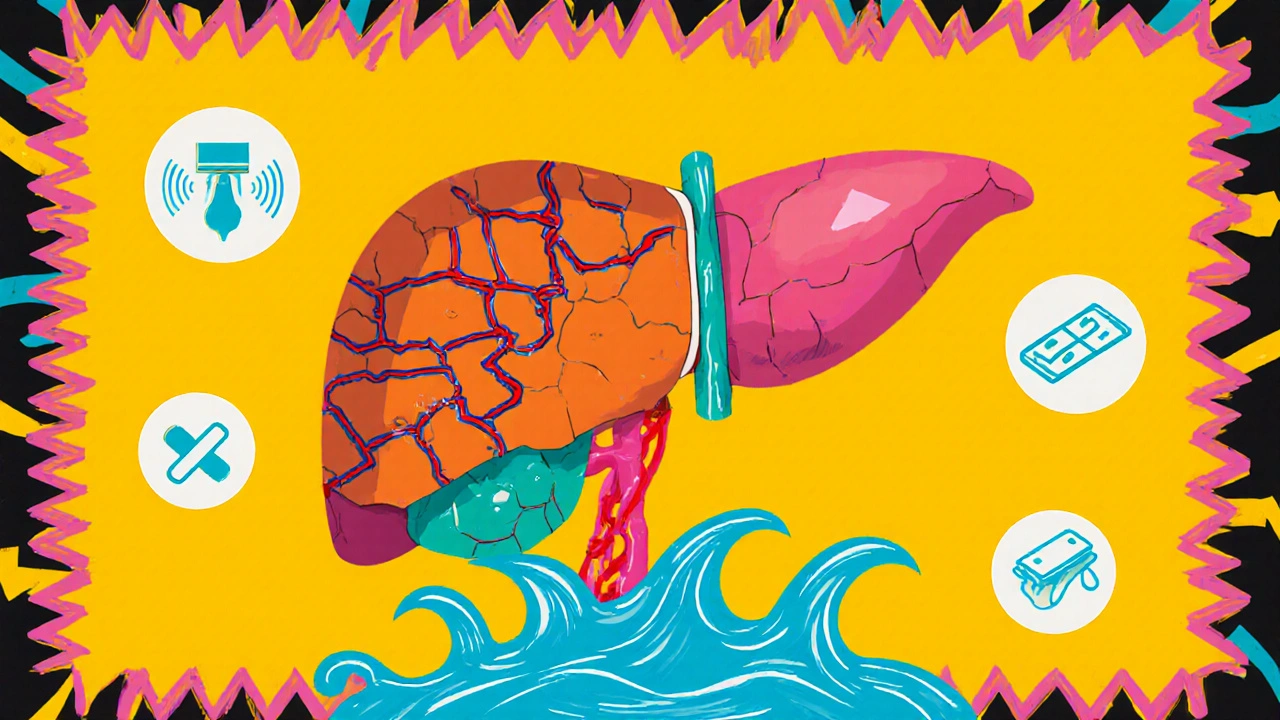
When your liver gets damaged over years-whether from alcohol, hepatitis, or fatty liver disease-it doesn’t just heal. It scars. That scarring is cirrhosis, the final stage of chronic liver disease. It’s not a single event. It’s a slow, silent process that turns healthy liver tissue into stiff, nonfunctional scar tissue. By the time symptoms show up, the damage is often advanced. But knowing what to watch for and how to respond can make all the difference.
What Happens When the Liver Turns to Scar Tissue
The liver is your body’s chemical factory. It filters toxins, makes proteins, stores energy, and helps digest food. When cirrhosis sets in, those functions start to fail. The scar tissue doesn’t just sit there-it blocks blood flow. That’s where the real problems begin.One of the first major consequences is portal hypertension. This means pressure builds up in the vein that carries blood from your intestines to your liver. When that pressure hits 10 mmHg or higher, it triggers a chain reaction. Fluid leaks into your belly, veins in your esophagus swell and burst, and your body can’t clear toxins the way it should.
These aren’t theoretical risks. In fact, 90% of people with cirrhosis develop portal hypertension. And once it starts, complications follow fast.
The Big Five Complications
There are five major complications that define when cirrhosis moves from "compensated" (you feel okay) to "decompensated" (you’re in crisis). If you have even one, your life expectancy drops sharply.
- Ascites: Fluid builds up in your abdomen. It’s not just bloating-it can make breathing hard, cause pain, and lead to infection. About half of people with cirrhosis develop ascites within 10 years. The standard treatment? Cut salt to under 2 grams a day and take diuretics like spironolactone. But 1 in 10 people won’t respond. They need a procedure called paracentesis, where doctors drain the fluid with a needle. Without albumin infusion during the procedure, 37% of patients suffer circulatory collapse. With it, that drops to 10%.
- Spontaneous bacterial peritonitis (SBP): This is a life-threatening infection of the abdominal fluid. It happens in 10-30% of people with ascites. Symptoms are subtle-mild belly pain, fever, confusion. Many mistake it for worsening ascites. If untreated, 20-40% of patients die during their first hospital stay. Antibiotics given early can save lives.
- Variceal bleeding: High pressure in the portal vein causes veins in your esophagus or stomach to swell like balloons. They can rupture without warning. Bleeding from these varices kills 15-20% of people during the first episode. The fix? Endoscopic banding to tie off the veins, plus daily beta-blockers like propranolol or nadolol. These drugs lower pressure in the portal system and cut bleeding risk by 45%. Carvedilol works even better-it reduces pressure more than other beta-blockers.
- Hepatic encephalopathy: Your liver can’t remove ammonia and other toxins anymore. They build up in your blood and reach your brain. You get confused, forgetful, sluggish, or even fall into a coma. It affects 30-45% of decompensated patients. Lactulose, a sugar solution, pulls toxins out of your gut. It cuts recurrence by half. Rifaximin, an antibiotic that stays in the gut, reduces hospital visits by 58% when taken daily.
- Hepatocellular carcinoma (HCC): Cirrhosis is the biggest risk factor for liver cancer. Between 2% and 8% of people with cirrhosis develop it each year. The good news? If caught early, it’s treatable. That’s why everyone with cirrhosis needs an ultrasound every 6 months. Screening finds tumors at stage 0 or A in 70% of cases-when surgery or ablation can still cure. Without screening, most are found too late.
How Doctors Measure How Bad It Is
Not all cirrhosis is the same. Two people with the same diagnosis can have wildly different outcomes. That’s why doctors use scoring systems to predict survival and prioritize transplant candidates.
The Child-Pugh score looks at five things: bilirubin, albumin, INR (a blood clotting test), ascites, and brain function. It gives you a grade: A, B, or C. Class A patients have a 100% chance of surviving one year. Class C? Only 45% make it that long.
But Child-Pugh doesn’t predict transplant need well. That’s where the MELD score comes in. It uses three blood tests: bilirubin, creatinine, and INR. The higher the score, the sicker you are. A MELD score of 15 or above means you’re at high risk of dying within 3 months. That’s when transplant evaluation starts. But here’s the catch: patients with severe hepatic encephalopathy often have lower MELD scores because their liver still makes some bilirubin. Yet their quality of life is terrible. Experts are pushing to add quality-of-life metrics to the system-something the OPTN started doing in February 2024.
Managing Cirrhosis: What Actually Works
There’s no cure for cirrhosis-but you can slow it, manage symptoms, and avoid death. The key is consistency.
- Stop drinking: If alcohol caused your cirrhosis, quitting is non-negotiable. Even small amounts can push you into decompensation. Some centers require 6 months of sobriety before transplant. Others are moving toward individualized plans-some patients with strong support systems have been transplanted after just 30 days.
- Treat the cause: If you have hepatitis C, direct-acting antivirals (like glecaprevir/pibrentasvir) cure it in 95% of cases-even with cirrhosis. If you have fatty liver disease (now called MASH), weight loss and new drugs like resmetirom (Rezdiffra), approved by the FDA in March 2024, can reduce liver scarring.
- Watch your sodium: Less than 2 grams a day. That’s harder than it sounds. Processed food, canned soup, bread, even table salt-everything adds up. A dietitian can help you plan meals that taste good and keep fluid out of your belly.
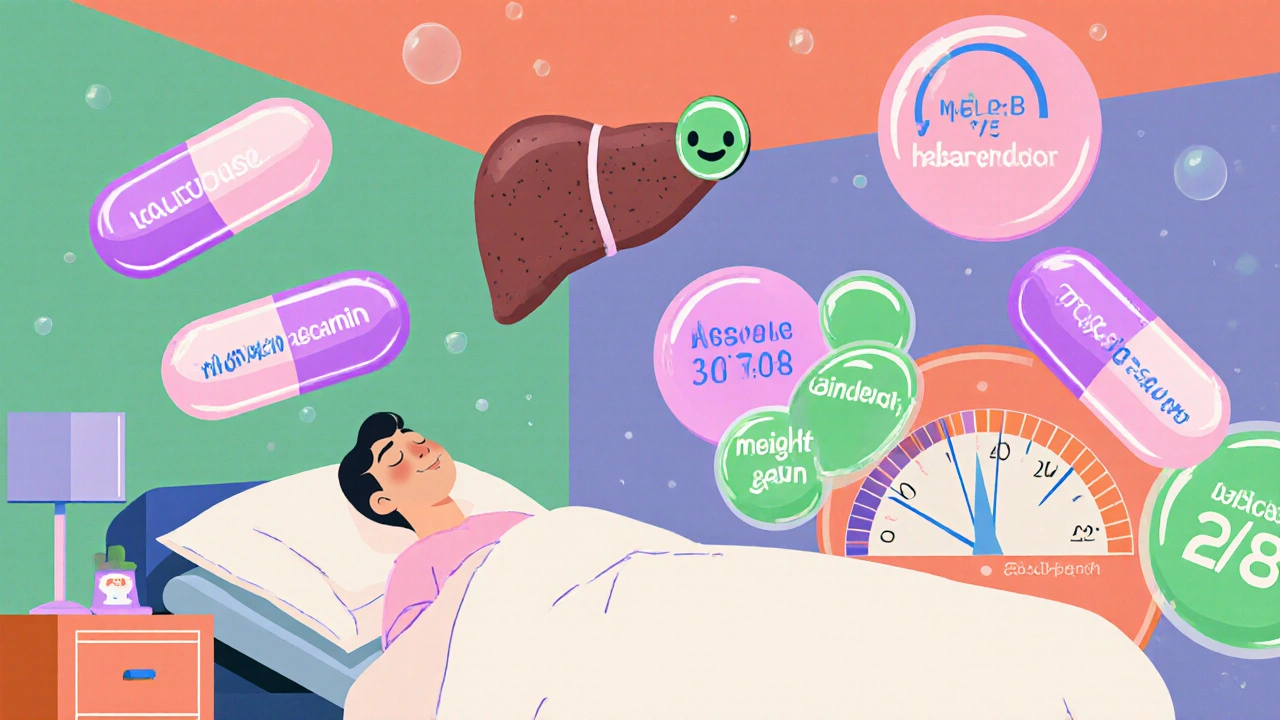
- Take your meds: Beta-blockers, lactulose, rifaximin-they only work if you take them daily. One study found that patients in structured care programs improved medication adherence from 62% to 85%. Nurses who called patients daily after discharge cut 30-day readmissions by 32%.
- Get screened: Ultrasound every 6 months for liver cancer. Don’t skip it. Early detection saves lives.
The Human Side of Cirrhosis
Behind every statistic is a person struggling to live.
People with cirrhosis report crushing fatigue-78% say it ruins their daily life. Lactulose causes constant diarrhea, making social events impossible. Ascites means frequent hospital visits for fluid drainage, often painful and exhausting. One Reddit user wrote, "I’ve missed 12 family events this year because of the diarrhea."
But there’s hope. Transplant changes everything. One patient shared: "18 months post-transplant, my MELD score dropped from 28 to 9. I went back to full-time work."
Structured care programs-where hepatologists, dietitians, social workers, and nurses work together-cut ER visits by 40%. They help patients stay out of the hospital, stay on meds, and live longer.
What’s New in Cirrhosis Care
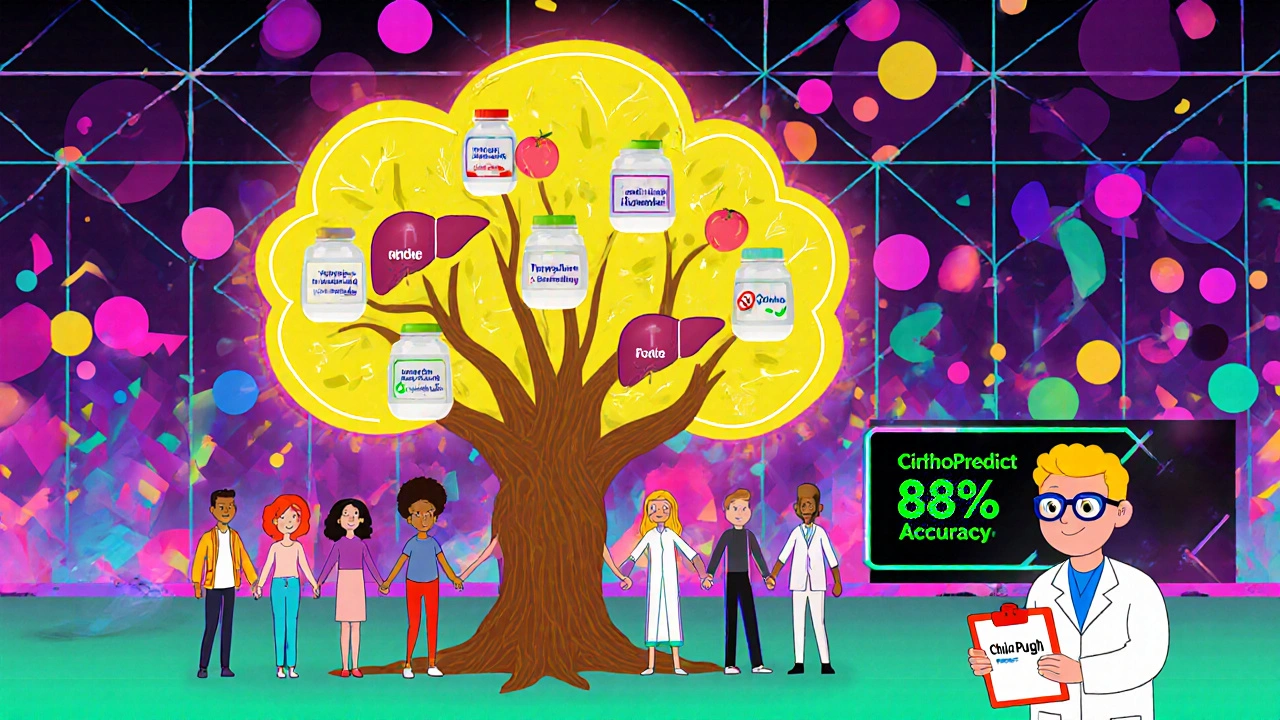
The field is moving fast. In 2024, an AI tool called "CirrhoPredict" was shown to predict who will decompensate in the next 90 days with 88% accuracy-using only routine blood tests. Imagine catching fluid buildup or infection before you even feel sick.
The NIH is investing $127 million over the next four years to find better ways to detect and reverse early cirrhosis. Drugs like galectin-3 inhibitors are showing promise in early trials, with some patients seeing actual fibrosis reduction.
And the way we allocate livers is changing. No longer is it just about how sick you are. Your quality of life matters too. The new system, rolled out in February 2024, tries to give priority to those suffering the most-even if their MELD score doesn’t reflect it.
What You Can Do Today
If you or someone you love has cirrhosis:
- Know your Child-Pugh and MELD scores. Ask your doctor for them.
- Get an ultrasound every 6 months. No excuses.
- Take your diuretics and beta-blockers daily. Set phone alarms.
- Track your weight every morning. A 2-pound gain in a day could mean fluid buildup.
- Call your doctor immediately if you feel confused, feverish, or have belly pain.
- Join a support group. You’re not alone.
Cirrhosis isn’t a death sentence. But it demands attention. The earlier you act, the more control you have. And with new treatments, better screening, and smarter care systems, the future for people with cirrhosis is brighter than ever before.

10 Comments
Rachel Wusowicz
November 14, 2025 AT 17:36So... let me get this straight: the government, Big Pharma, and the liver transplant industrial complex are ALL colluding to hide the REAL cure for cirrhosis-right? I mean, why else would they push all these expensive drugs and scans when the truth is, it’s just a mineral imbalance? I’ve read 17 PDFs from 1998 on Russian forums-goldenseal, black walnut, and 3 tablespoons of Himalayan salt every morning reverses fibrosis COMPLETELY. They’re just suppressing it because insulin and statins are more profitable. And don’t get me started on the MELD score-it’s a scam! They’re using it to ration organs to the politically connected. I’ve got a cousin in Saskatchewan who drank 3 liters of apple cider vinegar daily and his liver went from Child-Pugh C to A in 11 days. No one believes me. But I KNOW. I’ve seen the data. It’s all there. If you look hard enough. With the right filters. And a VPN.
Danish dan iwan Adventure
November 16, 2025 AT 01:27Portal hypertension threshold is 10 mmHg-correct. But you’re missing the hemodynamic cascade. Ascites isn’t just fluid leakage-it’s splanchnic vasodilation → RAAS activation → sodium retention. Diuretics only manage symptoms. The real issue is endothelial dysfunction and nitric oxide overproduction. Beta-blockers? Non-selective ones reduce portal pressure by decreasing cardiac output and splanchnic flow. Carvedilol’s alpha-blockade adds vasodilation. But if you’re not measuring HVPG, you’re flying blind. And MELD doesn’t capture neuroinflammation. Hepatic encephalopathy is a neurologic disease masquerading as a hepatic one.
Ankit Right-hand for this but 2 qty HK 21
November 16, 2025 AT 07:31USA and Canada pushing this ‘new care model’ nonsense. In India, we don’t need AI tools or fancy scoring. We treat with cheap generics, clean water, and discipline. No one here takes 6 months off work for a transplant. We work through pain. You think lactulose fixes anything? My uncle drank neem juice, did 100 squats daily, and stopped eating sugar. His bilirubin dropped in 3 weeks. Western medicine is a money racket. You pay for scans, then pay for drugs, then pay for transplants. In our villages, we use turmeric paste on the abdomen and pray. Works better than your algorithms.
Oyejobi Olufemi
November 17, 2025 AT 12:23Let me break this down for you, because clearly you’ve been brainwashed by pharmaceutical propaganda. Cirrhosis isn’t a disease-it’s a signal. Your body is screaming, ‘I’m overloaded with toxins!’ And what do you do? You give more toxins-spironolactone, rifaximin, beta-blockers-chemical warfare on a failing organ! You’re not healing. You’re suppressing. The liver doesn’t need drugs. It needs detoxification. Fasting. Sunlight. Grounding. And the removal of EMF pollution from your phone and Wi-Fi router-yes, that’s what’s really causing fibrosis. I’ve studied this for 14 years. The WHO is hiding the truth. The liver regenerates in 72 hours if you stop feeding it poison. And poison includes gluten, dairy, and… wait for it… ALCOHOL. Oh wait, you already mentioned that. But you missed the REAL poison: processed sugar. That’s the silent killer. Not alcohol. Not hepatitis. Sugar. And you’re all too dumb to see it.
Jamie Watts
November 17, 2025 AT 18:53Look I’ve been managing cirrhosis for 8 years and I can tell you this-meds work if you take them but the real game changer is consistency. I used to skip my beta blockers because I forgot. Then I started setting 3 alarms a day and got a pill organizer from CVS. Now I haven’t been hospitalized in 2 years. Also the ultrasound every 6 months? Non negotiable. I missed one last year because I was ‘too busy’ and guess what? They found a 1.2cm nodule. Caught it early. Treated it. Still alive. And yeah I know lactulose sucks but I drink Gatorade with it now and it’s bearable. Don’t let the side effects stop you. This isn’t a sprint. It’s a daily grind. And if you’re reading this? You’re already ahead of 80% of people with this diagnosis.
ZAK SCHADER
November 17, 2025 AT 23:11They say you need to cut sodium to 2g a day. Good luck. I ate a bag of chips yesterday. Then a frozen pizza. Then a can of soup. I’m not gonna lie. It’s impossible. And the doctors don’t get it. They act like you’re a robot. You’re a human. You want flavor. You want to eat with your family. So what’s the point of living if you can’t taste salt? I’ve been told I have 3 years. Fine. I’ll spend them eating what I want. At least I’ll die happy.
Deepak Mishra
November 18, 2025 AT 19:25OMG I just read this and I’m CRYING 😭 I’ve been living with cirrhosis for 5 years and the fatigue is REAL. I missed my sister’s wedding because I was too weak to stand. And the diarrhea from lactulose? I’ve ruined 3 pairs of pants. But then I joined a Reddit group and someone sent me a video of a guy who got a transplant and now he’s hiking in Patagonia 🥹 I started taking my meds again. I even bought a smart scale. And guess what? I lost 4 lbs in a week. I’m not giving up. Not anymore. 🙌❤️
Diane Tomaszewski
November 19, 2025 AT 18:15It’s easy to get lost in all the numbers and drugs but at the end of the day this is about people. The fatigue. The loneliness. The fear. I’ve watched my mom go through this and what helped most wasn’t the MELD score or the ultrasound-it was someone sitting with her while she cried. Not fixing. Just being there. We need more of that. Not just better drugs. Better hearts.
Dan Angles
November 20, 2025 AT 13:23Thank you for presenting this information with such clinical precision and human sensitivity. The integration of quality-of-life metrics into transplant allocation represents a paradigm shift in medical ethics-one that prioritizes dignity over mere survival metrics. I encourage all clinicians to adopt multidisciplinary care models, as the data unequivocally demonstrates improved outcomes in structured environments. Furthermore, the recent FDA approval of resmetirom underscores the importance of continued investment in targeted pharmacologic interventions. Let us not underestimate the power of patient education, adherence support, and compassionate communication in altering the trajectory of this disease.
David Rooksby
November 22, 2025 AT 08:03Alright so here’s the thing nobody’s telling you-this whole cirrhosis thing is just a symptom of modern life. We’re all poisoned. By sugar. By stress. By plastic. By Wi-Fi. By the fact that we don’t live in caves anymore. The liver’s just the canary in the coal mine. And now they want to give us AI to predict when we’re gonna collapse? That’s not progress-that’s a death sentence wrapped in a fancy algorithm. I’ve been reading about ancient Egyptian liver treatments. They used to cut open the abdomen and rub honey on the liver. No drugs. No scans. Just honey. And guess what? People lived to 80. Back then. Now? We’re getting MELD scores and being told we’re ‘high risk.’ What a joke. I’m moving to the Scottish Highlands. I’m gonna drink whiskey, eat raw haggis, and sleep under the stars. If the liver’s gonna die, let it die on its own terms. Not because some app told me to take a pill at 8am.