
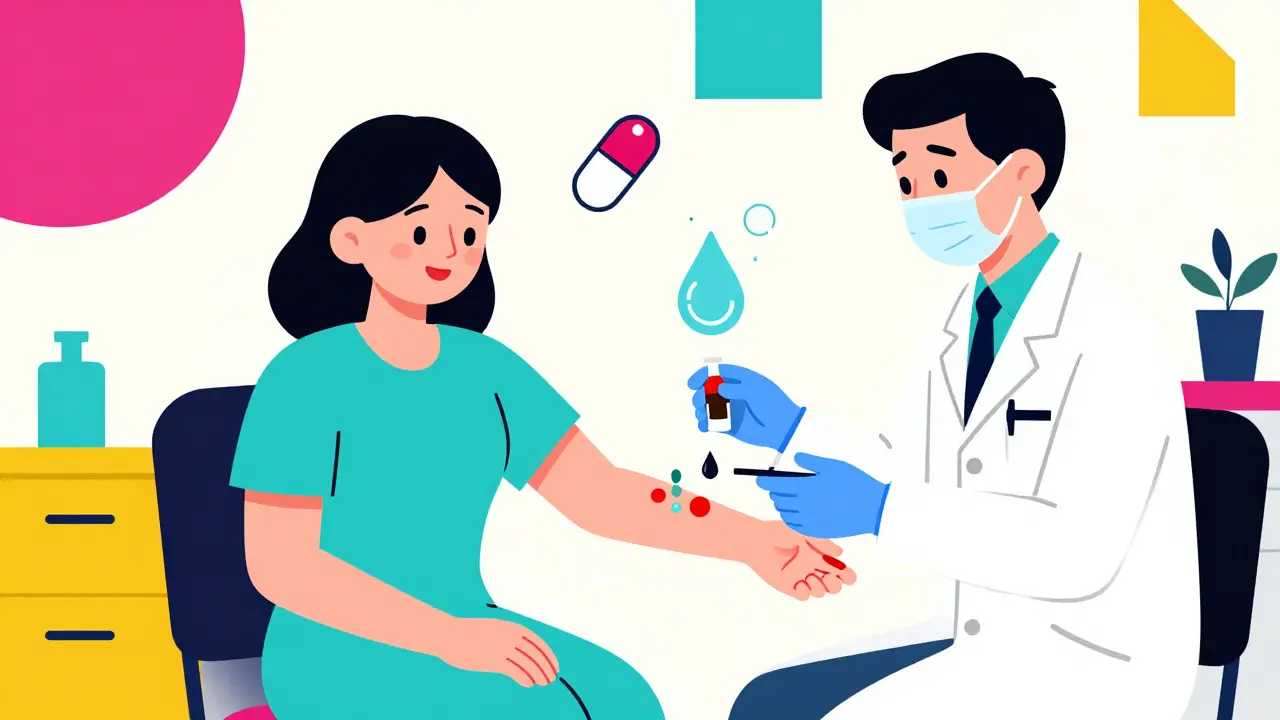
If you’ve been told you’re allergic to a drug-especially penicillin-you’ve probably been handed a warning label and told to avoid it forever. But here’s the truth: 9 out of 10 people who think they’re allergic to penicillin aren’t. That’s not a guess. It’s backed by data from the CDC and hospitals across the U.S. The problem? Most of those people never had a proper test. Skin testing is the best way to find out if you really have a drug allergy-and it’s safer, faster, and more accurate than most people realize.
What Is Drug Allergy Skin Testing?
Drug allergy skin testing is a simple, controlled way to check if your body reacts to a specific medication. It doesn’t mean you’re getting the full dose. Instead, tiny amounts of the drug are introduced just under your skin to see if your immune system responds. If it does, you’ll get a small bump or redness, like a mosquito bite that gets itchy. If nothing happens, you’re likely not allergic. This test is most useful for drugs that cause immediate reactions-things like hives, swelling, trouble breathing, or anaphylaxis-within minutes to an hour after taking the drug.There are three main types of skin tests used:
- Skin prick test (SPT): A drop of the drug solution is placed on your skin, then a tiny needle lightly pricks the surface. It’s quick, barely feels like a pinch, and gives results in 15-20 minutes.
- Intradermal test (IDT): A small amount of the drug is injected just under the skin with a fine needle. This creates a tiny bubble (a bleb) and is more sensitive than the prick test. It’s often used when the prick test is negative but doctors still suspect an allergy.
- Patch test: A patch with the drug is taped to your back for 48 hours. This is used for delayed reactions-rashes that show up a day or more after taking the drug.
These tests aren’t random. They’re done with strict controls. A positive control (histamine) should always cause a reaction to prove your skin is working right. A negative control (saline) should do nothing. If neither works, the test is invalid. Results are measured in millimeters. A positive intradermal test means the bump grew at least 3 mm bigger than the control.
Who Should Get Tested?
You should consider skin testing if:- You were told you’re allergic to penicillin, amoxicillin, or another beta-lactam antibiotic-but never had a formal test.
- You had a reaction to a drug years ago and want to know if you still react to it.
- You need a specific drug for treatment (like surgery or infection) but were told you can’t take it due to a reported allergy.
- You’ve had multiple reactions to different drugs and want to find out which ones are truly risky.
It’s especially important if you’ve been labeled allergic to penicillin. That label can lead doctors to prescribe broader, more expensive, and sometimes more dangerous antibiotics. Hospitals that test patients for penicillin allergy have seen 30% fewer cases of infections like C. diff because they can use safer, targeted drugs instead of broad-spectrum ones.
How Accurate Is It?
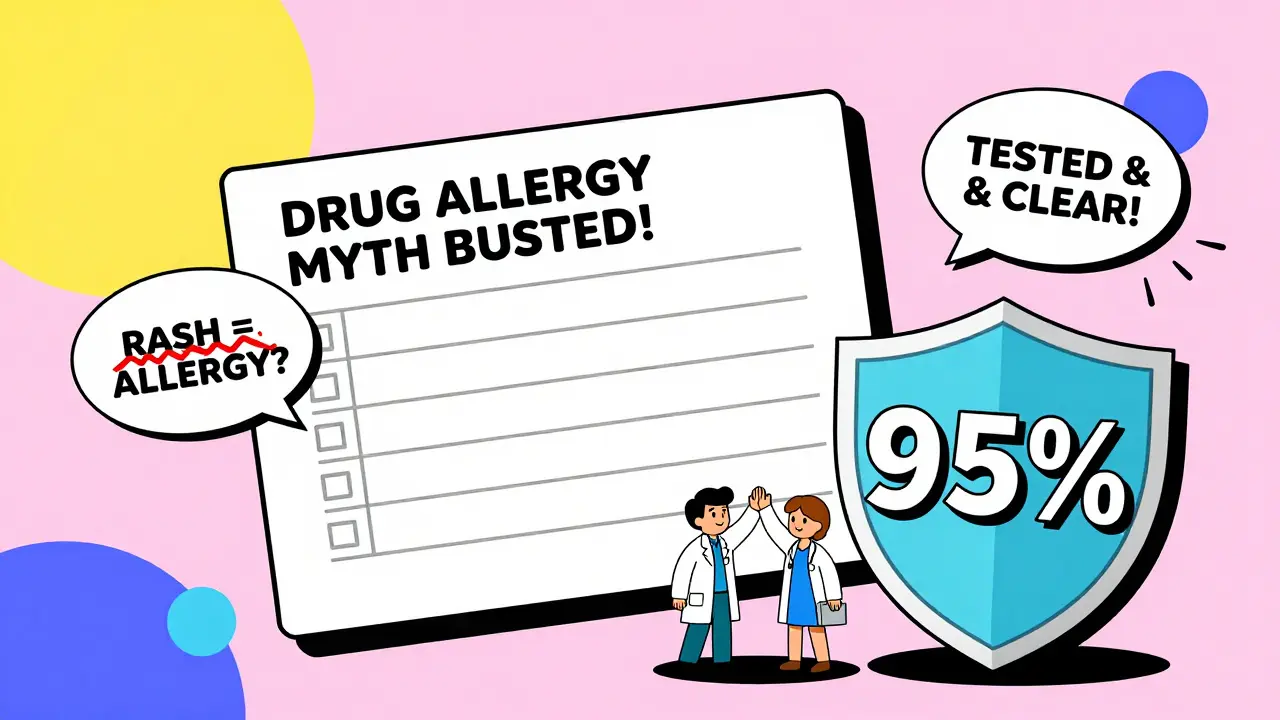
Skin testing is the gold standard-but it’s not perfect. Its accuracy depends heavily on the drug.For penicillin and related antibiotics, skin testing is very reliable. When both skin prick and intradermal tests are negative, there’s a 95% chance you can safely take the drug. That’s why experts recommend testing before removing the label.
But for other drugs? It’s trickier. For cephalosporins, sulfa drugs, or NSAIDs like ibuprofen, the skin test sensitivity drops to 30-50%. That means even if the test is negative, you might still be allergic. In those cases, doctors may follow up with a controlled drug challenge-giving you small, increasing doses under supervision.
And here’s something important: skin tests only work for immediate reactions. If your reaction was a rash that showed up a week later, skin testing won’t help. You’ll need other methods.
What Happens During the Test?
The whole process takes about 45-60 minutes. You’ll sit or lie down while a nurse or allergist marks your forearm or back with a permanent marker. Each test spot is spaced at least 2.5 cm apart so they don’t overlap. No skin creases-no elbows or wrists.First, the skin prick test. A drop of each drug (and the controls) is placed on your skin. A lancet lightly touches each spot-just enough to break the top layer. You won’t bleed. It feels like a quick, light scratch. Then you wait 15-20 minutes. If you react, you’ll see a red, raised bump. It might itch. That’s normal.
If the prick test is negative and the doctor still suspects an allergy, they’ll move to the intradermal test. A tiny syringe injects 0.02-0.05 ml of the drug under the skin. It feels like a small sting, lasting a few seconds. Again, you wait 15-20 minutes. The doctor measures the bump size. If it’s grown more than 3 mm, it’s positive.
Afterward, you’ll be monitored for another 30 minutes. Even though systemic reactions are rare, trained staff are there to act fast if needed. You’ll get a report with photos of the results. These are kept in your medical record so future doctors know exactly what you tested for.
How to Prepare
Preparation matters. If you take antihistamines-even over-the-counter ones like cetirizine or diphenhydramine-you must stop them for 5 to 7 days before testing. They block your skin’s ability to react, which can give you a false negative. Decongestants, some antidepressants, and even certain heart medications can interfere too. Always tell your doctor what you’re taking.Don’t shave the test area. Don’t apply lotions or creams. Wear short sleeves. If you’re feeling sick, have a fever, or are having an active allergic reaction, the test will be postponed. You also shouldn’t get tested if you have uncontrolled asthma or a history of severe anaphylaxis without proper emergency backup.
What If the Test Is Negative?
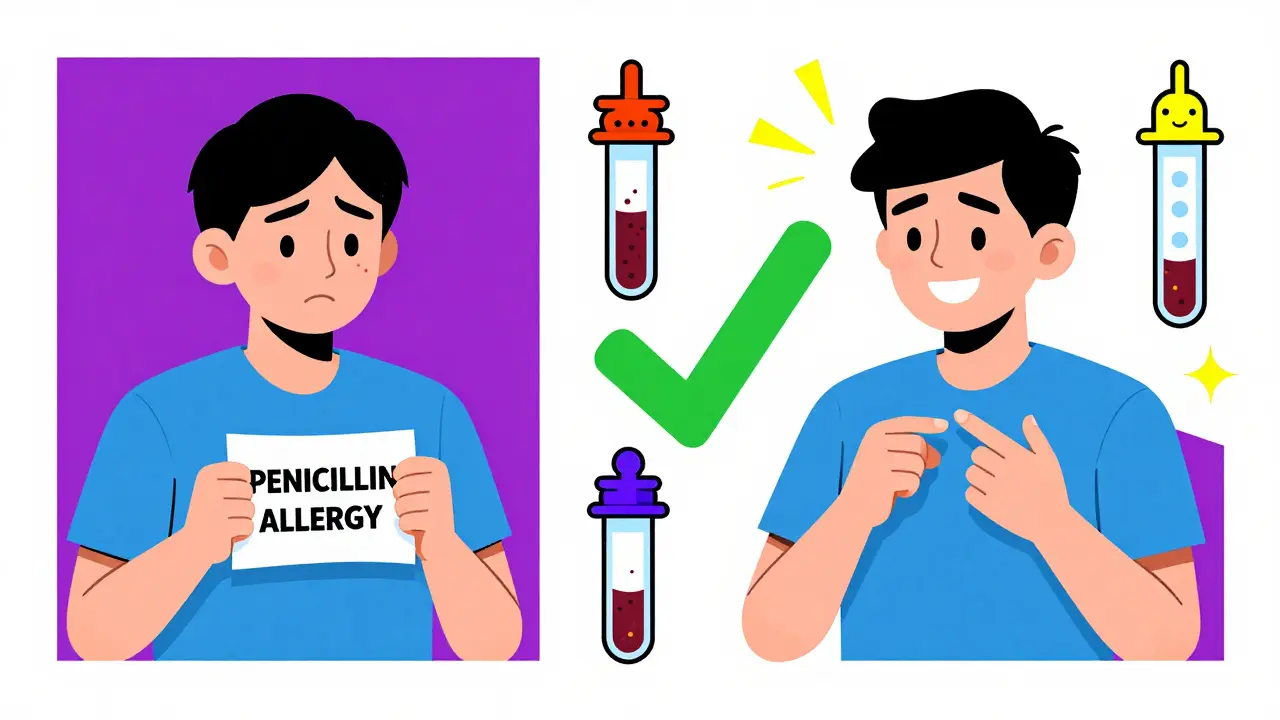
A negative test is great news-but it doesn’t always mean you’re completely off the hook. For penicillin, it’s very strong evidence you’re not allergic. Many doctors will then do a drug challenge: give you a full dose of amoxicillin in the clinic and watch you for an hour. If nothing happens, you’re cleared. You can now safely take penicillin-type drugs for the rest of your life.For other drugs, a negative test might mean you’re not allergic-or it might mean the test just isn’t sensitive enough. Your doctor will explain what this means for your future care.
What If the Test Is Positive?
If you have a positive result, you’ll be advised to avoid that drug and any closely related ones. You’ll get a medical alert bracelet or card. You’ll also be given an emergency plan, including when to use an epinephrine auto-injector if you’re ever exposed accidentally.But here’s the key: a positive test doesn’t always mean you’ll react again. It means your immune system recognizes the drug as a threat. That’s useful info. It helps doctors choose safer alternatives. You might still be able to take a different drug in the same class, or you might need to do a challenge under strict supervision.
Common Misconceptions
Many patients believe:- “I had a rash once, so I’m allergic forever.” Rashes can be caused by viruses, not drugs. Skin testing helps sort this out.
- “Allergies get worse each time.” Not true. Your body doesn’t always react more severely. Some people never react again.
- “Skin testing is dangerous.” The amount of drug used is microscopic. It stays in the skin. Systemic reactions are extremely rare-less than 1 in 1,000 tests.
- “I don’t need testing if I never took the drug again.” But if you ever need it-say, for an infection during pregnancy or surgery-you’ll be stuck with a riskier alternative.
One patient from Melbourne shared online: “I thought I was allergic to penicillin after a rash at 12. I got tested at 35. Negative. Took amoxicillin for a sinus infection. No problem. Felt like I got my health back.”
Why Isn’t This Done More Often?
Despite being accurate and safe, skin testing is underused. In the U.S., only 30-40% of people with reported penicillin allergies get tested. In Europe, it’s 65-75%. Why? Lack of awareness, limited access to allergy specialists, and outdated medical records. Many doctors still rely on patient history alone. But that’s changing. Hospitals are starting allergy clinics. Insurance is covering it. And with new standardized reagent kits approved in 2022, testing is more reliable than ever.The biggest shift? Moving from “avoid at all costs” to “test and confirm.” That’s saving lives-and cutting costs. Antibiotics are cheaper. Hospital stays are shorter. Infections like C. diff drop by 22% in hospitals with testing programs.
What’s Next?
Research is expanding. In early 2023, new guidelines from the NIAID included skin testing for opioid allergies, which were once considered too risky to test. Clinical trials are now underway to create reliable skin tests for ciprofloxacin and vancomycin. Component-resolved diagnostics-testing for specific parts of a drug molecule-are improving accuracy even more.For patients, the message is clear: if you think you’re allergic to a drug, don’t just accept it. Ask if skin testing is right for you. It’s quick. It’s safe. And it could change how you’re treated for the rest of your life.
Can I take antihistamines before a drug allergy skin test?
No. You must stop all antihistamines-prescription and over-the-counter-for at least 5 to 7 days before testing. They block your skin’s reaction and can give a false negative result. This includes medications like loratadine, cetirizine, fexofenadine, and diphenhydramine. Always tell your doctor what you’ve been taking.
Does skin testing hurt?
It’s usually mild. The skin prick test feels like a light scratch or tiny mosquito bite. The intradermal test feels like a small sting as the fluid is injected. Most people say it’s less uncomfortable than a blood draw. The itching from a positive reaction lasts only minutes and is usually manageable. The histamine control can make your arm itchy, but that’s expected and shows the test is working.
Can I get a reaction during the test?
Serious reactions are rare. The amount of drug used is tiny and stays in the top layer of skin. It doesn’t enter your bloodstream in significant amounts. Most people only get local redness or swelling. Clinics are equipped to handle reactions immediately. Staff are trained in anaphylaxis management. You’ll be monitored for at least 30 minutes after testing. If you’ve had a severe reaction before, the test may be done in a hospital setting.
Is skin testing only for penicillin?
No. While penicillin is the most common reason, skin testing is used for many drugs, including cephalosporins, vancomycin, insulin, chemotherapy agents, and even some painkillers like morphine. However, its reliability varies. It’s most accurate for beta-lactam antibiotics. For other drugs, results are less certain, and doctors may use a drug challenge to confirm.
How long do I have to wait for results?
You’ll see results from the skin prick test within 15-20 minutes. If the intradermal test is needed, you’ll wait another 15-20 minutes after that. The entire process usually takes 45-60 minutes. You’ll be monitored for at least 30 minutes after the last test. Results are documented with photos and added to your medical record.
Can I get tested if I’m pregnant?
Yes. Skin testing is considered safe during pregnancy. In fact, it’s often recommended for pregnant women with a history of drug allergy, especially if they need antibiotics for infections. The test uses minimal amounts of drug and doesn’t cross the placenta. Doctors will still take extra precautions, but the benefits usually outweigh the risks.
What if I’ve never had a reaction but my family is allergic?
Drug allergies aren’t inherited like eye color. Just because a parent is allergic to penicillin doesn’t mean you are. Skin testing is only recommended if you’ve had a reaction yourself. Family history alone isn’t enough to justify testing.
If you’ve been told you’re allergic to a drug, ask your doctor: “Can I get skin tested?” It’s not just about avoiding a reaction-it’s about getting the right treatment. And that’s worth the 60 minutes.

11 Comments
Mandy Vodak-Marotta
February 4, 2026 AT 12:56Okay but can we talk about how wild it is that so many people are just told they're allergic and never questioned it? I had a rash after amoxicillin when I was 8, and my mom just took me off it forever. Fast forward 20 years, I needed it for a bad UTI and my doctor was like, 'You can't take that.' I was like, 'Wait, how do you even know?' Turned out I wasn't allergic at all. Skin test was negative, took the full dose, no problem. Felt like I got my health back. Why isn't this routine??
Meenal Khurana
February 5, 2026 AT 18:12Test before assuming.
Amit Jain
February 6, 2026 AT 09:35As a pharmacist in Delhi, I see this all the time. Patients come in saying 'I'm allergic to penicillin' and they’ve never been tested. They get azithromycin or ciprofloxacin instead, which costs more and sometimes causes more side effects. Skin testing is cheap, safe, and accurate for beta-lactams. If your clinic doesn’t offer it, ask for a referral. It’s not complicated. We’ve done hundreds here - zero serious reactions. Just need trained staff and the right reagents.
Kunal Kaushik
February 8, 2026 AT 05:10My cousin got tested last year after being told she couldn't take penicillin since she was 5. She cried when she found out she wasn’t allergic. 😭 Now she takes amoxicillin for every cold. No more 'I can't take that' panic when she's sick. Also, her mom finally stopped giving her Zyrtec before every doctor visit - turns out it was messing with her allergy tests for years. So many people don’t even know meds like that interfere. This needs to be on TV.
Lorena Druetta
February 9, 2026 AT 00:51It is truly remarkable how many individuals carry lifelong medical restrictions based on anecdotal experiences rather than scientific validation. The data presented here is not merely encouraging - it is transformative. By undergoing proper skin testing, patients not only avoid unnecessary avoidance of life-saving medications, but they also reduce the risk of complications from broader-spectrum antibiotics. This practice is a cornerstone of responsible, evidence-based care. I urge every individual who has been labeled allergic to a medication to pursue formal evaluation. It is not a burden - it is a gift to your future self.
Keith Harris
February 9, 2026 AT 21:19LMAO so now we’re supposed to believe Big Pharma doesn’t profit off people being scared of penicillin? 🤡 They make billions off those 'alternative' antibiotics - the ones that cost 10x more and wipe out your gut flora. And don’t even get me started on how hospitals don’t wanna train staff for skin tests because it’s ‘too time-consuming.’ Meanwhile, people are getting C. diff from antibiotics they didn’t even need. This isn’t science - it’s corporate laziness dressed up as ‘protocol.’ And yeah, I’ve seen the ‘false negative’ BS. You test negative, then get a full dose and go into anaphylaxis? Who’s liable then? The hospital? The doctor? Or the poor schmuck who trusted a 15-minute poke with a needle?
Sherman Lee
February 10, 2026 AT 04:27Did you know the CDC only started pushing this in 2020? Before that, every allergy label was just handwritten on a chart by some intern. 😏 And those 'standardized reagent kits'? They’re only approved for 3 drugs. The rest? Guesswork. And don’t get me started on how they use histamine as a control - what if you’re allergic to histamine? 🤔 I read a paper where 12% of 'negative' tests were actually false negatives because the patient had taken a Zyrtec 10 days before. That’s not science - that’s Russian roulette with your immune system. And why do they never test for cross-reactivity with cephalosporins? 🤷♂️
Rachel Kipps
February 10, 2026 AT 22:21I found this article very helpful, though I did notice a few typos - 'infection like C. diff' should probably be 'infections like C. diff.' Also, the part about antihistamines says '5 to 7 days' but doesn't specify if that includes the day of the test. I'm a nurse and I always double-check these details because patients rely on accuracy. Still, the overall message is powerful and I'm going to share it with my patients. Thank you for writing this.
Wendy Lamb
February 11, 2026 AT 04:20If you’ve been told you’re allergic - ask for a test. That’s it. No drama. No fear. Just a simple 60-minute appointment that could change your life. No need to overthink it. If your doctor says no, find another one. Your health isn’t a suggestion.
Justin Fauth
February 11, 2026 AT 11:21They want you to get tested because they’re trying to get you to take American-made antibiotics again. Meanwhile, in Europe, they’ve been doing this for decades - and guess what? Their hospitals are cleaner, their antibiotics are cheaper, and their people live longer. We’re falling behind because our system’s broken. Stop letting them push you into expensive, dangerous drugs just because you didn’t get a needle test. This isn’t medicine - it’s profit-driven nonsense. 🇺🇸
Prajwal Manjunath Shanthappa
February 13, 2026 AT 09:37Let me be perfectly clear: the notion that 90% of penicillin 'allergies' are false is not only statistically dubious - it is, frankly, an affront to the integrity of immunological science. The CDC? A bureaucratic entity with vested interests in pharmaceutical reporting. Skin testing? A crude, antiquated methodology with inter-operator variability exceeding 22%. And yet, you suggest we abandon decades of clinical caution - based on a single, poorly replicated meta-analysis? Please. I’ve seen patients develop delayed hypersensitivity reactions weeks after a 'negative' test. This isn’t empowerment - it’s reckless de-medicalization masquerading as progress. 📉🩺