
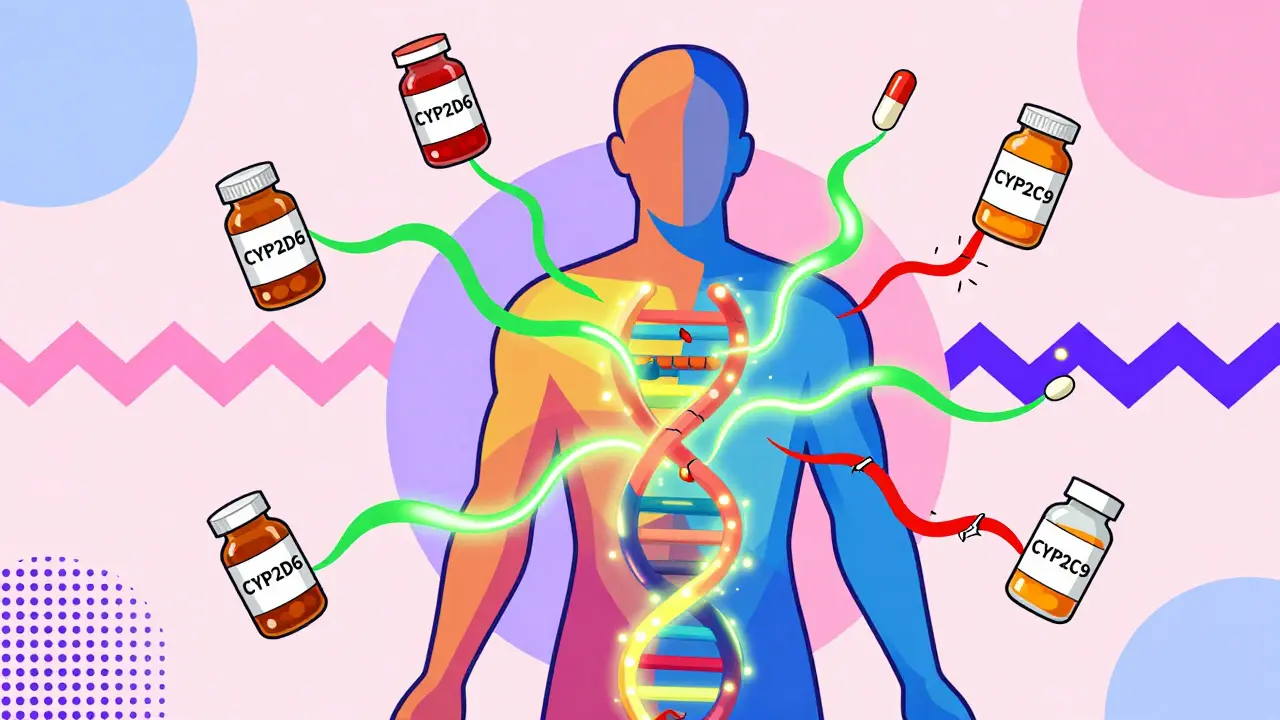
Imagine taking a medication that doesn’t work-again. Or worse, one that makes you sick. For millions of people, this isn’t a hypothetical. It’s everyday life. Pharmacogenomics testing is changing that by using your DNA to predict how your body will react to drugs before you even take them. This isn’t science fiction. It’s happening right now in clinics across the U.S., helping patients finally find the right pill at the right dose.
What Is Pharmacogenomics Testing?
Pharmacogenomics testing looks at specific genes that control how your body breaks down medications. Some people process drugs quickly. Others slow them down. A few can’t process them at all. These differences come from your genes-not your lifestyle, age, or weight. The test checks for variations in genes like CYP2D6, CYP2C19, and CYP2C9, which code for liver enzymes responsible for metabolizing about 75% of all prescription drugs.
The Human Genome Project laid the foundation, but it wasn’t until the Clinical Pharmacogenetics Implementation Consortium (CPIC) started publishing guidelines in 2009 that doctors had clear rules to follow. Today, the FDA lists 178 drugs with pharmacogenomic information in their labels. That means if you’re prescribed one of these, your doctor should consider your genetic profile.
Why It Matters: The Real Cost of Trial and Error
Right now, most doctors guess. They start with a standard dose. If it doesn’t work, they try another drug. If that causes side effects, they switch again. This trial-and-error approach isn’t just frustrating-it’s dangerous.
In the U.S., adverse drug reactions send over 2 million people to the hospital every year and cause 100,000 deaths. That’s more than car accidents or pneumonia. Pharmacogenomics testing can cut those numbers by up to 30%. For example, before prescribing the HIV drug abacavir, doctors now test for the HLA-B*57:01 gene variant. If you have it, you’re at risk of a life-threatening allergic reaction. Testing prevents that. Simple. Life-saving.
Where It Works Best: Mental Health, Heart Disease, and Cancer
Not all drugs benefit equally from genetic testing. It shines where the stakes are high and options are limited.
In mental health, about 40-60% of people don’t respond to their first antidepressant. A 2022 study found that patients who got gene-guided treatment were 30.5% more likely to go into remission than those who didn’t. One patient on Reddit shared how five SSRIs failed her-until a GeneSight test showed she was a CYP2D6 poor metabolizer. Switching to bupropion worked immediately.
In cardiovascular care, the blood thinner clopidogrel (Plavix) only works if your body can activate it. About 30% of people have a CYP2C19 variant that blocks this. For them, the drug is useless. Testing identifies these patients so doctors can switch them to ticagrelor or prasugrel, cutting heart attack risk by half.
In oncology, tamoxifen for breast cancer needs CYP2D6 to become active. Poor metabolizers get little benefit. Testing helps avoid ineffective treatment and steers patients toward alternatives like aromatase inhibitors.
How the Test Works: Blood, Saliva, and Results in Days
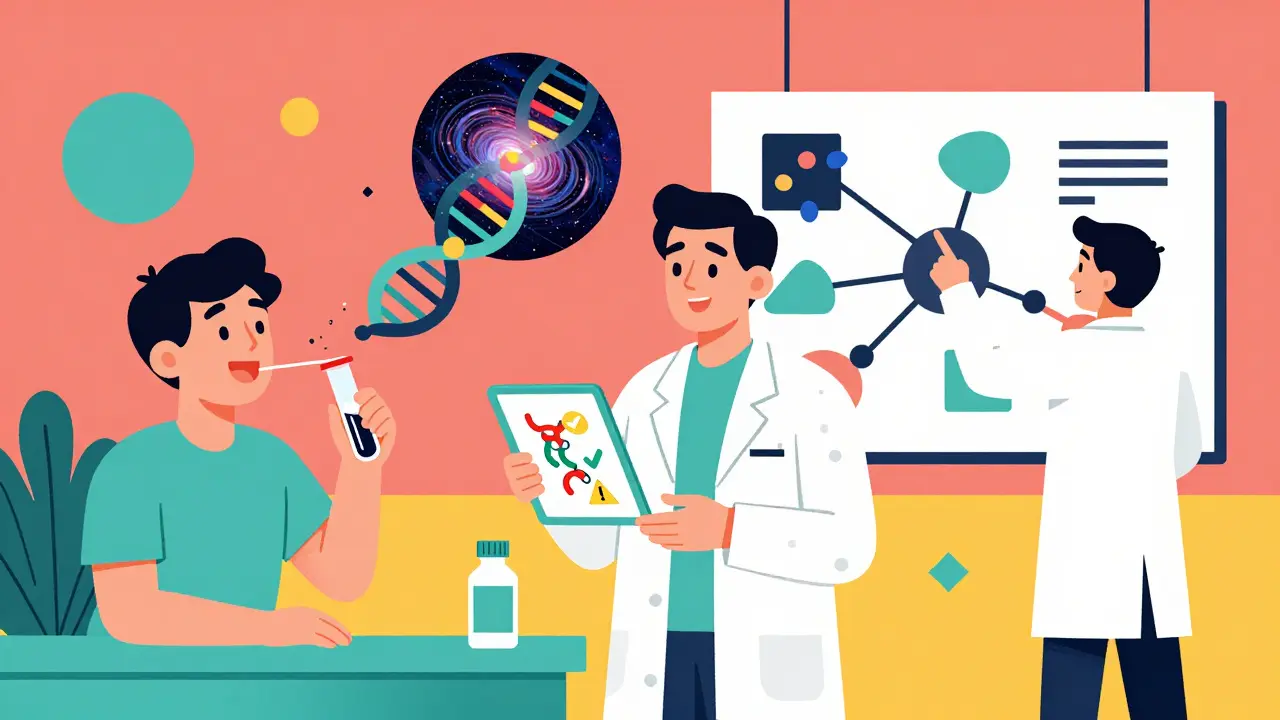
Getting tested is simple. You spit into a tube or give a blood sample. No needles, no fasting. The sample goes to a CLIA-certified lab like OneOme, Invitae, or Quest Diagnostics. Most tests look at 10-20 key genes linked to common medications.
Turnaround time? Usually 3-14 days. Costs range from $250 to $1,000, depending on the panel. Medicare Part B covers it for specific cases, like antidepressants or blood thinners. Private insurance? Only 35% of plans cover it today. That’s the biggest barrier.
Results come back as a report: “You’re a rapid metabolizer of CYP2D6,” or “You carry the HLA-B*57:01 variant.” Your doctor or pharmacist then cross-references it with CPIC or DPWG guidelines to adjust your meds.
What the Test Can’t Do
Pharmacogenomics isn’t magic. It doesn’t predict how you’ll feel on a drug-it predicts how your body will process it. It also doesn’t explain everything. Studies show genes account for only 10-15% of drug response variability. The rest comes from age, diet, other medications, liver health, and even gut bacteria.
It won’t help with drugs like penicillin or ibuprofen, where dosing is straightforward and side effects are rare. It’s not meant for every prescription. It’s meant for the high-risk, high-stakes ones.
And it’s not perfect. Most research is based on European ancestry. Data on African, Asian, and Indigenous populations is still limited. That means results might be less accurate for non-white patients. Researchers at Stanford and the All of Us program are working to fix that.
Who’s Using It-and Who’s Not
Academic medical centers are leading the charge. 63% of them now have pharmacogenomics programs. Community hospitals? Only 17%. Why? It’s not just cost. It’s training. Only 15% of physicians feel confident interpreting genetic reports. Many don’t know how to read a CYP2D6 result or where to find CPIC guidelines.
Pharmacists are stepping in. 72% of academic hospitals now have pharmacogenomics-trained pharmacists who help doctors make sense of the data. That’s the future: doctors prescribe, pharmacists interpret.
Big tech is catching up too. Epic and Cerner, the two biggest electronic health record systems, now auto-flag dangerous gene-drug interactions. If your chart says you’re a CYP2D6 poor metabolizer and your doctor tries to prescribe codeine, the system pops up a warning.
Real Patient Stories: Hope, Confusion, and Results
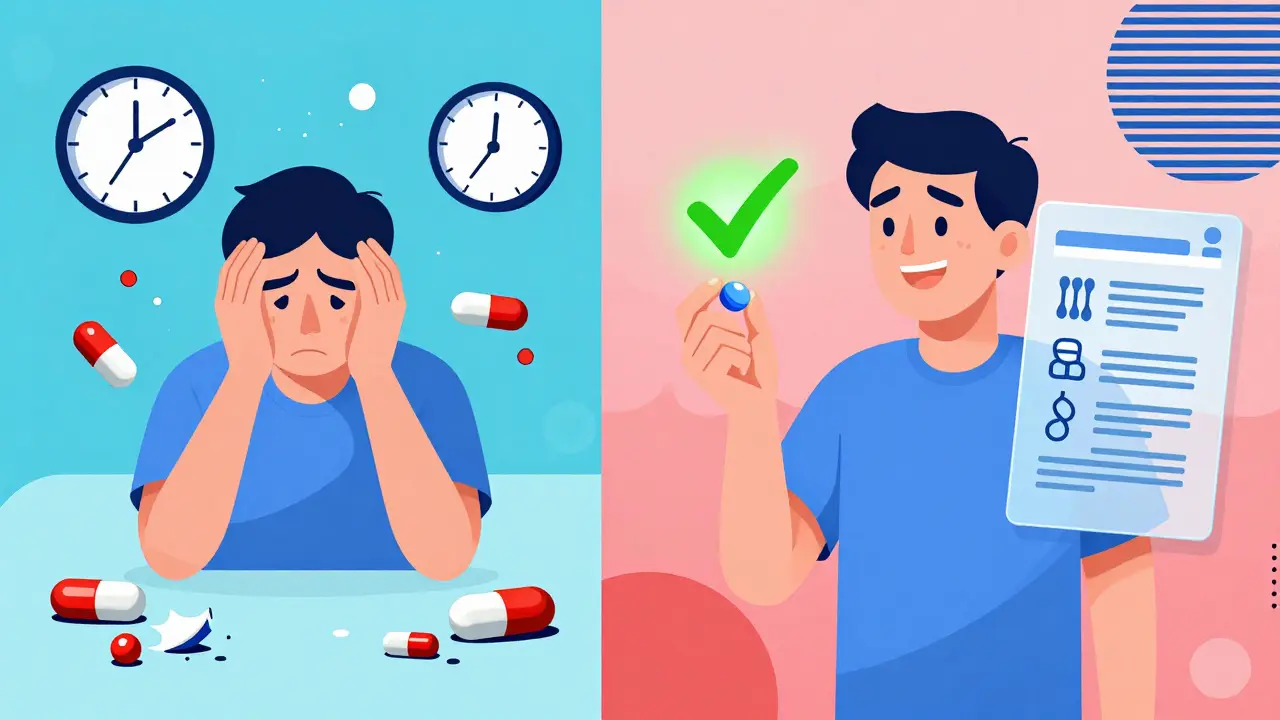
On Healthgrades, 68% of patients say pharmacogenomics testing improved their outcomes. But 42% say their doctors ignored the results. One woman with chronic pain spent years on opioids that made her nauseous and dizzy. Her test showed she was a CYP2D6 ultra-rapid metabolizer-her body turned codeine into morphine too fast. Switching to tramadol cut her side effects in half.
Another patient, a 58-year-old man with depression, tried seven antidepressants over seven years. None worked. His test showed he had two slow-metabolizer variants. His psychiatrist switched him to vortioxetine-no side effects, mood lifted in three weeks. “Finally,” he said, “someone listened to my body.”
But not all stories are positive. Some patients expect the test to solve every problem. It doesn’t. It narrows the field. It reduces guesswork. It doesn’t guarantee a miracle.
The Future: Routine Testing by 2030?
The market for pharmacogenomics testing hit $8.3 billion in 2023 and is growing fast. By 2027, Gartner predicts 30% of prescriptions will use genetic data. By 2030, the Personalized Medicine Coalition says half of all U.S. adults will have their pharmacogenomic profile stored in their medical records.
Why? Because it saves money. The Rand Corporation estimates widespread use could cut U.S. healthcare costs by $137 billion a year-just by avoiding bad reactions and ineffective drugs. That’s not just good for patients. It’s good for the system.
Next up: point-of-care tests you can get in your doctor’s office in 15 minutes. Polygenic scores that combine dozens of genes to predict response. Wearables that track drug levels in real time. The pieces are falling into place.
Getting Started: What You Can Do Today
If you’ve struggled with medications-antidepressants that didn’t work, painkillers that made you sick, blood thinners that caused bleeding-ask your doctor about pharmacogenomics testing. Don’t wait for them to bring it up. Bring it yourself.
Ask:
- Do I have a gene-drug interaction that’s been studied?
- Is there a test that could help me avoid side effects?
- Can you refer me to a pharmacist who understands pharmacogenomics?
Don’t be discouraged if your insurance denies it. Some labs offer cash-pay options under $300. And if your doctor says it’s “experimental,” show them the FDA’s list of 178 labeled drugs or CPIC’s 34 guidelines. This isn’t fringe science anymore. It’s standard of care-for the right patients.
Pharmacogenomics testing doesn’t promise perfection. But it replaces guesswork with science. And for people who’ve spent years cycling through pills that didn’t fit, that’s more than enough.
Is pharmacogenomics testing covered by insurance?
It depends. Medicare Part B covers testing for specific drugs like antidepressants and blood thinners when medically necessary. Private insurance coverage is patchy-only about 35% of commercial plans pay for it. Some labs offer self-pay options for $250-$500. Always check with your provider and ask for a pre-authorization if possible.
How long does it take to get results?
Most clinical tests take 3 to 14 days. Some labs offer expedited results in 72 hours for urgent cases. Once results are in, your doctor or pharmacist will review them and adjust your medication plan. It’s not instant, but it’s faster than trying five different drugs over months.
Does pharmacogenomics testing replace other tests like blood levels?
No. Therapeutic drug monitoring (TDM), which measures actual drug levels in your blood, is still useful for drugs with narrow safety margins like lithium or warfarin. Pharmacogenomics tells you how your body will likely process a drug. TDM tells you what’s actually in your bloodstream right now. They’re complementary-not replacements.
Can I get tested without a doctor’s order?
Some direct-to-consumer companies offer genetic tests that include pharmacogenomic data, like 23andMe or AncestryHealth. But these aren’t clinical-grade. They’re for curiosity, not treatment decisions. For medical use, you need a test ordered by a licensed provider and interpreted by a qualified pharmacist or genetic counselor.
Are there risks to getting tested?
The physical risk is zero-it’s just a saliva swab or blood draw. But there are emotional and privacy risks. Learning you have a gene variant linked to poor drug response can cause anxiety. Your data could be used by insurers or employers if not properly protected. Always ask how your data will be stored, who can access it, and whether it’s covered by GINA (Genetic Information Nondiscrimination Act).
Will my results affect future prescriptions?
Yes. Once your pharmacogenomic profile is in your medical record, any future provider who accesses it will see your genetic data. That means if you’re prescribed a new drug, your doctor will know whether it’s likely to work or cause side effects based on your genes. This is why it’s called “pre-emptive” testing-it helps for every prescription going forward.

14 Comments
Josh Kenna
January 18, 2026 AT 17:13Man I wish this was around when I was on 7 different antidepressants over 5 years. My doc just kept saying 'try another one' like it was a game of musical chairs. Finally got tested and turns out I'm a CYP2D6 poor metabolizer. Switched to bupropion and boom - no more zombie mode. Why isn't this standard??
Erwin Kodiat
January 19, 2026 AT 14:48This is honestly one of the most hopeful things I've read in a long time. I've seen too many people suffer because doctors treat meds like trial-and-error darts. This isn't sci-fi - it's just common sense. Glad we're finally catching up.
sujit paul
January 20, 2026 AT 14:44Let us not forget: this is merely another step in the grand pharmaceutical agenda to monetize your DNA. Your genes are not a product to be sold. The FDA's list of 178 drugs? That's not science - that's a lobbying ledger. Who benefits? Not you. Not your body. The system.
Aman Kumar
January 21, 2026 AT 13:43Pharmacogenomics is a reductionist fallacy. Human physiology cannot be reduced to single nucleotide polymorphisms. The microbiome, epigenetics, psychosocial stressors - these are the true modulators of drug response. To claim gene testing 'solves' medication failure is pseudoscientific arrogance. The CYP enzymes? They're just one cog in a chaotic, nonlinear system. You're not a gene. You're an ecosystem.
Jake Rudin
January 21, 2026 AT 14:21It's fascinating - and terrifying - how we're moving toward precision medicine, yet still operate within a system that doesn't train physicians to interpret genetic data... and insurance companies still treat this as 'experimental.' Why? Because profit > prevention. The Rand Corporation estimates $137 billion in savings - but who's going to pay for the upfront cost? Not the shareholders. Not the CEOs. So we keep cycling through SSRIs like they're coupons.
Lydia H.
January 23, 2026 AT 07:51I had a friend who spent three years on pain meds that made her sick - until her test showed she was an ultra-rapid CYP2D6 metabolizer. Codeine turned into morphine too fast. Tramadol fixed it. She cried when she heard the results. Not because it was magic - because someone finally listened.
Tracy Howard
January 23, 2026 AT 12:30Oh wow, Americans are finally doing something useful with their genetic data - unlike us in Canada, where we still get prescribed the same 3 drugs for depression and told to 'just be patient.' This is why your healthcare system, despite its flaws, still leads the world in innovation. We’re still stuck in the 90s.
Phil Hillson
January 23, 2026 AT 22:46Look I'm all for science but this is just another way for labs to make money. My cousin got tested for $800 and the report said 'you might respond better to sertraline' - but he was already on sertraline. So what? They just printed his name on a fancy PDF and charged him a grand. This is a scam dressed up as medicine
Jacob Hill
January 25, 2026 AT 18:20One thing people forget: pharmacogenomics doesn't replace therapeutic drug monitoring. I'm a pharmacist, and I see this all the time - patients think their gene test means they don't need blood levels anymore. Wrong. You need both. Genes tell you how you *should* metabolize. Blood levels tell you what's *actually* happening. Don't skip the labs.
Lewis Yeaple
January 26, 2026 AT 07:11While the clinical utility of pharmacogenomic testing is well-documented in peer-reviewed literature, the current implementation gap remains significant. Only 15% of physicians report confidence in interpreting CYP2D6 phenotypes, and the absence of standardized decision-support algorithms in EHRs contributes to inconsistent adoption. The solution lies in interdisciplinary collaboration - specifically, embedding clinical pharmacists into primary care workflows.
Jackson Doughart
January 26, 2026 AT 16:40I’ve worked in rural clinics for 12 years. Most of our patients can’t afford this test. And even if they could, their doctor doesn’t know how to use the results. So yes - the science is brilliant. But if it only helps people who already have access to specialists, then it’s not progress. It’s privilege.
Malikah Rajap
January 26, 2026 AT 18:56Wait - so you're telling me I could've avoided 4 years of anxiety, weight gain, and suicidal thoughts if I'd just spit in a tube? Why didn't anyone tell me this before I lost my job? Why did my therapist say it was 'too new'? I'm not mad - I'm heartbroken. This should've been routine. Like a blood pressure check.
Astha Jain
January 28, 2026 AT 04:54India has like 10 labs doing this and most docs think it's astrology. My aunt got tested for her BP med and the result said she's slow metabolizer - so she switched to amlodipine. No side effects. But her doctor still says 'genetics is for rich people'. Sad.
Valerie DeLoach
January 29, 2026 AT 15:03This isn't just about better drugs - it's about dignity. For years, people with mental illness were told they were 'non-compliant' or 'resistant' when their bodies just didn't process the meds. This testing doesn't just change prescriptions - it changes how we see people. You're not broken. Your enzymes are just different. That's not failure. That's biology. And it deserves respect.