
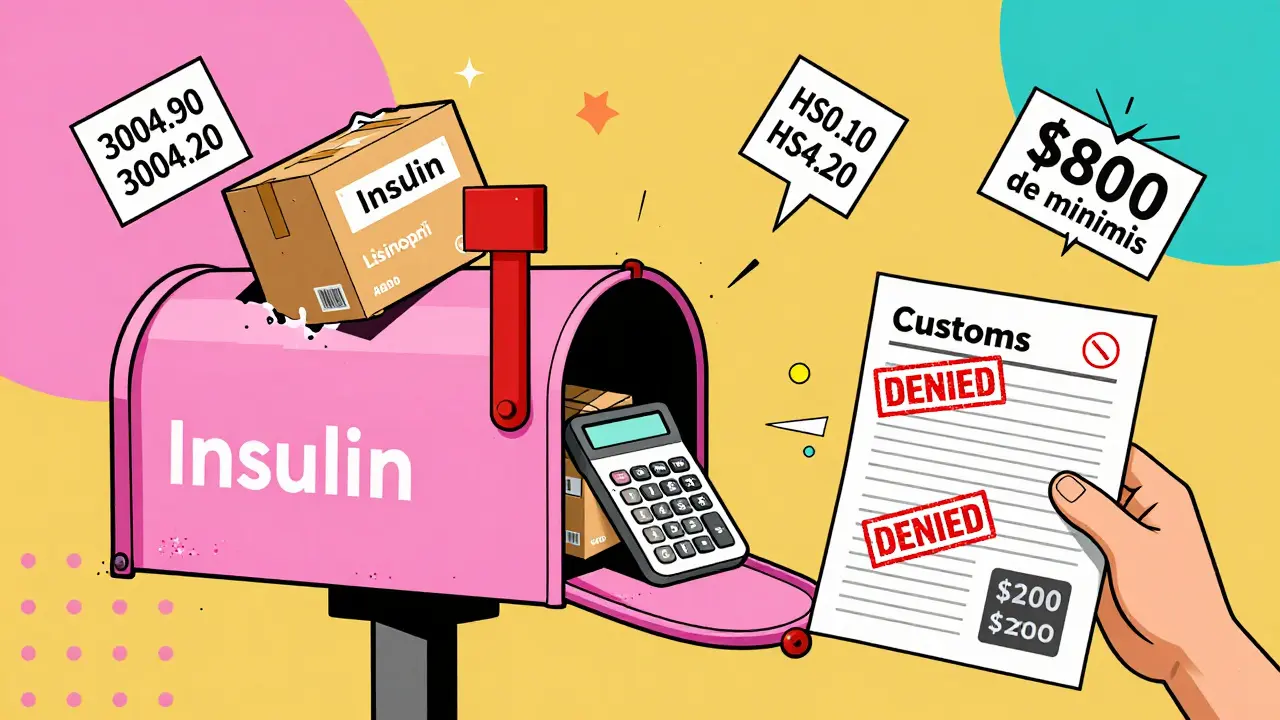
Buying medications from overseas used to be simple. For years, people in the U.S. could order prescription drugs from Canada, India, or the UK through the mail, pay a small fee, and have them delivered without paying any customs duty. That changed on August 29, 2025. The $800 de minimis threshold - the amount you could import duty-free - was eliminated for all commercial shipments. Now, if you’re ordering medication from abroad, you’re dealing with a completely new system. And if you don’t understand it, your package could be seized, fined, or never arrive.
What Changed in 2025?
Before August 2025, if you ordered a $60 bottle of blood pressure pills from a Canadian pharmacy, it came in without any extra fees. That’s because packages under $800 were considered "de minimis" - too small to tax. But on August 29, 2025, that rule vanished. Now, every commercial shipment entering the U.S. by mail, no matter how small, is subject to customs duties. The only exception? Private gifts under $100. That means if you’re buying meds from a foreign pharmacy, it’s no longer a gift. It’s a commercial import. And that triggers new rules.Two Ways Duties Are Collected - And Which One Matters for You
There are two methods for collecting duties right now, and you need to know the difference:- Method 1 (Ad Valorem): You pay a percentage of the item’s declared value. This rate varies by country and product type. For most prescription meds, it’s between 2% and 5%. So a $120 bottle of insulin might cost $3-$6 in duty.
- Method 2 (Flat Rate): A fixed fee based on the country’s tariff rate: $80 for low-tariff countries, $160 for medium, and $200 for high. This is where things get dangerous. If you order from a country with a 16%+ tariff rate - like some Asian suppliers - your $50 order could be hit with a $160 duty. That’s more than triple the cost of the meds.
Here’s the catch: Method 2 is only allowed until February 28, 2026. After that, only Method 1 is legal. So if you’re using a carrier that still offers Method 2, you’re playing with fire. Many international pharmacies still don’t understand this. They might quote you a "low price" but forget to tell you the duty could be $200. You’ll end up paying more than you would at a U.S. pharmacy.
HS Codes Are Now Mandatory - And They’re Tricky
Starting September 1, 2025, every international shipment must include a six-digit Harmonized System (HS) code. This isn’t just a formality. It determines the duty rate. For medications, the most common codes are:- 3004.90 - Other medicaments (most prescription pills)
- 3004.20 - Insulin and other hormones
- 3004.30 - Antibiotics
If the pharmacy uses the wrong code - say, they label your insulin as "dietary supplement" - CBP can reclassify it and apply a 300% higher duty. One user reported their $80 insulin order was reclassified as a "cosmetic product" and hit with a $200 duty. That’s not a mistake. That’s a penalty.
Always ask your overseas pharmacy for the exact HS code on the commercial invoice. If they don’t know it, find another supplier.
Documents You Can’t Skip
You’re not just filling out a form. You’re creating a legal record. Missing documents = seized package. Here’s what you need:- Commercial Invoice: Must list the medication by its generic name, dosage, quantity, and manufacturer. No "vitamins," "supplements," or "health products." If it says "for personal use," it’s still commercial if you’re paying for it.
- Packing List: Matches the invoice. If the invoice says 30 pills and the box has 50, CBP will flag it.
- Prescription or Doctor’s Note: Not required by law, but highly recommended. If you’re importing controlled substances (like Adderall, Xanax, or opioids), you’ll be asked for proof it’s for personal use. Without it, your package is gone.
Don’t rely on the pharmacy to handle this. Many overseas sellers don’t know U.S. rules. Print your own invoice and send it to them to include. Use a template from the U.S. Customs and Border Protection website.
Who Pays the Duty? And Why It’s Your Problem
This is the biggest confusion. The carrier (USPS, DHL, etc.) doesn’t pay. The pharmacy doesn’t pay. You do. CBP will send you a notice - usually by mail or email - demanding payment before delivery. If you ignore it, your package gets destroyed or returned. Some carriers will pay the duty upfront and bill you later, but they add a 15-25% handling fee. That’s why some people end up paying $250 for a $75 medication.There’s no way around this. Even if you use a "trusted" pharmacy, you’re still the importer of record under U.S. law. That means you’re legally responsible. No exceptions.
What Carriers Still Work?
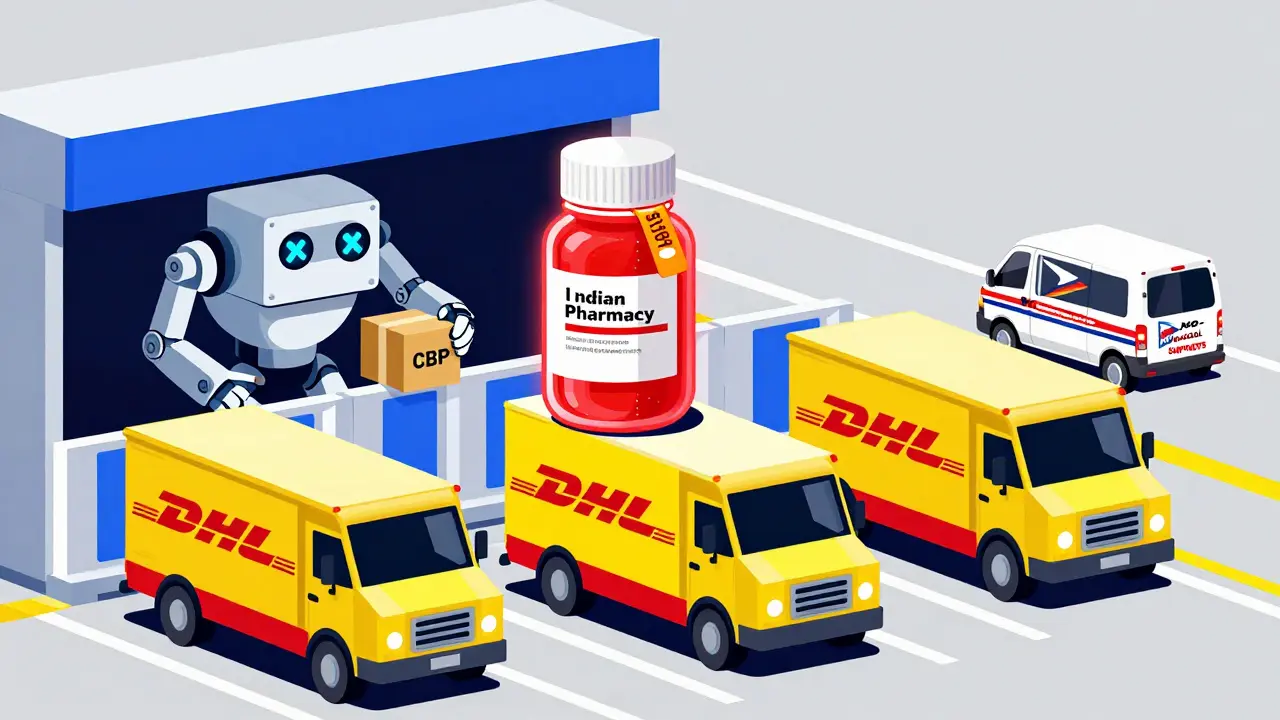
Deutsche Post, Canada Post, and many other national postal services stopped accepting business parcels to the U.S. after August 22, 2025. That means you can’t just drop off a package at your local post office and expect it to go through.Only three carriers are reliably handling commercial medication shipments now:
- DHL Express - Handles customs clearance automatically. Best for high-value or time-sensitive orders.
- FedEx International - Offers duty-paid options. You pay upfront, no surprises.
- UPS Worldwide Express - Similar to FedEx. Good for tracking and documentation.
USPS still delivers, but only if the shipment is pre-cleared by a bonded carrier. If you order from a small pharmacy that uses USPS, your package will sit in customs for weeks - if it gets through at all.
What Medications Are Still Allowed?
Not all meds are legal to import, even if you pay the duty. CBP allows personal use imports of non-controlled substances under these conditions:- Up to a 90-day supply
- For a condition diagnosed by a U.S. licensed physician
- Not a controlled substance (Schedule II-V drugs like opioids, stimulants, benzodiazepines)
- Not for resale
Controlled substances? Almost never allowed. Even if you have a foreign prescription, U.S. law doesn’t recognize it. You can’t legally import Adderall, Xanax, or Vicodin from overseas - no matter how much duty you pay.
Real Cost Comparison: U.S. vs. Overseas
Let’s say you need a 30-day supply of generic Lisinopril (blood pressure). Here’s what it costs now:| Source | Price | Duty (Method 1) | Shipping | Total |
|---|---|---|---|---|
| U.S. Pharmacy (with coupon) | $4 | $0 | $0 | $4 |
| Canadian Pharmacy (mail-order) | $12 | $0.60 | $8 | $20.60 |
| Indian Pharmacy (mail-order) | $5 | $0.25 | $12 | $17.25 |
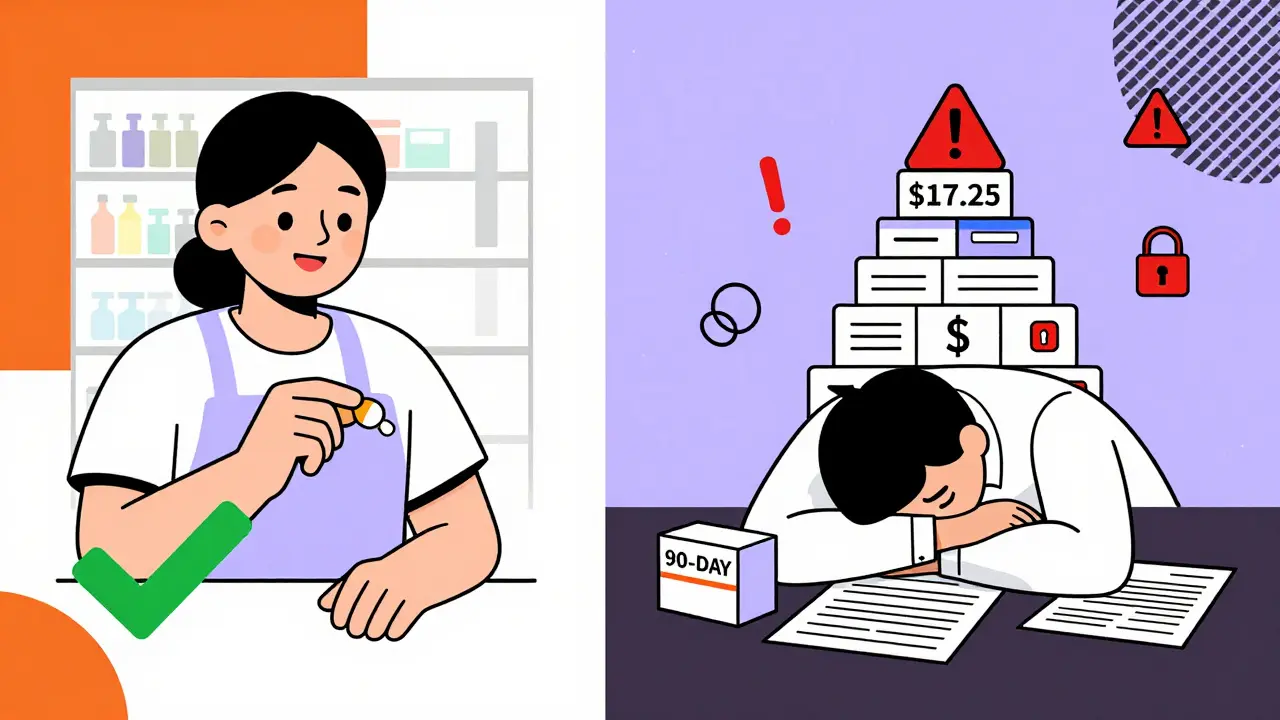
Even with low duties, shipping and handling make overseas orders barely cheaper - and far riskier. If your package gets held up for 6 weeks, you’re out of meds. In the U.S., you can get it in 24 hours.
When It’s Still Worth It
There are two cases where international mail-order still makes sense:- You need a medication that’s not available in the U.S. - like certain compounded hormones or rare generics from the EU.
- You’re buying a long-term supply (90+ days) of a non-controlled drug, and the savings are 50%+ after duty and shipping.
For most people, it’s not worth the hassle. The time, risk, and paperwork outweigh the savings.
Red Flags to Avoid
If a pharmacy does any of these, walk away:- Says "no prescription needed"
- Uses vague terms like "health supplement" or "dietary aid"
- Won’t provide an invoice with HS code
- Offers "free shipping" - that usually means they’re hiding the cost in the product price or won’t pay duties
- Asks you to lie on the customs form
These aren’t mistakes. They’re illegal. And you’re the one who gets punished.
What Happens If You Get Caught?
CBP doesn’t fine every person who imports a $20 pill. But they do:- Seize packages that violate the law
- Require payment of duties plus penalties (up to 3x the value)
- Flag your name for future inspections
- In rare cases, refer to the DEA if controlled substances are involved
You won’t go to jail for a single $50 order. But if you do it repeatedly, you become a target. And your next package? It won’t even make it to the border.
Bottom Line: Is It Still Worth It?
The short answer? For most people, no.The $800 de minimis rule made international medication shopping easy. Now, it’s a minefield. The savings are smaller. The risks are bigger. The paperwork is heavier. And the penalties are real.
If you’re considering it, ask yourself:
- Is this medication available in the U.S.?
- Can I get a discount through my pharmacy or insurance?
- Am I willing to pay $100+ in fees for a $30 drug?
- Can I afford to wait 6 weeks if it gets stuck in customs?
If you answered "no" to any of those, don’t risk it. Use your U.S. pharmacy. Ask about patient assistance programs. Talk to your doctor about generics. There are legal, safe, and cheaper ways to manage your meds - without crossing international borders.
Can I still order prescription meds from Canada?
Yes, but only if you pay customs duties. As of August 2025, all commercial shipments from Canada are subject to duty under Method 1 (a percentage of value). You must also have a valid prescription and a commercial invoice with the correct HS code (3004.90). USPS no longer accepts business parcels from Canada - use DHL Express or FedEx instead.
What if I order from India and the package gets seized?
If your package is seized, CBP will send you a notice explaining why and how to appeal. You’ll need to pay any owed duties and penalties to get it released - or forfeit it. If the medication is a controlled substance or lacks proper documentation, it will be destroyed. There’s no guarantee of return, even if you paid for it.
Are online pharmacies from Mexico legal?
No. Even though Mexico is close, U.S. law doesn’t allow personal importation of prescription drugs from Mexican online pharmacies unless they’re FDA-approved and shipped by a licensed U.S. pharmacy. Most Mexican sites are unregulated. Ordering from them violates the Federal Food, Drug, and Cosmetic Act. You risk fines, seizure, and potential DEA investigation if controlled substances are involved.
Do I need a U.S. prescription to order meds internationally?
Not legally required, but strongly recommended. CBP may ask for proof the medication is for personal use. Without a U.S. doctor’s note or prescription, your package is more likely to be held or seized. A foreign prescription is not recognized under U.S. law.
Can I use a forwarding service to avoid duties?
No. Using a forwarding service doesn’t change your legal status as the importer. CBP sees the original sender and final recipient. If the shipment is commercial, duties apply regardless of routing. Forwarding services that claim to "hide" the origin are violating customs law - and you’re liable.

13 Comments
lisa Bajram
January 8, 2026 AT 21:23Okay, but let’s be real - if your insulin costs $4 at CVS with a coupon, why are you even scrolling through Indian pharmacies? 😅 I get it, we’re all broke, but this whole system is designed to scare you off. And honestly? It’s working.
Paul Bear
January 10, 2026 AT 14:24Actually, the de minimis elimination was codified under Section 321 of the Tariff Act of 1930, as amended by the Trade Facilitation and Trade Enforcement Act of 2015 - the 2025 change was just the enforcement trigger. You're not 'being punished' - you're being subject to existing statutory authority that was previously waived administratively. Stop treating regulatory compliance like a moral failing.
neeraj maor
January 11, 2026 AT 06:46They’re lying. The whole ‘duty system’ is just a backdoor for Big Pharma to crush competition. You think Canada and India are charging you $12 for insulin because they’re nice? No - they’re selling it cheap because the U.S. government won’t regulate pricing. Now they’re using customs to make you pay twice. This isn’t policy - it’s corporate collusion. CBP? Just the muscle for the pharma lobby. Don’t be fooled.
Jaqueline santos bau
January 11, 2026 AT 07:03Wait - so if I order my Adderall from India and it gets seized… I’m not just out $50, I’m also flagged by the DEA?! Like… for life?! I’m not even a drug addict, I just have ADHD and my insurance won’t cover it - is that a crime now?! My therapist cried when I told her I might have to stop. I’m not a criminal, I’m just tired.
Dwayne Dickson
January 11, 2026 AT 18:31Let me get this straight: you’re willing to risk a 300% duty hike, potential DEA attention, and a 6-week customs delay… to save $15 on a bottle of lisinopril? The real tragedy isn’t the policy - it’s that we’ve normalized this level of financial desperation. You’re not saving money. You’re paying in anxiety.
Ritwik Bose
January 12, 2026 AT 04:54Respectfully, I appreciate the thorough breakdown. 🙏 As someone from India, I see how our pharmacies are caught between global regulations and local realities. Many are genuinely trying to help, but lack the legal infrastructure. Perhaps the solution isn’t to ban imports, but to create a certified international pharmacy registry - with U.S. oversight. That way, safety and access coexist. 🌍💊
chandra tan
January 12, 2026 AT 06:21My cousin in Mumbai orders his blood pressure meds from a clinic in Chennai - $3 for 30 pills. He ships it via DHL, pays $5 duty, gets it in 10 days. No drama. No forms. He just prints the invoice and writes ‘personal use’ on the box. Works every time. Maybe the system’s not broken - maybe you’re just overthinking it.
Ted Conerly
January 12, 2026 AT 06:44Hey - if you’re even considering this, start with your doctor. Ask for samples. Ask about patient assistance programs. Ask if they can write a letter to your insurer. There are *real* solutions that don’t involve customs forms and risk. You’re not alone. We’ve all been there. But you don’t have to risk it all for $12.
Saumya Roy Chaudhuri
January 12, 2026 AT 11:29THIS IS A WAR. They don’t want you to buy cheap meds because then they can’t charge $1,000 for a pill that costs $0.10 to make. The HS code? The duty? The ‘commercial shipment’ label? All smoke and mirrors. The real crime is that we let them get away with this for 20 years. Now they’re locking the door - but the medicine is still there. You just have to be smarter.
Mario Bros
January 14, 2026 AT 02:46Just ordered my 90-day supply of metformin from a verified Canadian pharmacy via FedEx. Paid $18 total. Took 8 days. No issues. No drama. Just a plain invoice with HS code 3004.90. If you do your homework, it’s not that hard. Don’t listen to the fear-mongers - just be precise.
Aurora Memo
January 14, 2026 AT 03:01For anyone feeling overwhelmed - you’re not failing. The system is broken. But you’re not alone. I’ve helped three friends navigate this process. Start with the CBP’s ‘Personal Importation’ page. Print everything. Keep copies. And if you’re nervous, ask your pharmacist for help - most will walk you through it. You deserve care. You don’t need to be a customs expert to get it.
anthony martinez
January 15, 2026 AT 22:10So… if I order from India, pay the duty, and get my meds - but don’t declare them on my taxes… is that a felony? Or just a misdemeanor? Asking for a friend who’s also broke and tired.
Faith Edwards
January 17, 2026 AT 03:28It’s not about the $4 insulin. It’s about principle. If we allow unregulated, unverified pharmaceutical imports - even for ‘personal use’ - we’re normalizing the erosion of the FDA’s authority. That’s not ‘freedom.’ That’s public health negligence. If you want cheap medicine, vote for policy change - don’t exploit a loophole that endangers everyone else.