
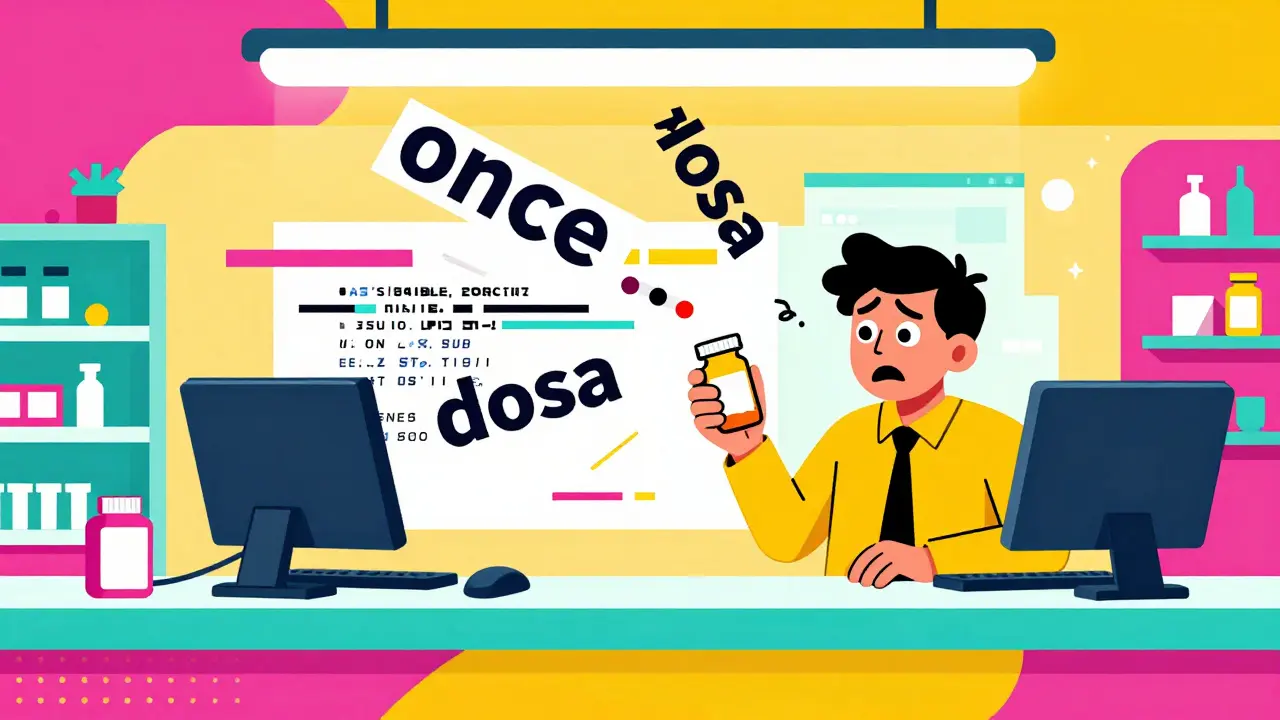
Getting your prescription filled should be simple: pick up your medicine, read the label, and take it as directed. But for millions of Americans who don’t speak English fluently, that simple step can turn into a dangerous guessing game. Prescription label translation errors are not rare mistakes-they’re life-threatening risks that happen every day in pharmacies across the country.
Imagine this: your doctor tells you to take one pill once a day. The label in Spanish says "tome una pastilla once al día." Sounds right? Not if "once" was translated by a computer. In Spanish, "once" means "eleven." So instead of taking one pill daily, you might be taking eleven. That’s not a typo. That’s a common error from automated translation systems used by most pharmacies.
How Bad Are Translation Errors Really?
A 2010 study in the journal Pediatrics looked at 286 pharmacies in the Bronx, where nearly half the population speaks Spanish. What they found was shocking: 86% of Spanish-language labels were generated by computer programs. Only 3% used professional interpreters. Half of all those labels had mistakes. Some were minor. Others? Deadly.
False cognates are the biggest problem. Words that look similar in English and Spanish but mean completely different things. "Once" as in "one time" becomes "eleven." "Dose" becomes "dosa" (which sounds like "dose" but in Spanish slang can mean "a hit" of drugs). "Take with food" might be mistranslated as "take with drink," leading someone to swallow pills on an empty stomach and risk stomach bleeding.
Even more confusing? The same English phrase can be translated five different ways depending on which pharmacy you go to. One CVS might say "take two tablets twice daily," another Walgreens might say "take two tablets two times per day." Both mean the same thing in English-but in Spanish, they use different grammar, vocabulary, or regional terms. A patient switching pharmacies doesn’t know if they’re getting the same medicine or something completely different.
Why Do These Errors Keep Happening?
Most pharmacies use cheap, automated translation tools because they’re fast and cheap. A computer system might cost $0.02 per label. A professional human translator? $0.25. For a pharmacy filling thousands of prescriptions a day, the math is simple: save money now, risk lives later.
But here’s the catch: medical language isn’t like translating a menu or a weather report. It’s high-stakes. "Take on an empty stomach" isn’t just about comfort-it’s about absorption. "Take at bedtime" isn’t a suggestion-it’s about circadian rhythms and drug effectiveness. These nuances get lost in machine translation.
And it’s not just Spanish. For Chinese, Vietnamese, Arabic, or Russian speakers, translation services are even scarcer. Only 23% of major pharmacy chains offer labels in languages other than English and Spanish. That means if you speak Tagalog or Korean, you’re often left with no label at all-or a badly translated one.
Real People, Real Consequences
Reddit threads, patient forums, and hospital reports are full of stories:
- A grandmother took her heart medication "twice weekly" instead of "twice daily" because the label said "dos veces semanal" instead of "dos veces diario." She ended up in the ER with dangerously low blood pressure.
- A father gave his child the wrong dose of antibiotics because the label said "una vez" (once) but the system translated it as "once" (eleven). The child got sick for weeks.
- A man with diabetes took insulin at the wrong time because "before meals" was translated as "after meals." His blood sugar crashed.
A 2023 survey by the National Health Law Program found that 63% of limited English proficient patients felt confused about their medication instructions. Nearly 3 in 10 admitted they’d taken the wrong dose because of translation errors.
Which States Are Doing Something About It?
Only two states have laws requiring accurate, professional translation of prescription labels: California and New York.
California passed Senate Bill 853 in 2016. Since then, pharmacies there must use certified medical translators-not machines-and verify translations with a second professional. The results? A 32% drop in medication errors among Spanish-speaking patients. ER visits for drug-related issues fell by 27%.
New York followed with Local Law 30 in 2010. But outside those two states? Nothing. Most pharmacies operate under no legal requirement to provide accurate translations. That means if you live in Texas, Florida, or Ohio, you’re at the mercy of whatever system your pharmacy uses.
How to Get Help Right Now
You don’t have to wait for the system to fix itself. Here’s what you can do today:
- Ask for a human translator-not a machine. Say: "Can I speak with a certified medical interpreter?" Most pharmacies have access to phone or video interpreters, even if they don’t offer printed labels.
- Request a bilingual pharmacist. Some chains like Walgreens and Kaiser Permanente have pharmacists who speak Spanish, Mandarin, or Vietnamese. Ask if one is available.
- Bring a trusted friend or family member who speaks both languages. Have them double-check the label with the pharmacist. Don’t assume they’ll explain it to you.
- Use free translation tools wisely. Apps like Google Translate can help-but only if you use them to check, not to replace professional advice. Type the English label into the app, then compare it to the printed version. If something looks off (like "once"), ask about it.
- Call your doctor. If the label doesn’t make sense, call your prescriber. Ask them to confirm the dosage, frequency, and instructions in writing.
Some pharmacies, like Kaiser Permanente and select Walgreens locations, now offer labels with QR codes. Scan it with your phone and hear a voice recording of the instructions in your language. Ask if your pharmacy offers something like that.
What’s Being Done to Fix This?
Change is coming-but slowly. The FDA released new draft guidance in January 2024 pushing for plain language on labels to make translation easier. Walgreens launched MedTranslate AI in late 2023, cutting errors by 63% in test locations. CVS rolled out LanguageBridge in early 2024, combining AI with pharmacist verification.
The federal government is stepping in too. In March 2024, the HHS launched a $25 million grant program to help pharmacies pay for professional translation services. Seventeen states are now considering laws like California’s.
But here’s the truth: technology alone won’t fix this. AI can’t understand cultural context. A machine doesn’t know that in some Latin American communities, "alcohol" on a label means "rubbing alcohol," not "drinking alcohol." Only a trained human translator can catch that.
What You Can Do to Push for Change
If you’re frustrated with translation errors, speak up:
- File a complaint with your state’s pharmacy board. Most have online forms.
- Ask your pharmacy to adopt certified translation services. If enough people ask, they’ll listen.
- Share your story. Talk to local media. Post on social media. #PrescriptionTranslationMatters.
Every time you ask for help, you’re not just protecting yourself-you’re helping someone else down the line. Because this isn’t about language. It’s about safety. And no one should risk their life because a computer got a word wrong.
