
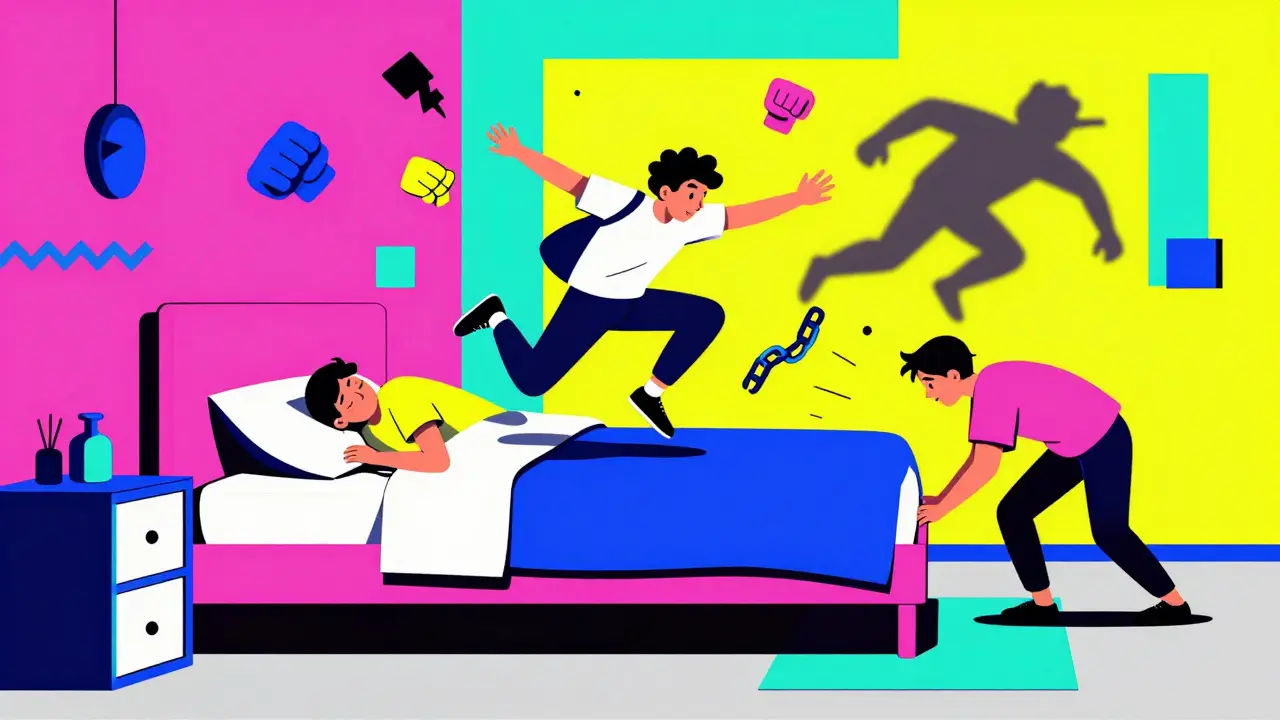
Imagine sleeping peacefully, only to wake up bruised, with your partner bleeding from a punch you don’t remember throwing. Or finding yourself on the floor after leaping out of bed during a vivid dream. This isn’t a nightmare-it’s REM sleep behavior disorder (RBD), a real and dangerous condition that turns sleep into a battlefield.
RBD isn’t just about acting out dreams. It’s a neurological red flag. People with RBD lose the natural muscle paralysis that happens during REM sleep, the stage where most dreaming occurs. Instead of lying still, they kick, shout, punch, or even jump out of bed. These behaviors aren’t random. They match the content of their dreams-being chased, fighting off attackers, or defending themselves. And the worst part? This isn’t just a sleep problem. For most people, RBD is the earliest sign of something far more serious: Parkinson’s disease, dementia with Lewy bodies, or multiple system atrophy.
How RBD Is Diagnosed: More Than Just a Sleep Study
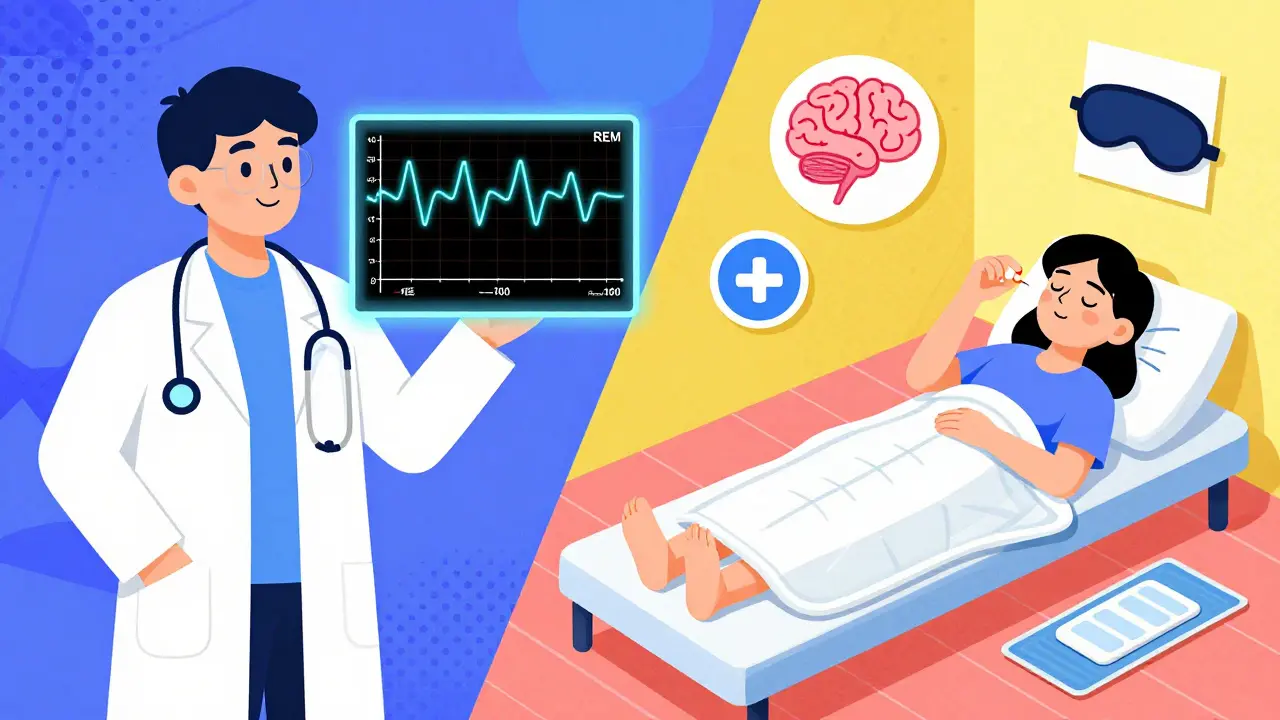
Diagnosing RBD isn’t about guessing. It requires a full overnight sleep study called polysomnography (PSG). This test tracks brain waves, eye movements, heart rate, breathing, and muscle activity. The key finding? REM sleep without atonia (RSWA). That’s medical jargon for: your muscles are active during REM sleep when they should be completely turned off.
The International Classification of Sleep Disorders says RSWA must show up in at least 15% of REM sleep epochs. In practice, that means doctors see clear spikes in muscle tone on the EMG (electromyogram) trace during REM. On average, patients have about 4.2 episodes of abnormal movement per hour. That’s more than one every 15 minutes.
But PSG alone isn’t enough. Doctors also look for:
- History of dream enactment (confirmed by a bed partner)
- No seizures or other neurological conditions that could explain the behavior
- Exclusion of substance use or other sleep disorders like sleep apnea
Many patients are misdiagnosed for years. Some are told they’re just having bad dreams. Others are labeled as having night terrors or PTSD. But RBD is distinct. It happens only during REM sleep, not in deep sleep. And unlike night terrors, people with RBD usually remember their dreams clearly when they wake up.
First-Line Medications: Melatonin vs. Clonazepam
There are no FDA-approved drugs specifically for RBD. That means treatment is off-label. But two medications have become the go-to options: melatonin and clonazepam.
Melatonin is the safer choice, especially for older adults. It’s a natural hormone your body makes to regulate sleep. In RBD, it helps restore muscle paralysis during REM sleep. The standard starting dose is 3 mg at bedtime. Most people need to increase it slowly-6 mg, then 9 mg, up to 12 mg-waiting 2 to 4 weeks at each level to see if it helps. About 65% of patients respond well. Side effects are mild: occasional morning grogginess or headaches. One 68-year-old man in a Cleveland Clinic case study went from 7 episodes a week to just 1 after starting 6 mg nightly. His only complaint? A few days of mild drowsiness that faded.
Clonazepam, a benzodiazepine, has been used for decades. It’s more potent. Studies show it reduces symptoms in 80-90% of patients. A 2000 study found 88.7% effectiveness. The typical dose starts at 0.25-0.5 mg at bedtime, with a max of 2 mg. Many patients see improvement within a week.
But here’s the catch: clonazepam carries risks. It can cause dizziness (22% of users), unsteadiness (18%), and daytime sleepiness (15%). For older people, the danger of falls increases by 34%. One patient stopped clonazepam after 3 months because his falls went from zero to two per month. Long-term use can lead to tolerance-needing higher doses-or dependence. Abruptly stopping it can trigger severe nightmares or agitation in 38% of cases.
That’s why many neurologists now start with melatonin. A 2022 survey of 450 neurologists found 58% choose melatonin first. Only 32% start with clonazepam. Combination therapy is used in 10% of cases.
Other Medications: What Else Works?
Not everyone responds to melatonin or clonazepam. For those patients, other options exist, though evidence is weaker.
Pramipexole, a dopamine agonist used for Parkinson’s and restless legs syndrome, helps some RBD patients-especially those with RLS too. But studies show mixed results. One 2006 trial found it worked in only 60% of idiopathic RBD cases. It’s usually dosed at 0.125-0.5 mg daily. Side effects include nausea, dizziness, and impulse control issues.
Rivastigmine, a cholinesterase inhibitor used for dementia, showed promise in one small trial for patients with RBD and mild cognitive impairment who didn’t respond to other treatments. It reduced dream enactment frequency, but it’s not a standard option due to lack of large-scale data.
And then there’s the new frontier: dual orexin receptor antagonists. Orexin is a brain chemical that helps keep you awake. Blocking its receptors-especially orexin-2-may calm the overactive brain circuits in RBD. Mount Sinai research in October 2023 showed a 78% reduction in dream enactment behaviors in animal models. The drug suvorexant (Belsomra), already approved for insomnia, is being tested for RBD. Neurocrine Biosciences’ NBI-1117568, a selective orexin-2 blocker, received FDA Fast Track designation in January 2023. Phase II trials are underway, with results expected in 2024. If they pan out, this could be the first targeted RBD treatment.
Neurological Assessment: Why It Matters More Than You Think
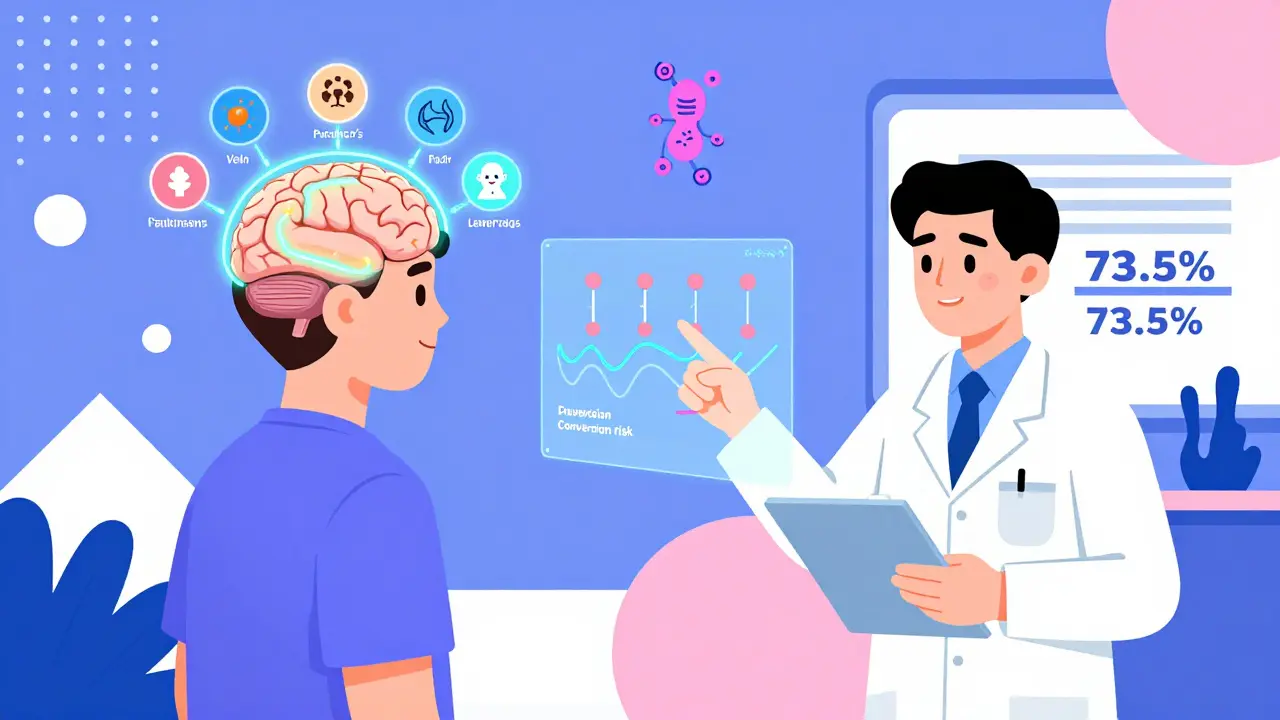
RBD isn’t just a sleep disorder. It’s a warning sign. About 73.5% of people with idiopathic RBD (meaning no known cause) will develop a neurodegenerative disease within 12 years. That’s not a small risk-it’s the majority.
That’s why every RBD patient needs regular neurological checkups. The American Academy of Neurology recommends annual exams. These aren’t just about checking reflexes. They look for early signs of Parkinson’s: subtle tremors, reduced arm swing while walking, stiff muscles, or changes in smell (hyposmia). Brain imaging, like DaTscan, may show dopamine transporter loss, a sign of upcoming Parkinson’s.
One study found a 6.3% annual conversion rate to neurodegenerative disease. That means if you have RBD, your risk of developing Parkinson’s or dementia each year is over 6%. Over 10 years, that adds up to more than half the population.
Doctors now treat RBD as a prodromal stage-meaning it comes before full disease. That changes everything. Instead of just managing symptoms, the goal becomes early detection and, someday, prevention.
Safety First: Protecting Yourself and Your Partner
Medication helps, but safety measures are non-negotiable. Even with treatment, 78% of patients still need to modify their sleeping environment.
Here’s what works:
- Remove all weapons from the bedroom
- Pad sharp corners of furniture
- Place thick rugs or mats beside the bed
- Install bed rails or sleep on a mattress on the floor
- Keep the bedroom clear of clutter
Alcohol is a major trigger. Even one or two drinks can double the risk of an episode. Many patients report dramatic improvement after quitting alcohol entirely.
Some couples eventually sleep apart. The American Brain Foundation reports 42% of RBD patients end up in separate rooms, even with medication. That’s not failure-it’s survival. One spouse said, “After my husband started 0.5 mg clonazepam, I could finally sleep in the same bed without fear of being kicked or punched.” That’s the goal: safety, peace, and rest.
What’s Next? The Future of RBD Treatment
The global RBD market is growing fast-$1.2 billion in 2023, projected to hit $1.8 billion by 2030. Why? Because awareness is rising. Diagnosis rates jumped 217% between 2010 and 2020. More people are getting tested. More neurologists are asking about sleep.
But the real breakthrough won’t come from better sleep meds. It will come from stopping the brain from degenerating. Right now, we treat symptoms. In the next 5-10 years, we may treat the root cause.
Researchers are exploring whether early intervention-like starting dopamine-enhancing drugs or immune-modulating therapies-can delay or prevent Parkinson’s in RBD patients. The hope is that by the time symptoms like tremors or memory loss appear, we’ve already slowed the disease.
For now, the best advice is simple: If you or your partner are acting out dreams during sleep, get evaluated. Don’t wait. Don’t assume it’s just stress or bad dreams. See a sleep specialist. Get a PSG. Start treatment. Make your bedroom safe. And keep up with neurological checkups. You’re not just sleeping better-you’re protecting your future brain.
Can REM sleep behavior disorder be cured?
There is no cure for RBD yet. But symptoms can be effectively managed in most cases with medication and safety measures. For many, melatonin or clonazepam reduces episodes by 70-90%. The bigger challenge is that RBD often signals an underlying neurodegenerative disease like Parkinson’s. While we can’t stop that progression yet, early detection gives patients more time to plan and access emerging therapies.
Is RBD always linked to Parkinson’s disease?
No, but it’s strongly linked. About 90% of RBD cases are connected to synucleinopathies-Parkinson’s, dementia with Lewy bodies, or multiple system atrophy. About 10% of cases are idiopathic (no known cause) or linked to other conditions like narcolepsy or certain medications. Still, even idiopathic RBD has a very high chance of turning into a neurodegenerative disease over time. That’s why all RBD patients should be monitored long-term.
How long does it take for melatonin to work for RBD?
Melatonin doesn’t work overnight. Most patients need 2 to 4 weeks at a single dose before seeing improvement. It’s common to start at 3 mg, wait 3 weeks, then increase to 6 mg, wait again, and so on up to 12 mg. Some patients respond at 6 mg. Others need the full 12 mg. Patience is key. Unlike clonazepam, which can work in days, melatonin builds up slowly and works by restoring natural sleep regulation.
Can I stop taking clonazepam if I feel better?
Never stop clonazepam suddenly. Abrupt discontinuation can cause rebound nightmares, anxiety, agitation, or even seizures. If you want to stop, work with your doctor to taper slowly-usually by reducing the dose by 0.125 mg every 1-2 weeks. Some patients stay on low doses long-term because the risk of returning symptoms is high. The goal isn’t to stop the medication if it’s working safely, but to find the lowest effective dose.
Are there any new drugs on the horizon for RBD?
Yes. The most promising is NBI-1117568, a selective orexin-2 receptor antagonist from Neurocrine Biosciences. It received FDA Fast Track status in January 2023 and is in Phase II trials, with results expected in 2024. Another drug, suvorexant (Belsomra), already approved for insomnia, has shown strong results in preclinical models. These drugs target the brain’s wake-sleep switch differently than melatonin or clonazepam, potentially offering better safety and fewer side effects. If trials succeed, they could become first-line treatments within the next 5 years.

15 Comments
Daniel Dover
February 16, 2026 AT 08:45This is terrifying. I never realized acting out dreams could be a sign of Parkinson's. My dad did this for years. We thought it was stress.
Charlotte Dacre
February 17, 2026 AT 08:13So let me get this straight - we have a drug that works 90% of the time but is basically a sedative with fall risks, and the ‘safer’ option is a supplement that takes months to work? Welcome to medicine.
Kaye Alcaraz
February 18, 2026 AT 16:29If you or someone you love is experiencing this, please don’t ignore it. Early intervention changes everything. I’ve seen families go from panic to peace with just a PSG and some melatonin. You’re not alone.
Chiruvella Pardha Krishna
February 20, 2026 AT 14:39The human mind, a cathedral of electrochemical whispers, where the veil between dream and deed thins - and in that thinning, we glimpse the slow unraveling of the self. RBD is not merely a disorder. It is the soul’s first whisper of mortality.
Mandeep Singh
February 20, 2026 AT 19:59You people are so obsessed with Western medicine. In India, we’ve been treating this with ashwagandha and yoga for centuries. Why do you need fancy drugs when your body has its own wisdom? This is why your healthcare costs are insane.
Josiah Demara
February 22, 2026 AT 19:01Let’s be real - melatonin is just a glorified vitamin. Clonazepam is a benzodiazepine. Both are band-aids on a hemorrhage. The real story? This is early Parkinson’s. And the medical system is still treating it like a sleep issue instead of a neurodegenerative emergency. We’re decades behind.
Erica Banatao Darilag
February 24, 2026 AT 11:37i just found out my husband has this. we’ve been sleeping in separate rooms for 2 years. i didn’t know it was a thing. i thought he was just having bad dreams. thank you for explaining this so clearly. i’m going to make an appt for him tomorrow.
Esha Pathak
February 24, 2026 AT 14:09The body dreams before the mind remembers. RBD is the universe’s way of saying: your brain is already gone. You just haven’t noticed yet. 😔
Mike Hammer
February 25, 2026 AT 05:45My cousin had this. He started on 3mg melatonin. Took 6 weeks. Then 6mg. Then 9mg. Finally, at 12mg, he stopped punching the wall. Now he sleeps like a baby. No clonazepam. No falls. Just patience and a really thick mattress. Seriously, try the melatonin route first.
Joe Grushkin
February 26, 2026 AT 00:27The fact that we’re still using off-label drugs for a condition that predicts neurodegeneration is a scandal. This isn’t ‘treatment.’ It’s triage. We’re buying time while the system ignores the elephant in the room - we’re failing to prevent the disease, only managing its symptoms.
Virginia Kimball
February 27, 2026 AT 00:35I’m so glad this got attention. My mom was misdiagnosed for 7 years. They thought it was PTSD. Then a sleep specialist caught it. Now she’s on 9mg melatonin and sleeps like a angel. We’ve padded the floor. Removed the lamps. It’s not glamorous - but it’s life-saving. You’re not crazy. You’re not lazy. You’re just sick. And there’s help.
Kapil Verma
February 28, 2026 AT 04:12In India, we don’t need your fancy sleep labs. We have gurus who chant mantras over the bed. The soul is not a machine to be scanned. Your Western obsession with data is why your people are broken. Sleep is sacred. Don’t reduce it to electrodes.
Michael Page
March 1, 2026 AT 02:39The dopamine hypothesis is too simplistic. RBD isn’t just about motor control. It’s about the collapse of the self’s narrative boundaries. The dreamer becomes the actor. The actor becomes the threat. The brain forgets it’s dreaming. That’s not a neurotransmitter imbalance. That’s ontological erosion.
Betty Kirby
March 2, 2026 AT 12:45I work in neurology. I’ve seen 47 RBD cases. 42 of them developed Parkinson’s or Lewy body dementia within 10 years. This isn’t ‘maybe.’ It’s ‘when.’ And yet, most neurologists still don’t screen for it. We’re not just late. We’re negligent.
Sarah Barrett
March 3, 2026 AT 04:49I’m a sleep specialist. The data is clear: melatonin first. Clonazepam second. Orexin antagonists are the future. But the real win? Early diagnosis. If you’re 55 and your partner says you’ve been kicking in your sleep for a year - get tested. Don’t wait for tremors. Don’t wait for memory loss. The window for prevention is narrow - but it exists.