
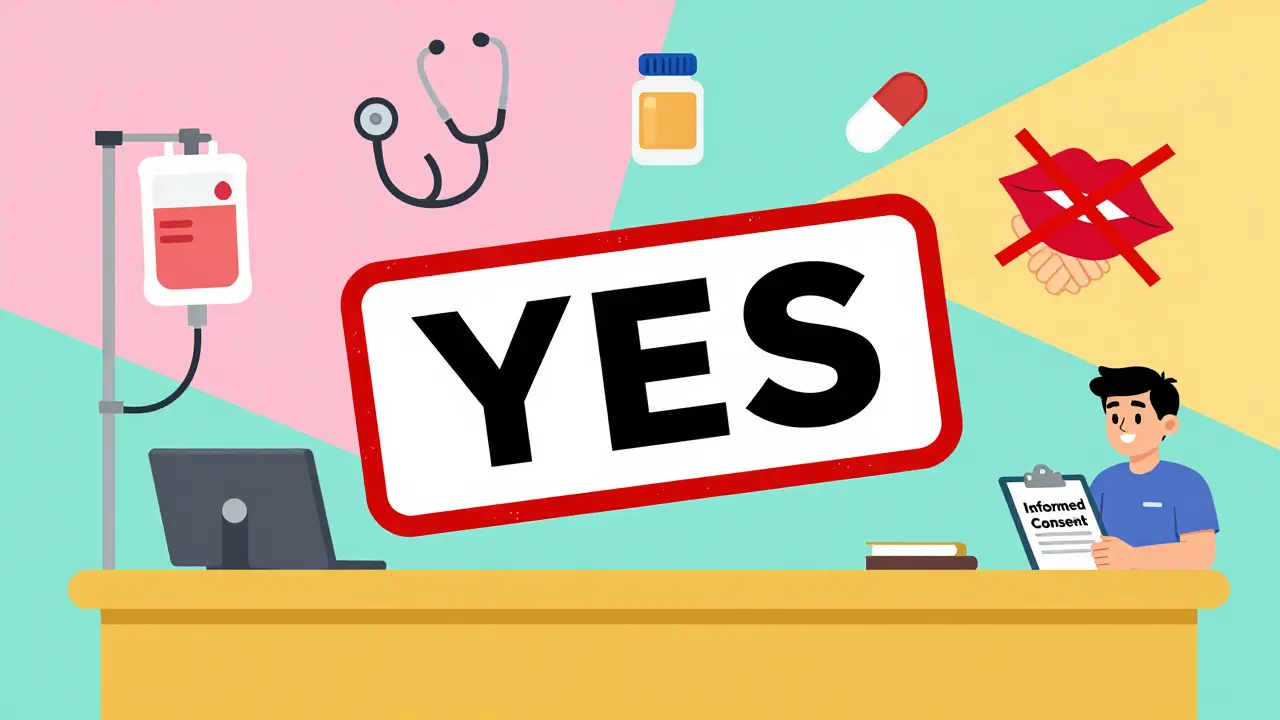
There’s a lot of confusion online about affirmative consent and medical decisions. You might have heard the term in the context of campus policies or #MeToo discussions, and now you’re wondering: does it apply when a doctor needs to make a treatment decision for someone who can’t speak for themselves? The short answer is no. Affirmative consent laws don’t govern medical substitution. They were never meant to.
What affirmative consent laws actually cover
Affirmative consent laws - like California’s Education Code Section 67386 or New York’s Campus Sexual Violence Elimination Act - are designed for sexual activity. They require clear, ongoing, voluntary agreement between people before and during any sexual act. It’s not enough to just not say no. You need an active, enthusiastic yes. This standard was created to combat sexual assault, especially in college settings where power imbalances and intoxication often blur boundaries. These laws are specific to sexual contexts. They don’t apply to signing a surgery form, choosing a medication, or deciding whether to receive dialysis. The language is different, the intent is different, and the legal framework is completely separate.How medical consent really works
When a patient can’t make their own medical decisions - because they’re unconscious, severely confused from dementia, or under sedation - the system doesn’t switch to an affirmative consent model. Instead, it uses informed consent and substituted judgment. Informed consent means the doctor explains everything: what’s wrong, what the treatment does, what the risks and alternatives are, and what happens if you do nothing. The patient then agrees, usually by signing a form. This is standard practice for every surgery, chemotherapy session, or even a simple blood draw. But when the patient can’t understand or communicate? That’s where substituted judgment comes in.Substituted judgment: the real legal standard for medical substitution
Substituted judgment isn’t about asking a family member what they think is best. It’s about asking: What would this patient have chosen if they could speak? Let’s say a 72-year-old woman with advanced Alzheimer’s suddenly has a heart attack. She never signed an advance directive. Her daughter is named as her legal surrogate. The doctors ask her: Did she ever say she didn’t want to be kept alive on machines? Did she talk about not wanting a feeding tube? What did she believe about quality of life? The surrogate’s job isn’t to decide what she thinks is right. It’s to remember the patient’s values. If the woman once told her daughter, “I don’t want to live hooked up to tubes if I can’t talk to my grandkids,” then the daughter should act on that. This isn’t guesswork. Courts and medical boards require surrogates to rely on documented wishes - like living wills, videos, emails, or even consistent verbal statements made over years. If no clear wishes exist, then the decision shifts to best interest - what a reasonable person would choose under those circumstances.
Why affirmative consent doesn’t fit in medicine
Imagine if doctors had to ask for affirmative consent every time they changed a patient’s IV bag or turned them in bed. “Are you okay with me adjusting your pillow now?” “Do you still consent to this antibiotic?” “Is this still a yes?” It would be impossible. In emergencies, patients are unconscious. In dementia, they forget what’s happening five minutes ago. In pain, they can’t articulate a clear yes or no. Medical care can’t wait for ongoing verbal affirmation. It needs predictability, legal clarity, and respect for past wishes. That’s why the American Medical Association explicitly says in its 2023 ethics guidance: “Physicians should not apply sexual consent standards to medical decision-making.” Doing so would delay care, confuse families, and create legal chaos.What you can actually do to prepare
If you want to make sure your medical wishes are followed - whether you’re 25 or 75 - here’s what works:- Write an advance healthcare directive - this is a legal document that names your decision-maker and states your treatment preferences.
- Have conversations with your family. Don’t assume they know what you’d want. Say it out loud: “If I can’t speak, I don’t want to be on a ventilator.”
- Give a copy to your doctor, your lawyer, and your main family member.
- Update it every few years or after a major health change.
What happens if you don’t plan ahead?
Without a directive, the law steps in. Most states and territories have a hierarchy: spouse, adult children, parents, then siblings. But without clear guidance, disagreements happen. A daughter might want to try everything. A son might believe Mom would have said no. Courts sometimes have to get involved - and that takes months. In 2022, a case in Melbourne went to court because two siblings couldn’t agree on whether to remove a feeding tube from their mother with late-stage dementia. No advance directive existed. The judge had to rely on old hospital notes and testimony from neighbors about what she used to say. It was messy. It was expensive. And it was avoidable.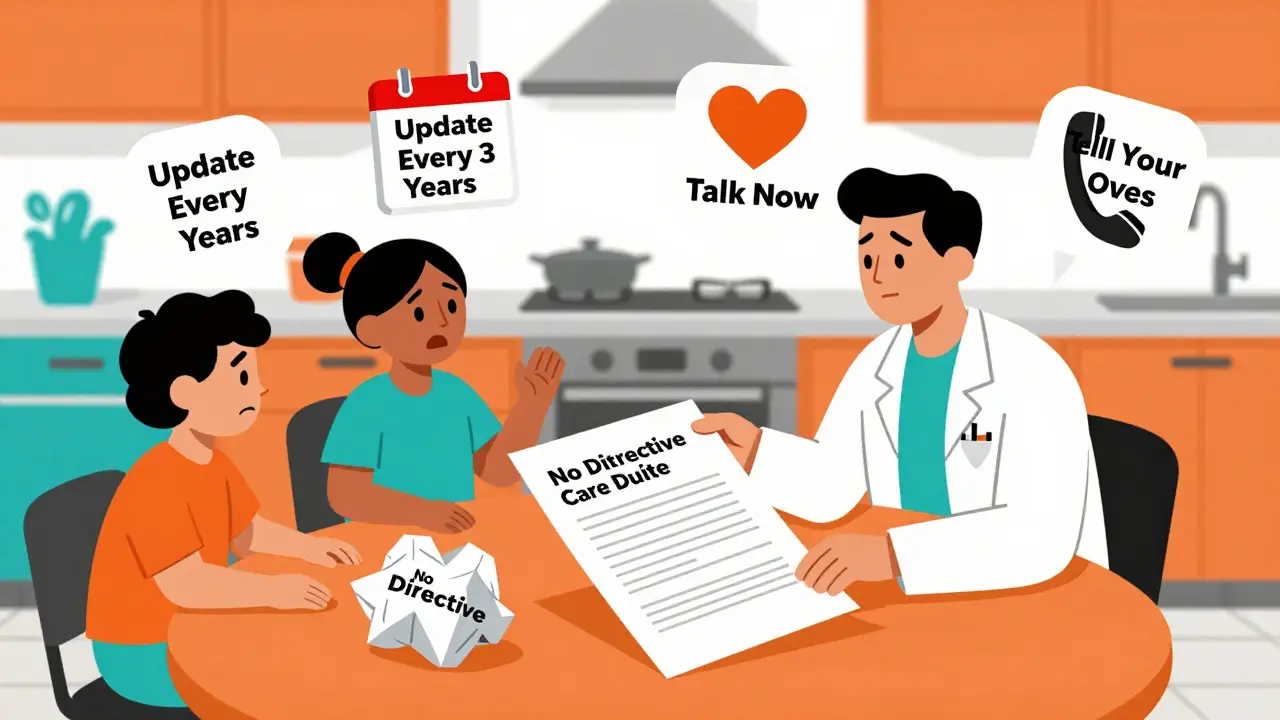
Common myths about medical consent
- Myth: A spouse can automatically make all medical decisions.
Truth: Only if you’ve named them in writing or if they’re next in line under state law. Even then, they must follow your known wishes, not their own. - Myth: If you’re unconscious, doctors can do anything to save you.
Truth: They must still follow your documented preferences. If you’ve said no to CPR, they can’t do it - even if you’re unconscious. - Myth: Affirmative consent means you have to say yes out loud every time.
Truth: That’s only true for sex. In medicine, your signature on a form, your past statements, or your living will are your consent.
What’s changing - and what’s not
In 2023, California’s courts reinforced the separation between sexual and medical consent in the case Doe v. Smith. The ruling was clear: affirmative consent laws under Title IX and education codes apply only to sexual misconduct. They don’t touch medical decision-making. Meanwhile, medical systems are getting better at advance care planning. Hospitals now routinely ask patients: “Have you thought about what you’d want if you couldn’t speak?” And more people are signing directives - especially after the pandemic. But the confusion? It’s still everywhere. A 2023 survey at the University of Colorado Denver found 78% of undergrads mixed up sexual and medical consent rules. Medical students on Reddit still ask: “Is affirmative consent the same as informed consent?” And the answer is still no.Bottom line
Affirmative consent is about preventing sexual assault. It’s not a medical tool. If you want to control your care when you can’t speak, you need an advance directive and honest conversations - not a “yes means yes” rule. The system isn’t perfect. But it’s built on decades of legal precedent, ethical standards, and real-world experience. It’s not about asking for constant permission. It’s about honoring what you’ve already said - before you lost the ability to say it.Does affirmative consent apply to medical decisions like surgery or medication?
No. Affirmative consent laws are only for sexual activity. Medical decisions use informed consent and substituted judgment. Doctors must explain risks and benefits, and if you can’t decide, your surrogate must follow your known wishes - not ask for ongoing verbal approval.
What’s the difference between substituted judgment and best interest?
Substituted judgment asks: What would this patient have chosen? It’s based on their past statements, values, and beliefs. Best interest is used only if there’s no clear record of their wishes. Then, the decision-maker picks what a reasonable person would choose under the same circumstances.
Can a family member override my living will?
No. A legally completed advance directive is binding. Even if family members disagree, doctors must follow your written instructions. Courts rarely override them unless there’s proof the document was signed under fraud or coercion.
Do I need a lawyer to make an advance directive?
No. Most states and territories provide free forms online. You just need to sign it in front of two witnesses (or a notary, depending on your location). The key is making sure your doctor and family have a copy.
What if I change my mind after signing a directive?
You can change it anytime - as long as you’re mentally capable. Just destroy the old version, write a new one, and tell your doctor and loved ones. Your most recent version is the one that counts.
Is this only for older people?
No. Accidents, sudden illness, or even complications from surgery can happen at any age. A 28-year-old athlete with a traumatic brain injury might need someone to decide for them. Planning ahead isn’t about aging - it’s about being prepared.

10 Comments
Gerard Jordan
January 22, 2026 AT 00:48Man, I love how this post clears up the confusion. 🙌 I’ve seen so many people on Twitter mixing up consent in bed with consent for surgery-it’s like they think the same rules apply to both. But nah, one’s about autonomy in intimacy, the other’s about autonomy in healthcare. Totally different beasts. Thanks for the breakdown!
Sangeeta Isaac
January 22, 2026 AT 07:25I’ve been a nurse for 18 years and let me tell you, the most heartbreaking cases aren’t the ones where families disagree-it’s the ones where no one ever talked about it. I had a 34-year-old guy in ICU after a motorcycle crash, no advance directive, no one knew if he’d want a ventilator, and his mom kept saying, ‘He’d never want to live like this’-but he never said that. Not once. We had to guess. And guess what? He woke up three weeks later and asked why we didn’t let him die. That’s the real tragedy-not the law, not the confusion, but the silence. Please, just talk to your people. Even if it’s awkward. Even if you’re 22. Just say it.
Jerry Rodrigues
January 22, 2026 AT 16:52Yeah this is right
Uju Megafu
January 23, 2026 AT 15:59Oh here we go again with the ‘it’s not about sex’ nonsense. You think this isn’t connected? The same people who scream ‘yes means yes’ on campus are the ones who refuse to sign a living will because ‘it’s morbid.’ Hypocrisy is alive and well in the woke generation. You want to control bodily autonomy? Then control ALL of it. Not just the parts that make you feel virtuous.
Andrew Rinaldi
January 25, 2026 AT 15:22I appreciate how this doesn’t just say ‘no’ but explains why. The substituted judgment model is actually beautiful-it treats people as individuals with histories, not just legal cases. It’s not perfect, but it’s human. The idea that we’d reduce someone’s medical care to a constant ‘yes/no’ loop feels like a parody of consent, not a protection of it.
Jarrod Flesch
January 27, 2026 AT 06:04As an Aussie, I’ve seen the system work both ways. Got my AD done last year-filled out the gov form, signed with two mates at the pub, gave copies to my sister and GP. No lawyer, no drama. My mum cried when I told her. Said she never thought I’d care this much at 29. Point is: it’s not about being old. It’s about being responsible. And yeah, it’s way easier than trying to explain to a judge why your cousin shouldn’t get a feeding tube. 😅
Rod Wheatley
January 28, 2026 AT 16:36PLEASE, PLEASE, PLEASE-everyone reading this: go to your state’s health department website RIGHT NOW. Download the advance directive form. Print it. Fill it out. Talk to your family. Do it before you’re in the ER. I’ve seen too many families cry in waiting rooms because someone didn’t say ‘no’ when they were healthy. Your voice matters-even after you can’t speak. Don’t make them guess. Don’t make them suffer. Just do it. Today. 🙏
Melanie Pearson
January 30, 2026 AT 14:14It is imperative to note that the conflation of affirmative consent standards with medical decision-making protocols represents a fundamental epistemological error, one which undermines the integrity of both legal and bioethical frameworks. The imposition of sexual jurisprudence upon clinical contexts constitutes a category error of alarming proportions, and further erodes the established precedent of substituted judgment as codified under the Uniform Health-Care Decisions Act. One must not permit ideological drift to corrupt clinical governance.
Alex Carletti Gouvea
January 31, 2026 AT 23:20Of course it’s not the same-because America doesn’t need more of this woke nonsense. You want to protect people? Don’t give them forms. Give them cops. Give them laws that say ‘do what’s right.’ Not this ‘what would they have wanted’ nonsense. If you’re unconscious, you’re out. Let the doctors fix you. Stop making everything a philosophy class.
Sangeeta Isaac
February 1, 2026 AT 22:57And yet… I still see people in the ER who don’t know their own parent’s wishes. I had a woman last month who said her dad told her he didn’t want to be ‘a vegetable’-but he never wrote it down. So when his heart stopped, they revived him. He’s been in a nursing home for two years now, barely aware, with a feeding tube and no one to visit. She blames the hospital. But really? She blames herself. Because she never wrote it down. And she thought saying it once at Thanksgiving counted. It doesn’t. You need paper. You need witnesses. You need to say it again. And again. Because memory fades. And grief makes people lie to themselves.