
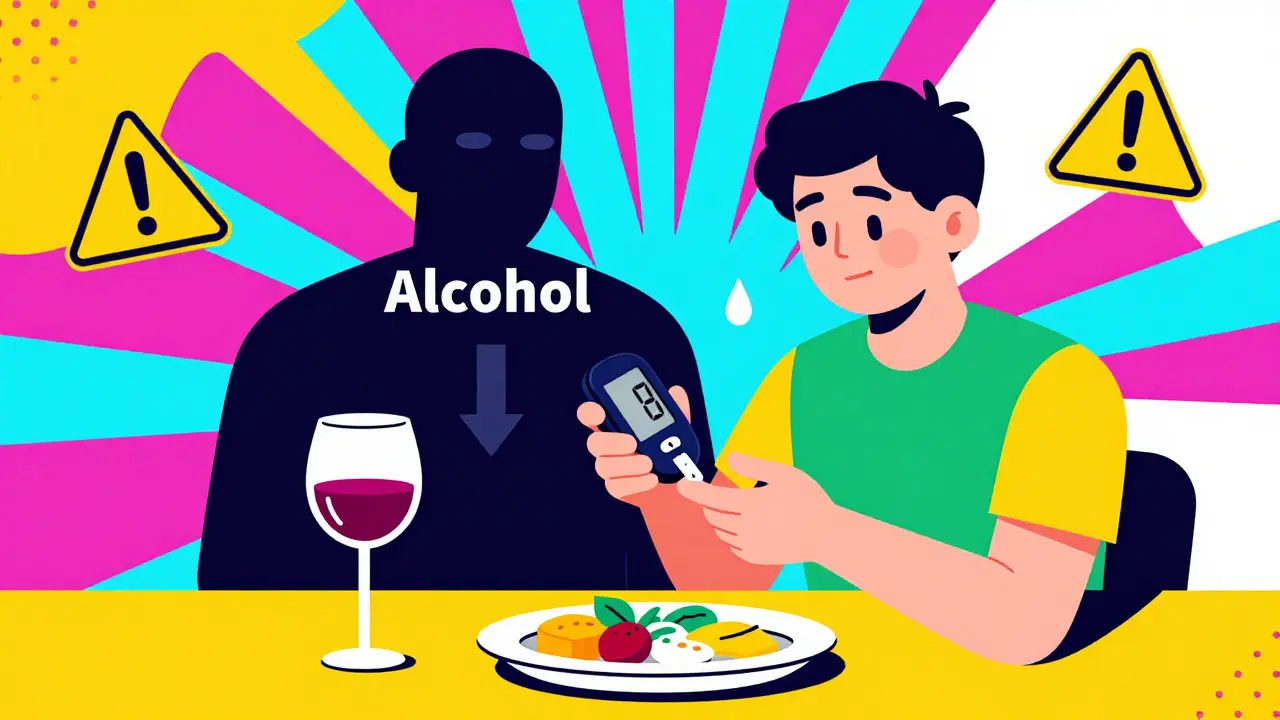
Drinking alcohol with diabetes isn’t just about choosing between beer or wine-it’s about staying alive. For people with diabetes, alcohol doesn’t just affect mood or sleep. It can send blood sugar crashing to dangerous levels, sometimes without warning. And because the symptoms of low blood sugar-dizziness, confusion, sweating-look a lot like being drunk, people around you might not realize you’re in medical danger. This isn’t hypothetical. About 25% of people with type 1 diabetes and 15% of those with type 2 experience at least one alcohol-related hypoglycemic emergency every year, according to Mount Sinai’s 2023 meta-analysis.
How Alcohol Messes With Your Blood Sugar
Your liver is the main player here. Normally, it releases glucose into your bloodstream to keep your levels steady, especially between meals or overnight. But when alcohol enters your system, your liver stops doing that job. Instead, it focuses on breaking down the alcohol-sometimes for up to 12 hours. That means no glucose gets released. If you’re on insulin or medications like sulfonylureas, your body is already lowering blood sugar. Add alcohol, and you’re stacking two forces that drag your levels down.
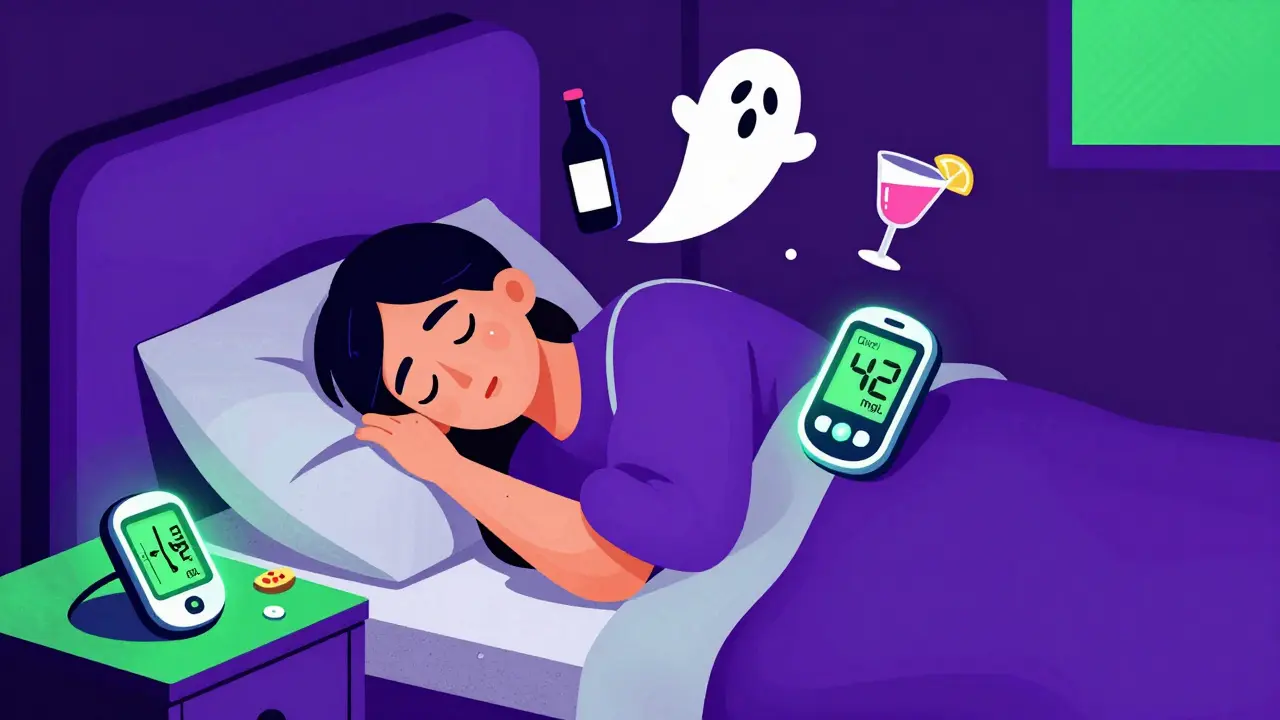
There’s also a sneaky two-phase effect. First, drinks with sugar-like sweet wines, cocktails, or regular soda mixers-cause a quick spike in blood sugar. Then, as your liver switches to alcohol mode, your blood sugar plummets. That drop doesn’t happen right away. It often hits 3 to 8 hours after your last drink, sometimes while you’re asleep. That’s why nighttime hypos are so dangerous. You’re alone, unaware, and your body can’t fight back.
What Counts as One Drink?
Not all drinks are created equal. Medical guidelines define one standard drink as:
- 12 ounces (360 mL) of regular beer (5% alcohol)
- 5 ounces (150 mL) of wine (12% alcohol)
- 1.5 ounces (45 mL) of 80-proof spirits like vodka, gin, or whiskey
That’s it. No more. The American Diabetes Association and Diabetes UK both recommend no more than one drink per day for women and two for men. But even that’s not a free pass. You need to spread those drinks over at least three days a week, with alcohol-free days in between. One drink on a weekend doesn’t mean you can binge on Saturday and call it “moderation.”
What Should You Drink?
Not all alcoholic beverages are equal when it comes to blood sugar. Here’s what’s safer:
- Dry wines (red or white): Usually under 4g carbs per 5 oz glass
- Light beers: Look for under 5g carbs per 12 oz
- Hard seltzers: Most have 2-4g carbs per can-popular in diabetes communities for predictable effects
- Spirits with sugar-free mixers: Vodka, gin, or tequila with club soda, diet tonic, or water. No soda, juice, or syrup.
Avoid these like the plague:
- Sweet wines (port, sherry, dessert wines): Can have 10-20g carbs per glass
- Liqueurs (Baileys, Kahlua): Often over 20g carbs per shot
- Cocktails (margaritas, piña coladas): Some contain 25g+ carbs from syrups and fruit juices
- "Diabetic" beers or ciders: These are a trap. They often have higher alcohol content (2-3% more) to compensate for less sugar-meaning more hypoglycemia risk, not less.
Reddit’s r/diabetes community, with over 245,000 members, rates hard seltzers 4.5/5 for safety. Margaritas? 1.8/5. Why? Because they cause "unpredictable glucose rollercoasters."
When NOT to Drink
There are times when drinking is simply too risky:
- Your blood sugar is below 100 mg/dL
- Your blood sugar is above 300 mg/dL
- You’ve exercised in the last 2 hours
- You’re drinking on an empty stomach
- You have diabetic neuropathy, pancreatitis, or liver disease
- You’re pregnant
Exercise and alcohol together are a deadly combo. Both use up glucose. Add them, and your risk of hypoglycemia jumps by 40%, according to MedlinePlus. And if you’re on insulin or sulfonylureas, your risk increases by 50% when alcohol is added, as shown in Mount Sinai’s 2022 study.
The Rules You Can’t Skip
If you choose to drink, follow these non-negotiable steps:
- Check your blood sugar before you drink. Target range: 100-140 mg/dL. If you’re below 100, eat 15-30g of carbs first.
- Always drink with food. A meal with at least 15g of carbohydrates helps slow the drop. Snacks alone aren’t enough.
- Monitor every 2 hours while drinking. Don’t assume you’re fine because you felt okay at first.
- Check your blood sugar before bed. If it’s below 120 mg/dL, eat a small carb snack. Set an alarm if you’re at risk.
- Use only sugar-free mixers. No tonic water with sugar, no soda, no fruit juice. Club soda or diet tonic are safe.
- Carry fast-acting glucose. 15g of glucose tablets or gel. Don’t rely on candy-some take too long to absorb.
- Wear medical alert jewelry. 92% of endocrinologists recommend it. If you pass out, someone needs to know you have diabetes-not that you’re "just drunk."
Why Symptoms Are Deceiving
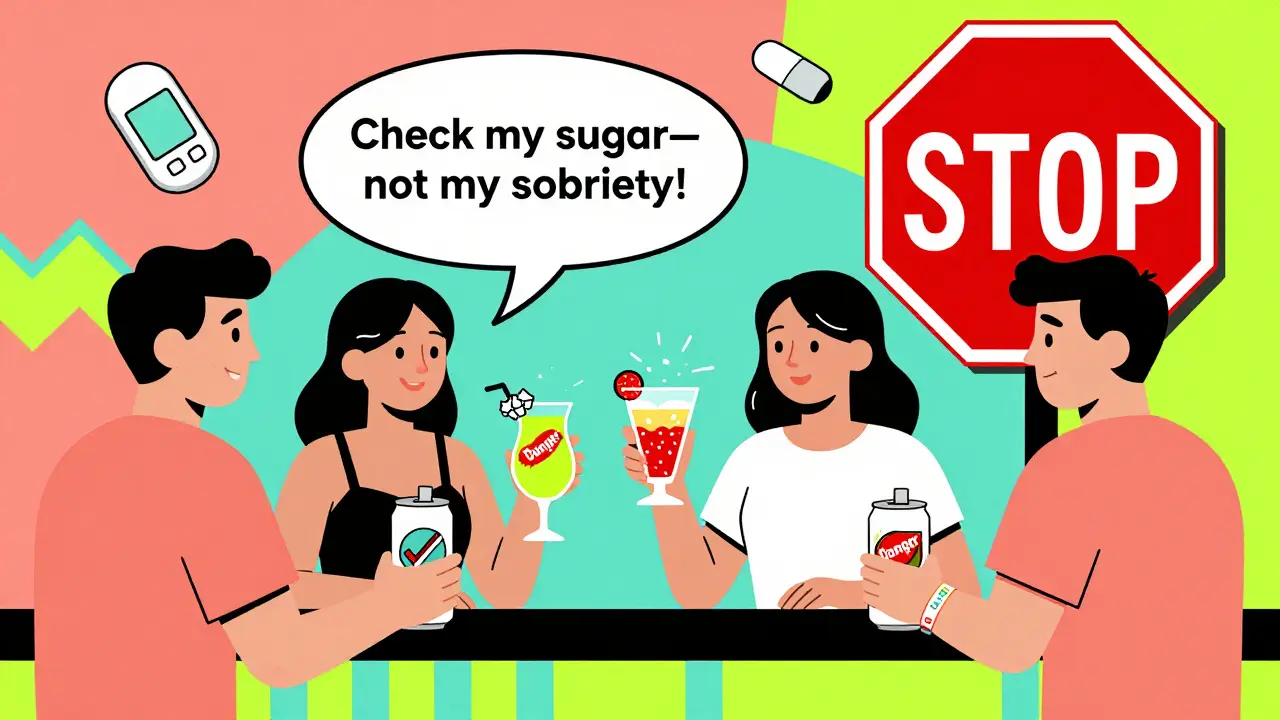
Here’s the scary part: low blood sugar and being drunk feel the same. Shaky hands? Dizzy? Confused? Sweaty? Slurred speech? These are signs of hypoglycemia-and also signs of intoxication. That’s why so many people with diabetes end up in the ER because their friends think they’re just "having a few too many."
Dr. Robert Gabbay, Chief Scientific Officer at the American Diabetes Association, says it plainly: "The symptoms of hypoglycemia mirror alcohol intoxication, making it difficult for others to recognize a medical emergency."
That’s why telling someone you’re diabetic before drinking matters. If you’re out with friends, say: "I’m diabetic. If I start acting weird, check my blood sugar before you assume I’m drunk."
Technology Can Help-But Doesn’t Replace Common Sense
New tech is making it easier. The Dexcom G7 continuous glucose monitor now includes an FDA-cleared "Alcohol-Diabetes Safety Algorithm." It tracks your glucose trend and warns you if alcohol is likely to cause a drop. In trials, it reduced severe hypos by 37%. That’s huge.
But it’s not magic. The algorithm still needs you to input your drink, eat food, and check your levels. No device can replace knowing your body and sticking to the rules.
Researchers at Joslin Diabetes Center are now testing time-restricted drinking: limiting alcohol to a 2-hour window, only after eating a full meal. Early results show a 28% drop in hypoglycemia compared to standard advice. That might become the new gold standard.
Who Should Avoid Alcohol Completely?
Some people shouldn’t drink at all-even one drink:
- Anyone with diabetic neuropathy (affects half of long-term diabetics)
- Anyone with pancreatitis or advanced liver disease
- People taking metformin who drink heavily (more than 4 drinks in 2 hours)-risk of lactic acidosis
- Anyone on sulfonylureas (like glipizide or glyburide)-these drugs already cause low blood sugar, and alcohol makes it worse
- Pregnant women with diabetes
If you have any of these conditions, talk to your doctor. No amount of "moderation" is safe.
Real Stories, Real Risks
On Breakthrough T1D forums, 68% of users reported at least one severe hypo after drinking-often requiring someone else to give them glucagon or call 911. Most happened 3-5 hours after drinking, when they stopped checking their numbers.
One user wrote: "I had two beers at dinner. Checked my sugar at 9pm-110. Felt fine. Woke up at 3am at 42. My partner found me confused, barely responsive. They gave me glucose gel. I didn’t even remember drinking."
Another said: "I switched to hard seltzers, ate a sandwich before, checked my glucose before bed. I’ve had zero hypos in 14 months. It’s not hard. It’s just discipline."
The difference isn’t luck. It’s following the rules.
Bottom Line
You can drink alcohol with diabetes. But you can’t drink like someone without it. The risks are real, the consequences can be deadly, and the symptoms are designed to fool you.
Stick to one drink max per day. Always eat with it. Never skip checking your blood sugar. Know your limits. Wear your medical ID. Carry glucose. Tell someone you’re diabetic.
It’s not about giving up drinking. It’s about staying in control. Your body is already working harder to manage your diabetes. Don’t let alcohol make it harder.

14 Comments
Alex Danner
January 8, 2026 AT 01:46Alcohol and diabetes is one of those topics nobody talks about until someone ends up in the ER. I’ve seen it firsthand-my uncle passed out after two beers, and his buddy thought he was just "wasted." He had to get glucagon. No joke. If you’re diabetic and you drink, you’re not being cool-you’re playing Russian roulette with your pancreas.
Hard seltzers are the only way to go. I switched last year after a 38 mg/dL scare at 2 a.m. Now I check before, during, and before bed. No more surprises. It’s not fun, but neither is waking up in a hospital with your partner crying over you.
And yeah, wearing a medical alert bracelet? Non-negotiable. I used to think it was uncool. Now I wear mine like a badge of honor. At least someone will know I’m not drunk-I’m dying.
Aparna karwande
January 8, 2026 AT 19:21This post is a masterpiece of medical clarity, but I’m sick of Westerners treating diabetes like a lifestyle choice. In India, we don’t have the luxury of "light beers" or "Dexcom G7." My cousin, a type 1 diabetic, drinks cheap rum because it’s all he can afford-and still checks his sugar with a $10 strip. You people complain about "sugar-free mixers" while we’re praying our glucose meters don’t die mid-check.
Stop treating this like a TikTok trend. This is survival. And if you’re not in a country where insulin costs less than your Netflix subscription, stop preaching moderation. You’re not helping. You’re performing.
Jessie Ann Lambrecht
January 10, 2026 AT 09:24Y’all are overcomplicating this. I’ve had type 2 for 12 years. I drink one glass of dry white wine with dinner every Friday. I eat a protein-rich meal first. I check my sugar before bed. I sleep with glucose tabs on my nightstand. That’s it.
No fancy gadgets. No obsession. Just discipline. You don’t need to be a scientist to live well with diabetes-you just need to care enough to not be lazy.
And yes, I’ve told my friends: "If I start slurring and looking like a zombie, check my finger. I’m not drunk-I’m low." They get it now. It’s not hard. It’s just human.
Ayodeji Williams
January 11, 2026 AT 21:19bro i just had a tequila soda and checked my sugar at 115 and i felt fine so i went to sleep and woke up at 54 and my dog was licking my face like "dude you’re dying" 😭
now i check before bed and eat a peanut butter cracker and i’m good. but why does nobody tell you about the 3am crash??? it’s like your body waits till you’re unconscious to betray you 🤡
also hard seltzers are life. i hate wine. it tastes like sad grapes.
Kamlesh Chauhan
January 12, 2026 AT 17:45who even cares about alcohol with diabetes you just dont drink period its not that hard why do you need a 2000 word essay on this its basic biology if you have diabetes you avoid sugar and alcohol is sugar and your liver shuts down and boom you die in your sleep easy
why are you all making this so complicated its not a podcast its your body
Elen Pihlap
January 13, 2026 AT 13:03wait so i can’t drink at all?? i just had a margarita and i felt fine?? what if i just drink less??
i don’t wanna check my sugar every 2 hours i’m not a robot
why do you make everything so scary??
Sai Ganesh
January 14, 2026 AT 18:36In India, many with diabetes avoid alcohol entirely-not out of fear, but because of cultural norms around health and discipline. The idea of "moderation" is often seen as a luxury of Western individualism. Here, the emphasis is on consistency: regular meals, routine sleep, and avoiding triggers. One drink may seem harmless, but for many, it becomes a gateway to broken routines.
The real solution isn’t just better drinks-it’s better systems. Access to affordable monitoring, community education, and family support matter more than any FDA algorithm.
Paul Mason
January 14, 2026 AT 21:07Look, I’ve been doing this for 15 years. I drink two beers on Friday. I eat a sandwich. I check before bed. I’m fine. That’s it.
People make this way too complicated. You don’t need an algorithm. You need common sense. And if you’re too lazy to check your sugar, then maybe you shouldn’t drink. Simple.
Also-yes, hard seltzers are the real MVP. I’ve switched. My wife even bought me a cooler just for them. I’m not joking. She calls it my "Diabetes Bar."
Andrew N
January 16, 2026 AT 14:5225% of type 1s have an alcohol-related hypo? That’s statistically significant, sure. But how many of those cases involved people who ignored the basic rules? Probably 90%.
The real problem isn’t alcohol. It’s denial. People read articles like this, nod along, then go out and drink like they’re in a frat house. The tech is good. The advice is solid. But people don’t follow it because they don’t want to feel like they’re being punished.
It’s not the alcohol killing you. It’s your own arrogance.
LALITA KUDIYA
January 18, 2026 AT 04:43i love how this post is so detailed but also so kind 🌸
i switched to dry wine and check before bed and now i sleep like a baby
no drama just peace
also i told my boyfriend and now he brings me glucose gummies when we go out 😊
Poppy Newman
January 18, 2026 AT 15:53wait so the dexcom g7 can actually detect alcohol-induced drops?? that’s wild 😱
i’ve been using it for 6 months and it’s saved me twice already
why isn’t this covered by insurance??
also hard seltzers are life. i hate tonic water. it tastes like chemical sadness
Anthony Capunong
January 20, 2026 AT 10:15Why are we even having this conversation? If you’re diabetic and you drink, you’re already ignoring your health. You don’t need guidelines-you need a wake-up call.
And why are we praising hard seltzers like they’re some kind of miracle? They’re just soda with alcohol. It’s still poison for your liver. Just because it’s low-carb doesn’t mean it’s safe.
Just quit. You’ll live longer. End of story.
Vince Nairn
January 21, 2026 AT 07:43you people are so dramatic. i had a beer once and my sugar dropped to 40. big deal. i ate a banana and went back to sleep.
why do you all act like this is the end of the world? it’s not. you’re not dying. you’re just low.
also i drink whiskey neat. no mixers. no carbs. no problem. why are you all overcomplicating this? it’s just alcohol. your body’s not a magic potion factory.
Emma Addison Thomas
January 21, 2026 AT 16:41I’ve lived with type 1 for 30 years. I’ve had hypos in taxis, at weddings, in hospital waiting rooms. I used to hide it. Now I say: "I’m diabetic. If I look off, check my sugar."
It’s not about restriction. It’s about connection. The people who care enough to ask are the ones who keep you alive.
And yes-I still have a glass of wine on Sundays. But I eat first. I check. I tell someone. That’s not a rule. That’s love.