
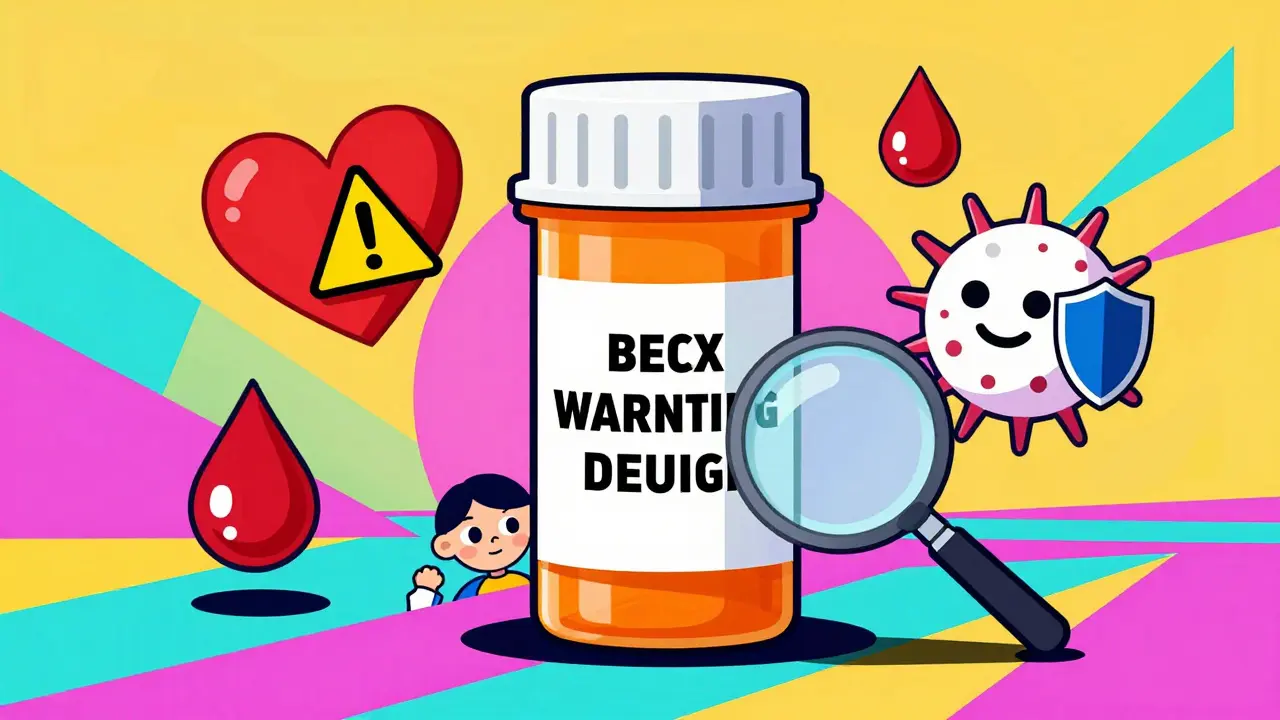
Every time you pick up a prescription, there’s a hidden guide on the bottle that could save your life. It’s not the dosage instructions. It’s not the name of the drug. It’s the safety and warnings section - the part most people glance at and skip. But if you don’t understand what it’s saying, you’re risking serious harm. Millions of people end up in the ER each year because they missed or misunderstood these warnings. This isn’t about being careful. It’s about knowing exactly what to look for - and why it matters.
What’s a Boxed Warning? (And Why It’s the Most Important Part)
Look for a black border around a section of text. That’s a boxed warning, also called a black box warning. It’s the FDA’s strongest alert. These aren’t just suggestions. They mean something serious can happen - maybe even death. Drugs like clozapine (for schizophrenia), warfarin (a blood thinner), and some antidepressants carry these warnings. For example, clozapine can cause a dangerous drop in white blood cells. That’s why patients on it must get weekly blood tests. If you see this warning, don’t ignore it. Talk to your doctor about what steps you need to take. Ask: "What signs should I watch for? What happens if I skip the monitoring?" Studies show patients who understand their boxed warning reduce serious side effects by up to 50%.Warnings and Precautions: What the Fine Print Really Means
This section comes right after the boxed warning. It’s longer, often in small print, and full of phrases like "may cause" or "has been associated with." Don’t let the wording fool you. "May cause" doesn’t mean "maybe." It means: this has happened to real people. For example, if a label says "may cause dizziness," that’s not just a side effect - it’s a red flag if you drive or operate machinery. The FDA requires this language to be precise. So if it says "increased risk of liver damage," it’s based on clinical data, not guesswork. Don’t assume it won’t happen to you. About 68% of patients don’t realize how serious these warnings are. Write down any warning that applies to you. Then ask your pharmacist: "Is this something I need to monitor?"Drug Interactions: The Hidden Danger of Multiple Medications
If you take more than one prescription - or even over-the-counter pills, vitamins, or herbal supplements - you’re at risk. The drug label will list interactions. These aren’t vague. They say exactly how the drugs affect each other. For example: "CYP3A4 inhibitors may increase levels of this drug by up to 400%." That means if you’re taking a common antibiotic like clarithromycin with this medication, your body could be flooded with too much of it. That’s how people end up in the hospital with serotonin syndrome or dangerous drops in blood pressure. A 2023 Reddit survey found 73% of patients on five or more medications didn’t realize their pills could clash. Use a pill organizer with clear labels. Keep a list of everything you take - including ginkgo, St. John’s wort, or even grapefruit juice (which affects over 85 drugs). Bring it to every appointment.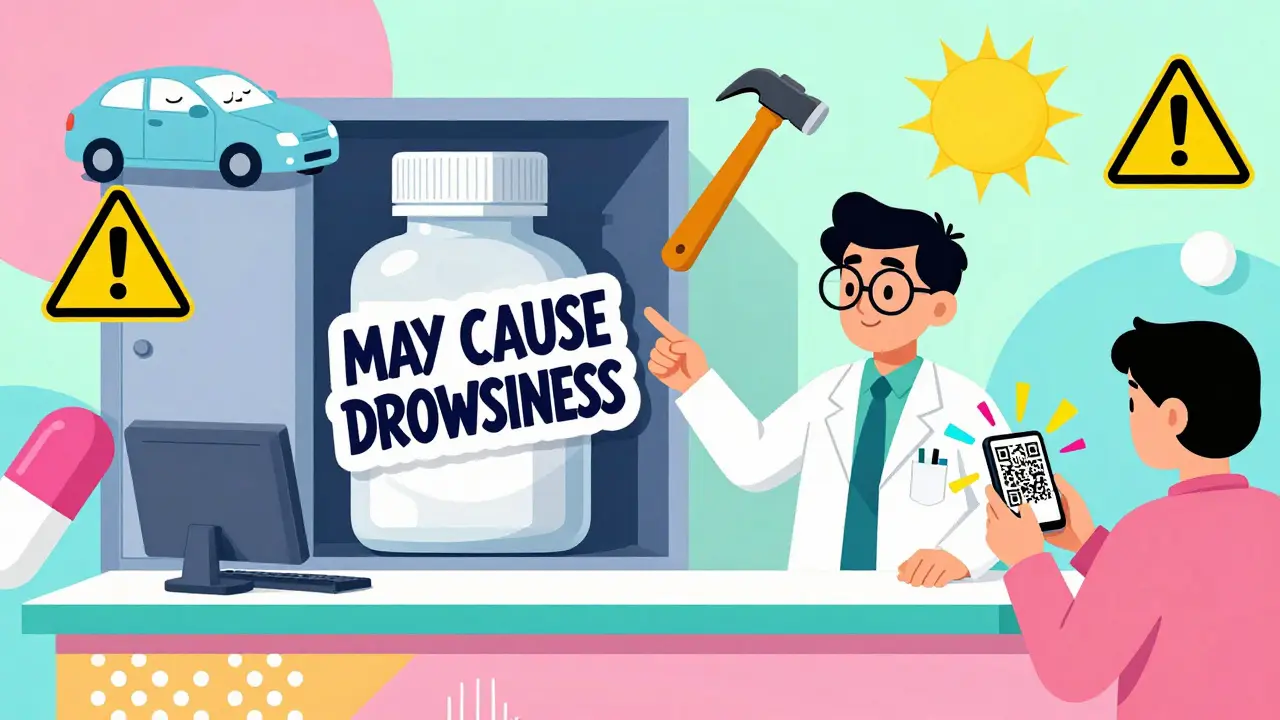
Pharmacy Labels: What the Stickers Are Really Telling You
The bottle you get from the pharmacy has extra warnings - usually printed on stickers. These are the ones you actually see every day. They’re required to be in at least 10-point font and often say things like: "May cause drowsiness - do not operate heavy machinery" or "Take on empty stomach." These aren’t optional. They’re legally required. But here’s the problem: 38% of patients say these stickers get lost at the bottom of the bottle, hidden when stored in cabinets. If you can’t read it, ask the pharmacist to print a bigger one. Some pharmacies now use color-coded stickers: red for critical, yellow for important, blue for general. If yours doesn’t, ask if they can add one. A 2022 study at CVS showed this system improved patient recall by 22%. And if you speak Spanish, California law requires these warnings to be translated. Don’t be shy - ask for it.How to Actually Understand What You’re Reading
Most people don’t read these sections because they feel too technical. But you don’t need a medical degree. Here’s how to break it down:- Find the black box. If it’s there, that’s your #1 priority.
- Look for "May cause," "Risk of," or "Contraindicated with." These are your danger signs.
- Check for numbers. "Take 2 hours before meals" means exactly that - not "whenever."
- Ask: "What happens if I ignore this?" Don’t just accept the warning - understand the consequence.
- Use the teach-back method. Tell your pharmacist: "So, if I take this with ibuprofen, I could get stomach bleeding. Is that right?" If they nod, you got it.
People with low health literacy are 3.2 times more likely to misread these warnings. If you struggle with reading, ask for help. Many pharmacies offer free one-on-one sessions. Some even have videos you can scan with your phone. Walgreens piloted NFC tags on bottles - just tap your phone and a video explains the warning in plain language. Comprehension jumped from 63% to 92%.
What to Do When You’re Confused
You’re not alone. Even doctors miss things sometimes. If you’re unsure, here’s what to do:- Call your pharmacist. They’re trained to explain this stuff - and they won’t judge you.
- Ask for a Medication Guide. The FDA requires these for high-risk drugs like isotretinoin or clozapine. They’re written in plain language and often include pictures.
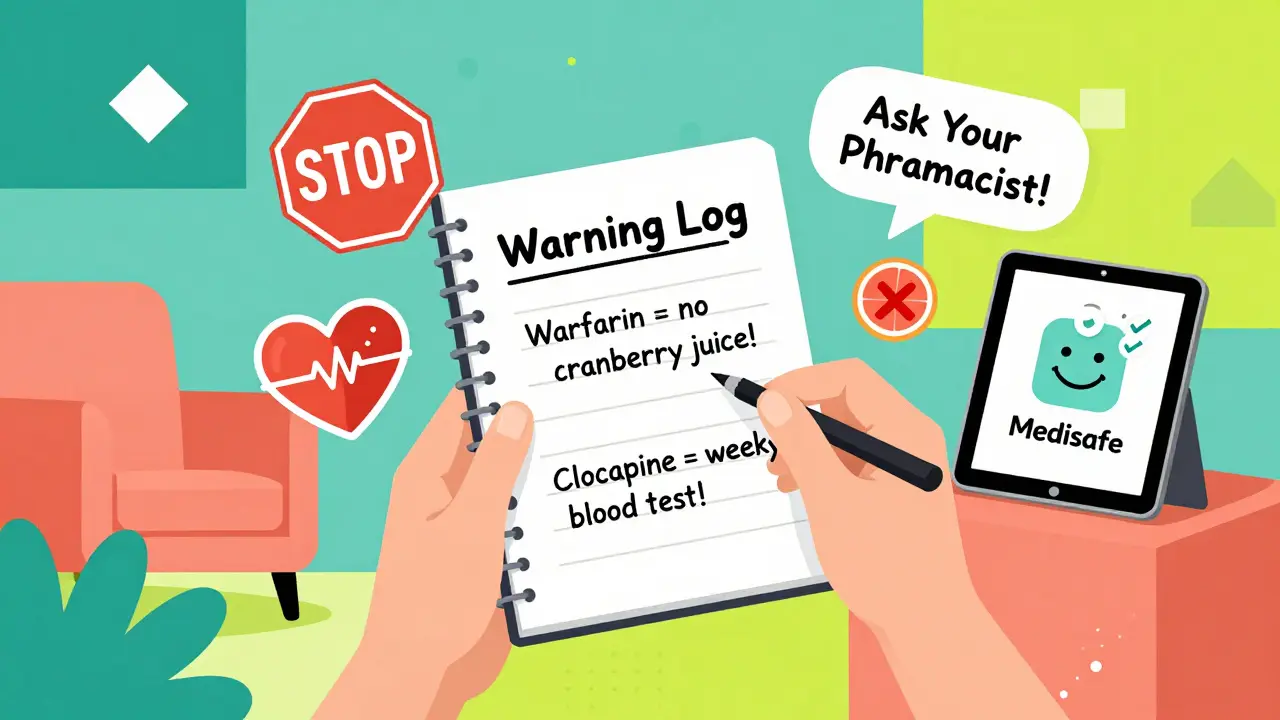
- Keep a warning log. Write down each drug, its warning, and what you need to do. Example: "Warfarin - avoid cranberry juice, check INR weekly, report bruising." This improves adherence by 41% in older adults.
- Use a digital tool. Apps like Medisafe scan your pills and alert you to interactions. They’re 89% accurate when used consistently.
Don’t rely on memory. Write it down. Say it out loud. Test yourself. The goal isn’t just to read the label - it’s to make sure you can explain it to someone else.
Why This Matters More Than You Think
Medication errors from misunderstood warnings cost the U.S. healthcare system $42 billion a year. That’s not just money - it’s lives. One 68-year-old patient developed serotonin syndrome because he ignored a tiny warning on dextromethorphan that said "do not take with SSRIs." He was on antidepressants. He thought it was just a cold medicine. He didn’t realize it could kill him. But on the flip side, a Reddit user shared how a "may cause drowsiness" sticker on his sleep aid helped him avoid a car crash. He had planned to drive home after work. He saw the sticker. He stayed home. That’s the power of understanding.The FDA is pushing for bigger changes: color-coded warnings, pictograms, QR codes, and plain-language labels. But until those are everywhere, you’re your own best safety net. Learn how to read the label. Ask questions. Don’t assume. Your life might depend on it.
What does a black box warning mean on a prescription label?
A black box warning is the strongest safety alert the FDA requires. It appears in a black border around text and signals that the drug carries a risk of serious or life-threatening side effects. Examples include increased risk of suicide with certain antidepressants, severe liver damage, or a dangerous drop in white blood cells. If your drug has this warning, you must follow all monitoring steps - like blood tests or avoiding other medications - exactly as directed.
Why are drug interactions so dangerous?
Drug interactions happen when two or more medications affect each other in your body - sometimes dangerously. For example, taking a common antibiotic with a cholesterol drug can cause muscle damage. Or mixing certain painkillers with blood thinners can lead to internal bleeding. These aren’t rare. About 73% of patients on five or more medications don’t realize their pills can interact. Labels list exact mechanisms like "CYP3A4 inhibitors increase levels by up to 400%" - meaning your body could absorb too much of the drug. Always tell your pharmacist everything you take, including vitamins and herbal supplements.
What should I do if I don’t understand a warning on my pill bottle?
Don’t guess. Call your pharmacist. They’re required to explain warnings in plain language. Ask for a Medication Guide - a separate, easier-to-read sheet the FDA requires for high-risk drugs. You can also ask the pharmacist to write the warning down in your own words. Use the "teach-back" method: repeat what you heard back to them. If they nod, you got it right. If they hesitate, ask again. Your safety matters more than your pride.
Are pharmacy warning stickers as important as the original label?
Yes - and sometimes more important. The original label is meant for doctors. The pharmacy sticker is meant for you. It’s the one you see every day. These stickers are required by law to be in at least 10-point font and say things like "May cause drowsiness" or "Take on empty stomach." But they’re often stuck on the bottom of bottles and get hidden. If you can’t read it, ask for a bigger sticker. Some pharmacies now use color-coded stickers: red for critical, yellow for important. If yours doesn’t, request it.
Can I trust online drug interaction checkers?
They can help - but don’t rely on them alone. Apps like Medisafe scan your pills and flag interactions with 89% accuracy when used consistently. But they can miss things, especially if you don’t enter every supplement or over-the-counter pill. The best approach is to use them as a tool, not a replacement. Always cross-check with your pharmacist. They have access to the full prescribing data and can spot risks apps might miss.
What’s the best way to remember all my drug warnings?
Keep a simple warning log. Write down each medication, its main warning, and what you need to do. For example: "Warfarin - avoid cranberry juice, check INR every 4 weeks, report unexplained bruising." Keep this list in your wallet or phone. Studies show patients who do this improve adherence to safety rules by 41%. Review it every time you refill a prescription. If something changes, update it immediately.

15 Comments
henry mateo
December 31, 2025 AT 01:16i read the black box warning on my clozapine script and thought it was just drama until i almost passed out from low wbc. now i get my blood drawn every week like clockwork. dont be me.
Glendon Cone
December 31, 2025 AT 06:07this is legit life-saving info 🙌 i used to skip all the fine print until my buddy ended up in the ER over grapefruit + statin. now i screenshot every warning and send it to my mom. she’s 72 and still drives. better safe than sorry.
Henry Ward
January 1, 2026 AT 14:37you people are so naive. the FDA doesn't give a damn about you. they approve drugs for profit, then slap on a black box warning like it's a badge of honor. you think reading the label changes anything? it's all theater. your life isn't in your hands - it's in the boardroom.
Sandeep Mishra
January 2, 2026 AT 14:54in india, we often get medicines without any proper labeling. i once took a painkiller that had no warning about liver damage - my uncle ended up in ICU. i now carry a printed copy of every warning i find online. sometimes, you have to be your own pharmacist.
Joseph Corry
January 3, 2026 AT 03:34how quaint. you assume the average person can parse CYP3A4 inhibitors or interpret FDA regulatory language. this is the same logic that told us to "just read the manual" before handing someone a nuclear reactor. systemic failure, not individual negligence.
srishti Jain
January 3, 2026 AT 18:29i ignore all warnings. my body knows what it's doing.
Nadia Spira
January 4, 2026 AT 11:06this article is a joke. if you need a 12-step guide to read a pill bottle, maybe you shouldn't be taking prescription meds at all. the real issue is that people are too lazy to think. just stop. stop. stop.
Kunal Karakoti
January 6, 2026 AT 03:23there's a deeper question here - why do we outsource our health to institutions that profit from our ignorance? the label is a bandage on a wound that started when we stopped trusting our intuition and started trusting corporate compliance.
Kelly Gerrard
January 6, 2026 AT 12:04I appreciate the effort put into this article. It is imperative that individuals take responsibility for their own health outcomes. The use of colloquial language, while accessible, undermines the gravity of pharmaceutical safety protocols. One must approach such matters with the utmost formality and diligence.
Aayush Khandelwal
January 7, 2026 AT 10:55the CYP3A4 thing? that’s the real MVP of drug chaos. i used to mix my antifungal with my antidepressant like it was a smoothie. now i have a color-coded spreadsheet. red = danger zone, yellow = tread lightly, green = you’re probably fine. also, grapefruit is the devil. i hate it now.
Colin L
January 8, 2026 AT 11:12you know what’s worse than not reading the label? thinking you’ve read it. i once spent three months arguing with my pharmacist because i "knew" the warning said "take with food" - it said "take on empty stomach." i had a panic attack over it. i’m still not sure if i’m right. maybe we should all just stop taking pills.
Hayley Ash
January 9, 2026 AT 04:27so let me get this straight - you want people to spend hours deciphering legalese just to not die? what a joke. if your medicine needs a 2000-word essay to be safe, maybe it shouldn’t exist. next you’ll be asking us to memorize the chemical structure of ibuprofen before buying it at CVS
kelly tracy
January 10, 2026 AT 15:49i read the label. i followed every rule. and still, i got hospitalized. so what’s the point? you think writing it down helps? you think asking questions helps? it’s all a scam. the system is rigged. and you’re just a pawn in a game you didn’t even know you were playing.
Cheyenne Sims
January 11, 2026 AT 05:24The FDA mandates these warnings for a reason. To suggest that individuals should "ask for a bigger sticker" or "scan a QR code" is to diminish the rigor of pharmaceutical regulation. Proper punctuation, capitalization, and adherence to grammatical standards are non-negotiable when it comes to safety information.
Shae Chapman
January 11, 2026 AT 07:45OMG I JUST REALIZED I’VE BEEN TAKING MY BLOOD PRESSURE MED WITH GRAPEFRUIT JUICE FOR 3 YEARS 😭 I JUST CRIED IN THE PHARMACY ISLE. THANK YOU FOR THIS. I’M GOING TO PRINT THIS OUT AND TAPE IT TO MY FRIDGE. I FEEL SO MUCH SAFER NOW 🤍