
When your doctor hands you a prescription for a generic drug, you might feel a quiet doubt. Generic drug safety isn’t just a scientific question-it’s a deeply personal one. You’ve seen the price tag: 80% cheaper than the brand. But you’ve also heard stories. A neighbor’s blood pressure spiked after switching. A friend’s depression returned. A Reddit post says the generic version of sertraline made them feel like they were withdrawing. So you ask yourself: Is this really the same?
Why Do People Think Generics Are Less Safe?
The word "generic" carries weight. It doesn’t just mean "cheaper." For many, it sounds like "lesser." A 2012 CDC survey found that 20 to 40% of patients weren’t sure if generic drugs worked the same as brand-name ones. One in five believed they were less safe. That’s not a small number-it’s millions of people making life-or-death choices based on perception, not data. The FDA says generics are identical in strength, purity, and how they work in the body. They must match the brand within 80-125% of its absorption rate. That’s not a loophole-it’s a tight, scientifically proven range. But patients don’t live in that range. They live in their bodies. And when they feel different after a switch, they don’t think, "Oh, bioequivalence variance." They think, "This isn’t working like it used to."Who’s Most Likely to Worry?
Not everyone feels the same way. Risk perception isn’t random. It’s shaped by who you are. Older adults-especially those over 60-are more likely to fear side effects. A 2024 study found 31.9% of seniors worried about generics causing harm, compared to 24.7% of younger people. Why? Many have been on the same brand for years. They know how it feels. A change, even a tiny one, feels risky. People with lower education levels are nearly twice as likely to believe generics are dangerous. One study showed 58.7% of those with less schooling saw generic use as risky. Meanwhile, those with higher education weren’t as worried about safety-they were more worried about having to change their routine. "I don’t want to remember a new pill shape," one patient said. Race and income matter too. Black and Hispanic patients were 1.8 times more likely to distrust generics than white patients. Unemployed and retired people were more open to generics. Employed people? Less so. Why? Financial pressure. If you’re working, you might fear losing your job if you get sick. So you cling to what you know.The Myth of the "Bad Batch"
One of the most persistent fears? "How do I know which batch they gave me?" It sounds irrational. But it’s not. Patients don’t think about regulatory oversight. They think about their own experience. A 2021 survey found that 68% of people who switched to generics saw no difference. But the other 32%? Their stories stick. There’s a reason. In 2012, the FDA issued a safety notice about certain generic versions of bupropion XL. Some patients reported reduced effectiveness. It was a rare case-only a few manufacturers had formulation issues. But it went viral. Now, every time someone says, "My generic didn’t work," they’re not just talking about one pill. They’re talking about that moment. Even when the science says it’s safe, one bad experience can override a hundred studies. It’s called the availability heuristic. Your brain remembers the story you heard, not the statistics you read.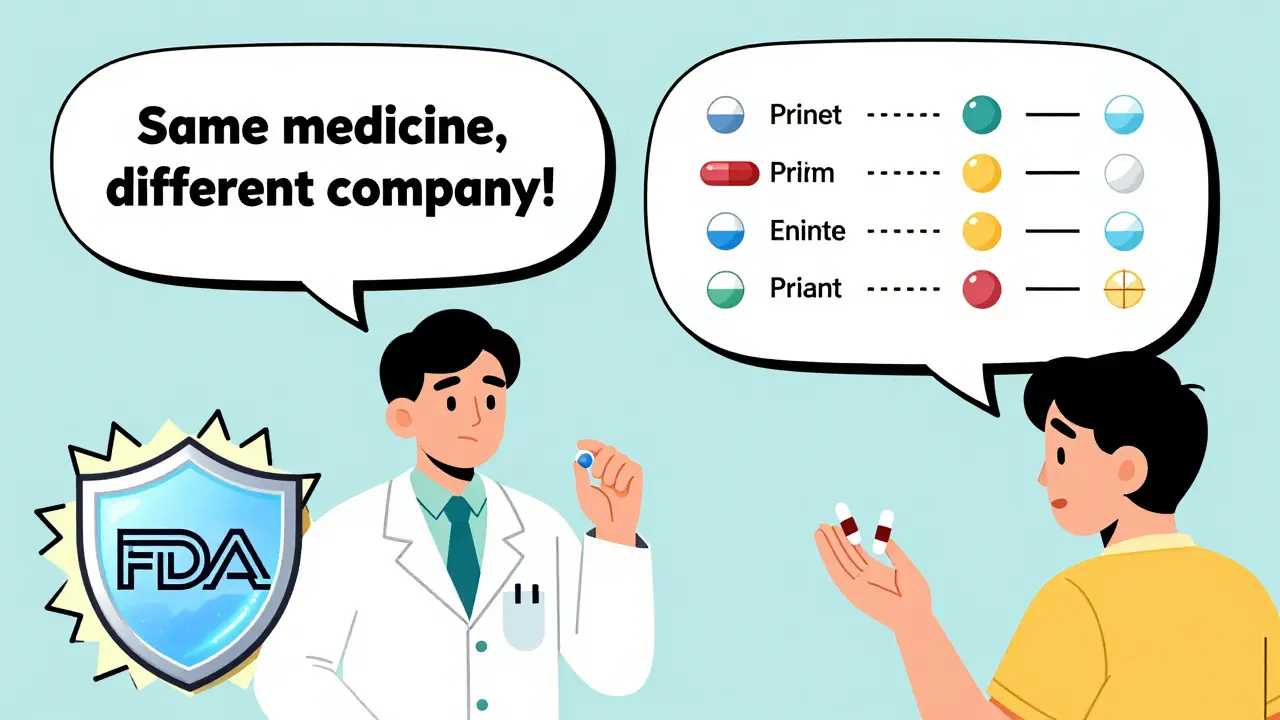
Doctors and Pharmacists: The Missing Link
The biggest predictor of whether someone accepts a generic? What their provider says. A 2011 study found patients were 3.2 times more likely to take a generic if their doctor explained bioequivalence. Not just said, "This is cheaper." But said, "This is the exact same medicine. It’s held to the same standards. It works the same way." But most doctors don’t say that. They assume patients know. Or they assume patients don’t care. The result? Silence. And silence breeds fear. Pharmacists are even more important. When a pharmacist takes two minutes to explain why the pill looks different, adherence goes up by 37%. But the average consultation lasts 47 seconds. Most of that time is spent scanning barcodes, not answering questions. The system isn’t designed for trust-building. It’s designed for speed. And that’s where the gap opens up.What Works to Change Minds?
You can’t just hand someone a FDA pamphlet and expect them to believe it. You need to meet them where they are. One study found that educational materials designed for low-health-literacy patients cut safety concerns by 42%. How? Simple language. Pictures. Real examples. Instead of "bioequivalence," they said, "This pill works just like the name-brand one. It’s made by a different company, but it does the same thing." Timing matters too. If you explain generics when the prescription is written, patients are 2.8 times more likely to accept them. That’s the moment they’re most open. AARP’s guide on generics scored 4.5 out of 5 for clarity. The FDA’s own guide? Only 3.2. Why? AARP used stories. The FDA used jargon.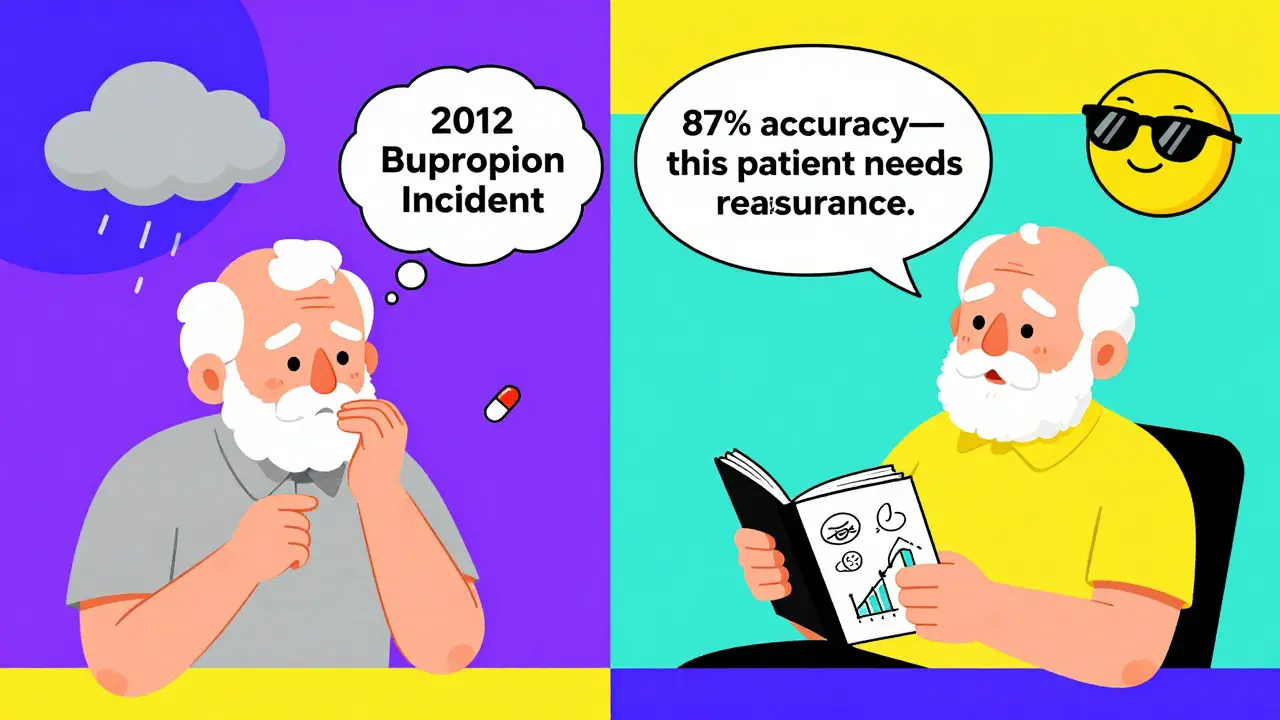
The Economic Cost of Fear
This isn’t just about feelings. It’s about money. Generics make up 90% of prescriptions in the U.S. But they account for only 23% of drug spending. That’s $370 billion saved every year. Yet, because of safety fears, patients still ask for brand-name drugs-$8 billion worth annually. Insurance plans that charge $0 for generics see 18% higher use. That’s proof: when cost isn’t a barrier, people still hesitate. The fear is deeper than price. Even worse, brand companies now sell "authorized generics"-their own drugs, repackaged as generics. It’s a clever trick. But it backfires. Patients think: "If this is the same, why did they charge me more before?"What’s Next?
New tools are emerging. Machine learning can now predict which patients are most likely to fear generics-with 87% accuracy. That means clinics can target interventions before the prescription is even filled. The FDA’s 2023 education plan is starting to show results. Spanish-speaking patients saw a 15% drop in safety concerns after multilingual campaigns. But the biggest challenge? Complex generics. Inhalers, creams, injectables. These aren’t pills. Their bioequivalence is harder to prove. And patients know it. Nearly half now say they’re unsure about these types of generics. Until we fix the trust gap-until patients truly believe that a $5 pill is just as good as a $50 one-we’ll keep paying more than we need to. And worse-we’ll keep people from getting the medicine they need because they’re afraid.What You Can Do
If you’re taking a generic and feel something’s off:- Don’t assume it’s the drug. Talk to your pharmacist. Ask if the manufacturer changed.
- Keep a simple journal: When did you switch? What changed? Sleep? Mood? Energy?
- Ask your doctor: "Is this generic FDA-approved? Is it the same as the brand?"
- Don’t say, "It’s cheaper." Say, "This is the same medicine. It’s just made by a different company that follows the same rules."
- Use pictures. Show the pill. Compare it to the brand. Say, "See? Same shape. Same dose. Same active ingredient."
- Follow up. Check in two weeks. Ask, "How’s it going? Any changes?"
Are generic drugs really the same as brand-name drugs?
Yes. The FDA requires generic drugs to have the same active ingredient, strength, dosage form, and route of administration as the brand-name version. They must also meet the same strict manufacturing standards. Bioequivalence testing proves they work the same way in the body-within a scientifically accepted range of 80-125% absorption. Thousands of generics have been used safely for decades.
Why do some people feel different on generic medication?
Sometimes, changes in inactive ingredients-like fillers or coatings-can affect how quickly a pill dissolves in the stomach. For most people, this makes no difference. But for a small number, especially with medications like seizure drugs or antidepressants, even small changes can cause noticeable effects. That’s why doctors monitor patients closely after a switch. It’s not that the generic is unsafe-it’s that individual bodies respond differently, and that’s why communication matters.
Can generic drugs be made in unsafe factories?
No. All generic drug manufacturers, whether in the U.S., India, or elsewhere, must pass the same FDA inspections as brand-name companies. The FDA inspects over 3,500 manufacturing sites annually. If a factory fails, its products are blocked from entering the U.S. market. The FDA has shut down dozens of foreign plants for safety violations. There’s no special rule for generics.
Why do generics look different from brand-name drugs?
By law, generic drugs can’t look identical to brand-name drugs. That’s to avoid trademark infringement. So they may have different colors, shapes, or markings. But the active ingredient-the part that treats your condition-is exactly the same. The difference is only cosmetic.
Should I avoid generics for serious conditions like heart disease or epilepsy?
No. Generics are approved for all conditions, including life-threatening ones. Studies show no difference in outcomes for heart medications, epilepsy drugs, or blood thinners when using FDA-approved generics. In fact, most hospitals use generics for critical care because they’re proven, reliable, and cost-effective. The key is consistency-if you start on a generic, stick with it. Frequent switching between manufacturers can increase the chance of noticing differences.
How can I tell if my generic is FDA-approved?
Look for the "ANDA" number on the bottle or packaging. It stands for Abbreviated New Drug Application-the FDA’s approval number for generics. You can also check the FDA’s online database of approved generics at [email protected]. If your pharmacy can’t provide this, ask for a different one. All legal generics must have this approval.

14 Comments
gerard najera
January 1, 2026 AT 21:16Trust isn't built with data. It's built with consistency.
People don't fear generics. They fear change.
And when your body's been stable for years, even a tiny shift feels like betrayal.
Stephen Gikuma
January 3, 2026 AT 02:29They're letting China and India make our medicine now and acting like it's fine.
Ever hear of the 2018 heparin scandal? Or the lead in the pills from Bengaluru?
The FDA's a joke. They inspect for 47 minutes and call it a day.
They're poisoning us slowly and calling it 'cost-saving'.
Next thing you know, your blood pressure med is laced with rat poison and they'll say 'it's within 80-125%'.
Wake up. This isn't science. It's corporate colonization.
Bobby Collins
January 3, 2026 AT 20:13i swear my anxiety got worse after switching to generic sertraline
like... i could feel it
not just in my head but in my bones
and when i asked my pharmacist she just shrugged
like it was normal
but it wasn't
and now i'm scared to take anything new
what if they swap my insulin next??
Layla Anna
January 4, 2026 AT 04:44my abuela switched to generics for her blood pressure and she's been fine for 3 years now 😊
she doesn't know what bioequivalence means but she knows her body
and she says the pills work the same
she even saved enough to buy groceries for her neighbors
maybe the real issue isn't the pill
but how we talk about it
we need more stories like hers
not just fear
❤️
Heather Josey
January 5, 2026 AT 09:52While the emotional response to generic medications is valid, it's critical to distinguish between perception and evidence.
The FDA's bioequivalence standards are among the most rigorous in the world.
When patients report differences, it's often due to variations in inactive ingredients or psychological factors - not pharmacological failure.
Healthcare providers must be trained to communicate this with empathy, not jargon.
Education paired with trust-building is not optional - it's foundational to public health.
Donna Peplinskie
January 6, 2026 AT 03:45I love how this post acknowledges that people's lived experiences matter - even if they don't fit neatly into statistical ranges.
And I think the pharmacist point is so under-discussed - that 47-second interaction? That's where trust is lost.
What if pharmacies had a 2-minute 'medication welcome' script? Just: 'This is the same medicine, just a different company. Here's what changed, and here's what to watch for.'
Small change. Huge impact.
Also - thank you for mentioning AARP. Their guides are actually readable. The FDA's? Feels like a legal contract written by a robot.
Olukayode Oguntulu
January 6, 2026 AT 20:27The entire discourse on generic pharmaceuticals is a symptomatic manifestation of late-stage capitalist epistemological collapse.
One cannot reduce ontological certainty of therapeutic efficacy to mere bioequivalence metrics - that is a reductive positivist fallacy.
Patients are not merely physiological vessels; they are hermeneutic subjects negotiating semiotic dissonance between brand-as-symbol and generic-as-commodity.
Furthermore, the FDA's 80-125% window is not a scientific consensus - it is a neoliberal compromise, a regulatory surrender to profit-driven logics.
And let us not forget: the active ingredient is only one component of a pharmakon - the excipients, the coating, the manufacturing ethos - these are the invisible vectors of power.
Until we deconstruct the pharmaco-political apparatus, we are merely rearranging deck chairs on the Titanic of public health.
jaspreet sandhu
January 8, 2026 AT 09:10You people act like generics are some new thing but in India we've been using them for 50 years and nobody dies.
My uncle takes five different generics for diabetes and heart and he's 78 and still drives a scooter.
And you think the FDA is the only one who knows what they're doing?
They approve drugs in India that would never pass in the US and those drugs are used by millions and nobody has a breakdown.
It's not the medicine, it's your mindset.
You think because it's cheap it's bad.
That's not science, that's fear.
And now you're scared of a pill because it looks different.
What's next? Scared of blue pills because they used to be white?
Grow up.
Alex Warden
January 8, 2026 AT 13:32China makes 80% of our generics and they don't follow our rules.
They cut corners. They use banned chemicals.
And the FDA lets them in because they're cheap.
They're not equal. They're not the same.
And if you think they are, you're either brainwashed or getting paid.
Ask yourself: Why do brand-name companies sell their own generics?
Because they know the truth.
And you're letting them poison your family for $5 a month.
Wake up.
This isn't about money.
This is about survival.
LIZETH DE PACHECO
January 8, 2026 AT 20:03My mom switched to a generic for her thyroid med and had a panic attack because the pill was yellow instead of white.
She thought it was wrong.
I sat with her, showed her the ANDA number, compared the pill images side by side.
Two weeks later, she said: 'It feels like the same me.'
It wasn't the drug.
It was the fear.
You can fix that.
One conversation. One picture. One moment of patience.
You don't need a pamphlet.
You just need to care enough to stay.
Lee M
January 9, 2026 AT 02:12The real issue isn't the generic. It's the system that treats patients like accounting entries.
We've turned medicine into a transaction.
Doctors don't have time to explain.
Pharmacists are rushed.
Patients are handed a pill like it's a coupon.
And then we wonder why people feel abandoned.
It's not about the 80-125% range.
It's about the 0% empathy.
Kristen Russell
January 10, 2026 AT 15:04I used to be scared of generics too
until I started keeping a journal
and realized my mood swings were from sleep, not the pill
and that my doctor had changed my dose without telling me
the generic was fine
the system wasn't
so I started asking questions
and now I help my friends do the same
it's not magic
just curiosity
Austin Mac-Anabraba
January 10, 2026 AT 18:53The assertion that 'science doesn't change minds' is both factually incorrect and intellectually lazy.
Science doesn't change minds when it is presented in a manner that is inaccessible, emotionally dissonant, or institutionally distrusted.
But science - properly communicated, contextualized, and consistently reinforced - has changed minds for centuries.
The failure lies not in the data, but in the transmission protocol.
And the fact that AARP's guide outperforms the FDA's is not a triumph of storytelling - it is a indictment of institutional incompetence.
Let us not confuse poor communication with the irrelevance of evidence.
Phoebe McKenzie
January 11, 2026 AT 14:31They're lying to you.
Every single one of them.
The FDA, the doctors, the pharmacists - they all get kickbacks from the generic manufacturers.
They don't care if you feel weird.
They care about the bottom line.
And if you're one of the 32% who feel different?
You're just collateral.
They'll tell you it's 'in your head'.
But your body knows.
And you know.
Don't be fooled.
This is a scam.
And you're paying for it - with your health.