

When you pick up a prescription, you might not think twice about whether it’s the brand-name drug or the cheaper generic version. But behind that decision is a strict, science-backed system designed to keep you safe: therapeutic equivalence. This isn’t just a regulatory buzzword. It’s the reason millions of people can switch to generic medications without risking their health. And if you’ve ever worried that a generic drug might not work the same way, understanding therapeutic equivalence will give you real clarity.
What therapeutic equivalence actually means
Therapeutic equivalence means two drugs - one brand-name, one generic - deliver the same clinical result and safety profile when used the same way. It’s not enough that they contain the same active ingredient. That’s just the starting point. The FDA requires three things to be true:
- Pharmaceutical equivalence: Both drugs must have the same active ingredient, strength, dosage form (like tablet or injection), and route of administration (oral, topical, etc.).
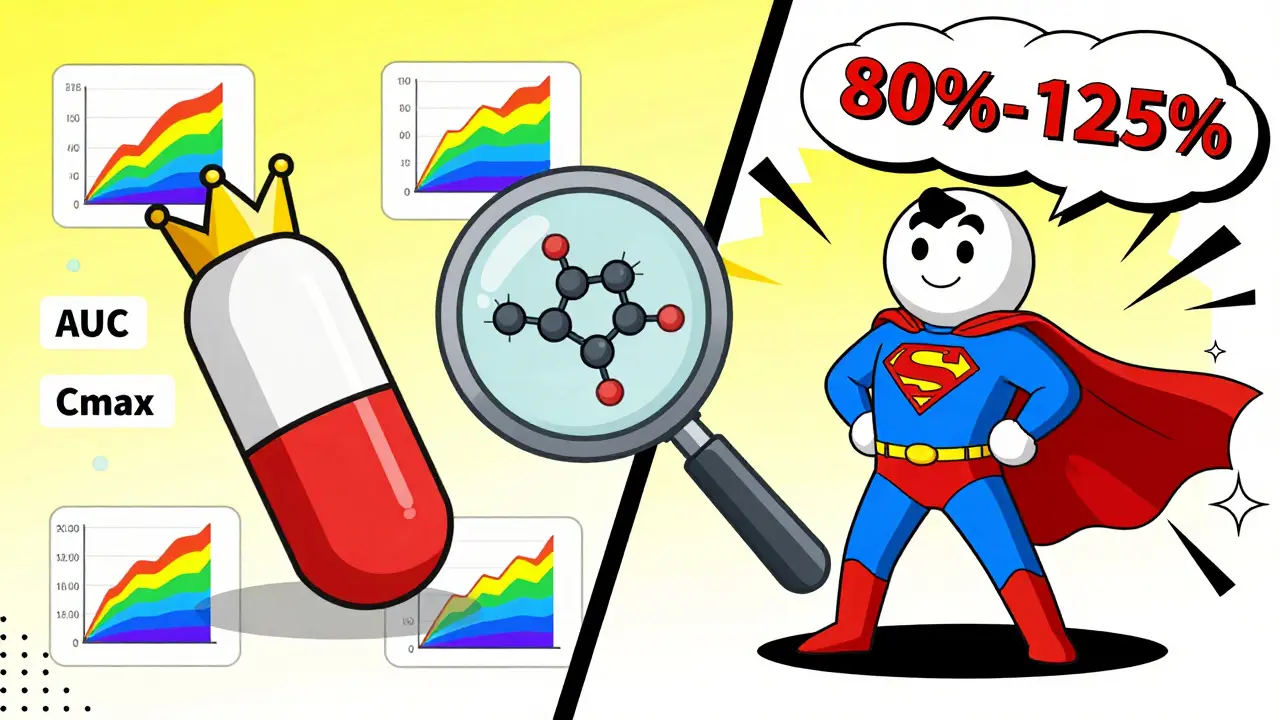
- Bioequivalence: The generic must absorb into your bloodstream at the same rate and to the same extent as the brand. This isn’t guesswork. It’s measured using blood tests that track how much of the drug enters your system (AUC) and how fast it peaks (Cmax). The FDA requires these numbers to fall within 80% to 125% of the brand’s values.
- Identical clinical effect: In real-world use, patients must experience the same benefits and side effects. No surprises.
The FDA uses a two-letter code system in the Orange Book - its official list of approved drug products - to show this. If a generic has an “AB” rating, it’s considered therapeutically equivalent. “A” means it meets all the criteria. “B” means it doesn’t. You’ll never see a “B” drug automatically substituted unless your doctor specifically allows it.
Why this matters for your safety
Imagine you’re taking warfarin, a blood thinner with a very narrow window between too little and too much. A tiny change in how the drug is absorbed could mean the difference between a clot and a dangerous bleed. That’s why the FDA applies stricter standards for these drugs: the bioequivalence range is tightened to 90-110%, not the usual 80-125%. This isn’t arbitrary. It’s based on decades of patient data and clinical outcomes.
Studies show that when patients switch to an FDA-approved therapeutically equivalent generic, their outcomes stay consistent. A 2022 survey of 12,500 patients by UnitedHealthcare found 87% saw no change in how the drug worked. Only 3.2% reported problems they linked to the switch. And when investigators looked closer, most of those cases weren’t due to the drug itself - they were anxiety, changes in pill size, or confusion over labeling.
The Institute for Safe Medication Practices reviewed 127 adverse event reports between 2018 and 2022 that involved generic substitution. Only 17 involved products with an “AB” rating. The rest were linked to non-equivalent products, mislabeled drugs, or unrelated causes. In other words, the system works.
How it compares to other substitution methods
Some doctors talk about “therapeutic interchange” - swapping one drug for another in the same class. For example, switching from one statin to another. But that’s not therapeutic equivalence. It’s a different game. A 2019 study in JAMA Internal Medicine found therapeutic interchange led to 32% more adverse events than substitution based on true therapeutic equivalence. Why? Because even within the same class, drugs can vary in how they’re absorbed, how long they last, and how they interact with other medications.
Therapeutic equivalence is about exact matches. It’s not about “similar enough.” It’s about scientifically proven identical performance. That’s why pharmacists can confidently substitute an “AB” rated generic without asking your doctor. They’re not taking a risk - they’re following a validated standard.
Where the system has limits
Not all drugs are easy to test. Inhalers, topical creams, eye drops, and some injectables don’t absorb the same way every time. Their effectiveness depends on how they’re applied, how the body absorbs them locally, or even how the device delivers the dose. For these, traditional blood tests don’t tell the whole story.
The FDA acknowledges this. In 2023, they released draft guidance for complex products like topical corticosteroids, outlining new methods to evaluate equivalence. They’re working with labs to use imaging, in vitro testing, and even AI models to predict whether a generic cream will behave like the brand. This isn’t science fiction - it’s happening now. The FDA has partnered with MIT on a $2.3 million project to build machine learning tools that identify formulation patterns linked to poor performance.
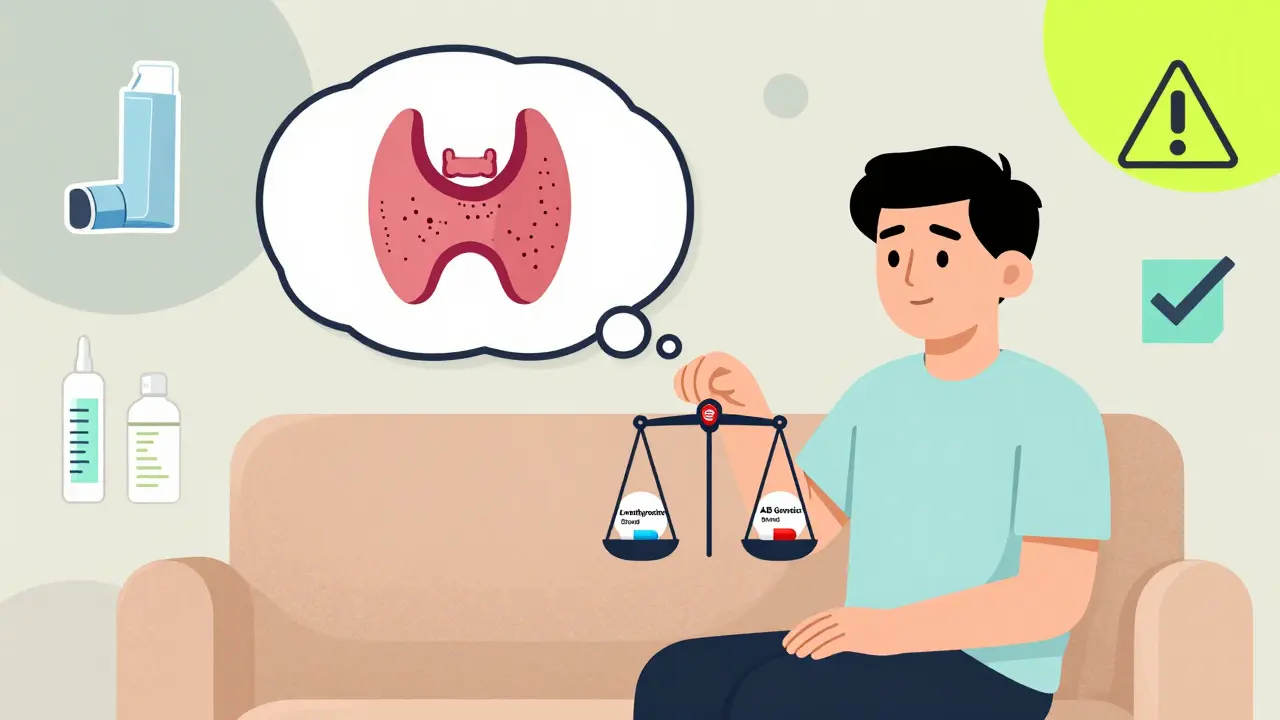
Even with these advances, some experts remain cautious. Dr. Jerry Avorn from Harvard has pointed out that for drugs like levothyroxine (used for thyroid conditions), even small variations in absorption can affect patients who are highly sensitive. The FDA responds by tightening standards for these specific drugs - not by abandoning equivalence, but by making it more precise.
What you need to know as a patient
You don’t need to memorize the Orange Book. But you do need to know what to look for.
- If your pharmacist switches your prescription to a generic, ask: “Is this an AB-rated product?” If they hesitate, ask for the name of the manufacturer - you can check the FDA’s online Orange Book yourself.
- If you notice a change in how you feel after switching - new side effects, reduced effectiveness - don’t assume it’s all in your head. Talk to your doctor. It’s rare, but it can happen.
- Never assume a generic from a different country is equivalent. The FDA’s standards don’t apply overseas. Products labeled “generic” in other countries may not meet U.S. bioequivalence rules.
Most people don’t have problems switching. In fact, 90.7% of all prescriptions filled in the U.S. in 2022 were generics. And those generics saved the healthcare system $158 billion last year alone. That money doesn’t just help insurance companies - it helps keep your premiums lower and your access to care open.
How providers use the system
Pharmacists are trained to read the Orange Book codes. In 49 states, they can substitute an “AB” rated generic without asking your doctor. In 11 states, prescribers must write “dispense as written” to block substitution. That’s why you sometimes see that note on your prescription - it’s not a red flag. It’s just a legal requirement.
Doctors and pharmacists also use the system to avoid errors. If a patient’s brand-name drug is in short supply, the pharmacist can quickly check for an equivalent generic. In 2022, 78% of therapeutic equivalence switches happened during brand shortages. Without this system, patients would face delays - or worse, no treatment at all.
What’s next for therapeutic equivalence
The FDA is investing $65 million through 2027 to improve how it evaluates complex drugs. They’re also updating their training programs. In 2022, 85% of healthcare professionals who completed their free 90-minute online course improved their ability to correctly identify therapeutic equivalence.
As more biologic drugs enter the market - complex proteins used for cancer, autoimmune diseases - the FDA is creating new rules called “interchangeability.” It’s similar to therapeutic equivalence, but with even higher bars. These aren’t the same as traditional generics. They’re a new category. And the system is evolving to keep up.
One thing won’t change: the goal. Therapeutic equivalence isn’t about saving money. It’s about making sure that saving money doesn’t cost you safety. And so far, the data shows it’s working.
Are generic drugs always as safe as brand-name drugs?
Yes - but only if they have an "AB" rating in the FDA’s Orange Book. These generics meet strict standards for pharmaceutical and bioequivalence, meaning they deliver the same clinical effect and safety profile. Products with "B" ratings are not considered equivalent and should not be substituted without medical approval. The vast majority of generics on the market today are AB-rated and are just as safe as their brand-name counterparts.
Can switching to a generic cause side effects?
It’s rare, but possible. Most side effects reported after switching are not caused by the drug itself, but by psychological factors, changes in pill size or color, or confusion over dosing. In rare cases, patients with very sensitive conditions - like those on levothyroxine or warfarin - may notice subtle changes. If you feel different after a switch, talk to your doctor. The FDA has stricter bioequivalence standards for these drugs, and switching between AB-rated products is still considered safe for nearly all patients.
How do I know if my generic is therapeutically equivalent?
Check the FDA’s Orange Book online or ask your pharmacist. Look for the two-letter code next to the drug name - "AB" means it’s approved as equivalent. If it says "B," it’s not interchangeable. You can also check the drug label: FDA-approved generics must list the brand name they’re equivalent to. If you’re unsure, request the manufacturer’s name and look it up. Most pharmacies can provide this information instantly.
Why do some people say generics don’t work as well?
Some reports come from confusion between therapeutic equivalence and therapeutic interchange. For example, switching from one statin to another - even if both are generics - isn’t therapeutic equivalence. It’s a class change, which carries more risk. Also, some patients report issues with products that aren’t FDA-approved or are imported from countries with looser standards. Real-world data shows that when patients switch to FDA-approved AB-rated generics, their outcomes remain stable. The perception that generics don’t work often stems from anecdotal stories, not scientific evidence.
Do all countries have the same standards for therapeutic equivalence?
No. The U.S. FDA’s Orange Book system is one of the most rigorous. The European Union uses similar principles but doesn’t have a standardized coding system. Japan requires more clinical data for certain drugs. Drugs sold outside the U.S. may not meet FDA standards. If you buy medication abroad or online, there’s no guarantee it’s therapeutically equivalent to your U.S. prescription. Always use U.S.-approved generics unless your doctor specifically approves an alternative.

14 Comments
tynece roberts
March 11, 2026 AT 15:39i've been on generics my whole life and never had an issue. honestly? i think the fear is more in our heads than in the pills. my grandpa took generic warfarin for 12 years and never bled out. weird how anxiety turns into "my med doesn't work" lol
Hugh Breen
March 12, 2026 AT 00:01THIS. 🙌 I work in pharmacy and see this every day. People panic because the pill is a different color. 🤦♂️ Here’s the truth: if it’s AB-rated, your body can’t tell the difference. The FDA doesn’t mess around. 💯 Let’s stop letting fear drive healthcare decisions. #TrustTheScience
Byron Boror
March 13, 2026 AT 20:54America still leads the world in drug safety. If you're using generics from India or China without checking FDA approval, you're playing Russian roulette. The Orange Book exists for a reason. Stop trusting foreign regulators who don't have our standards. This isn't just about money - it's about survival.
Rex Regum
March 15, 2026 AT 19:35Oh wow, so now we're supposed to trust the FDA? 🤡 Let me guess - the same agency that approved Vioxx and then quietly buried the data? You think AB rating means anything? I've seen patients crash after switching. You think it's "anxiety"? Nah. It's the fillers. The binders. The cheap crap they slip in. The FDA doesn't test those. They just look at blood levels and call it a day. This system is a scam.
Kelsey Vonk
March 16, 2026 AT 14:21i really appreciate how this post breaks down the science without jargon. it’s easy to feel scared when your pill changes shape or color - but the data really does show that AB-rated generics are safe. i think what’s missing is how we talk about this with patients. empathy matters as much as evidence. maybe we need more stories like this to calm the fear.
Emma Nicolls
March 18, 2026 AT 00:07so i switched to generic levothyroxine last year and felt kinda off for like two weeks then it was fine. my doc said it happens sometimes because of tiny absorption differences but its still safe. i just wanna say thanks for not making me feel dumb for noticing. also i love that theyre saving billions. that’s huge 🥹
Jimmy V
March 18, 2026 AT 12:32Let’s cut the nonsense. The FDA doesn’t approve generics because they’re cheap - they approve them because they’re identical. The 80–125% bioequivalence range? That’s not a loophole - it’s based on 40 years of pharmacokinetic data. If you’re having issues, it’s not the drug. It’s the placebo effect. Or you’re mixing them with alcohol. Or you’re not taking them at the same time every day. Stop blaming the system.
Richard Harris
March 19, 2026 AT 19:07Interesting read. I work in the UK and we don’t have the orange book - but we do have the 'green book' which is similar. The principles are the same. I’ve seen patients switch from brand to generic statins with zero issues. The science is solid. It’s just… people need to trust it. 🤷♂️
Kandace Bennett
March 21, 2026 AT 14:12I mean… if you’re taking generics, you’re basically gambling with your life. 🧪 The FDA’s standards are laughable. I read a study where 1 in 5 generics had inconsistent dissolution rates. And don’t even get me started on the fillers - cornstarch? talc? who knows what’s in there. If you’re rich, you pay for the brand. If you’re poor? You get the mystery pill. This isn’t healthcare. It’s class warfare.
Tim Schulz
March 23, 2026 AT 09:31Ohhh so the FDA is a saint now? 🤡 Let me guess - next you’ll tell me the moon landing was real. "AB-rated"? That’s just corporate-speak for "we didn’t catch the manufacturing flaw this time." My cousin’s husband had a stroke after switching to generic clopidogrel. You think that’s coincidence? Nah. It’s the binders. Always the binders.
Leah Dobbin
March 23, 2026 AT 17:41The entire framework of therapeutic equivalence is built on flawed assumptions about bioavailability. It presumes a homogenous population, which is patently absurd. Human metabolism varies wildly based on gut microbiome, epigenetics, even time of day. The FDA’s 80–125% range is statistically meaningless when applied to real human biology. We’re not engineering widgets - we’re managing complex physiological systems. This is reductionist nonsense dressed as science.
Ali Hughey
March 24, 2026 AT 04:53I’ve been following this for YEARS. The FDA is in bed with Big Pharma. 🤫 They only approve generics that DON’T compete too hard with the original. The "AB" rating? A marketing tool. The real data? Hidden in proprietary studies. I’ve got screenshots of FDA internal memos where they admit they can’t replicate bioequivalence in 17% of cases. And they still let them sell? This is a cover-up. Someone’s got to blow the whistle. #FDAcorruption #genericdanger
Alex MC
March 26, 2026 AT 03:31I’ve been a pharmacist for 22 years. I’ve seen thousands of switches. I’ve never seen a single case where an AB-rated generic caused a clinical problem that wasn’t tied to non-adherence, drug interactions, or patient anxiety. The data is overwhelming. The fear? Not. We’re not here to scare people. We’re here to inform them. Trust the process. It’s been tested. It works.
rakesh sabharwal
March 27, 2026 AT 10:49The entire therapeutic equivalence paradigm is a neoliberal construct designed to commodify biological outcomes. Bioequivalence metrics are reductionist and fail to account for pharmacodynamic heterogeneity across epigenetic subpopulations. The FDA’s reliance on AUC and Cmax is archaic - it ignores receptor binding kinetics, protein binding dynamics, and tissue-specific uptake. Until we adopt pharmacogenomic equivalence frameworks, we’re just performing placebo-controlled capitalism. Also, India produces 40% of global generics - and their regulatory oversight is fundamentally incompatible with Western ontologies of safety.