
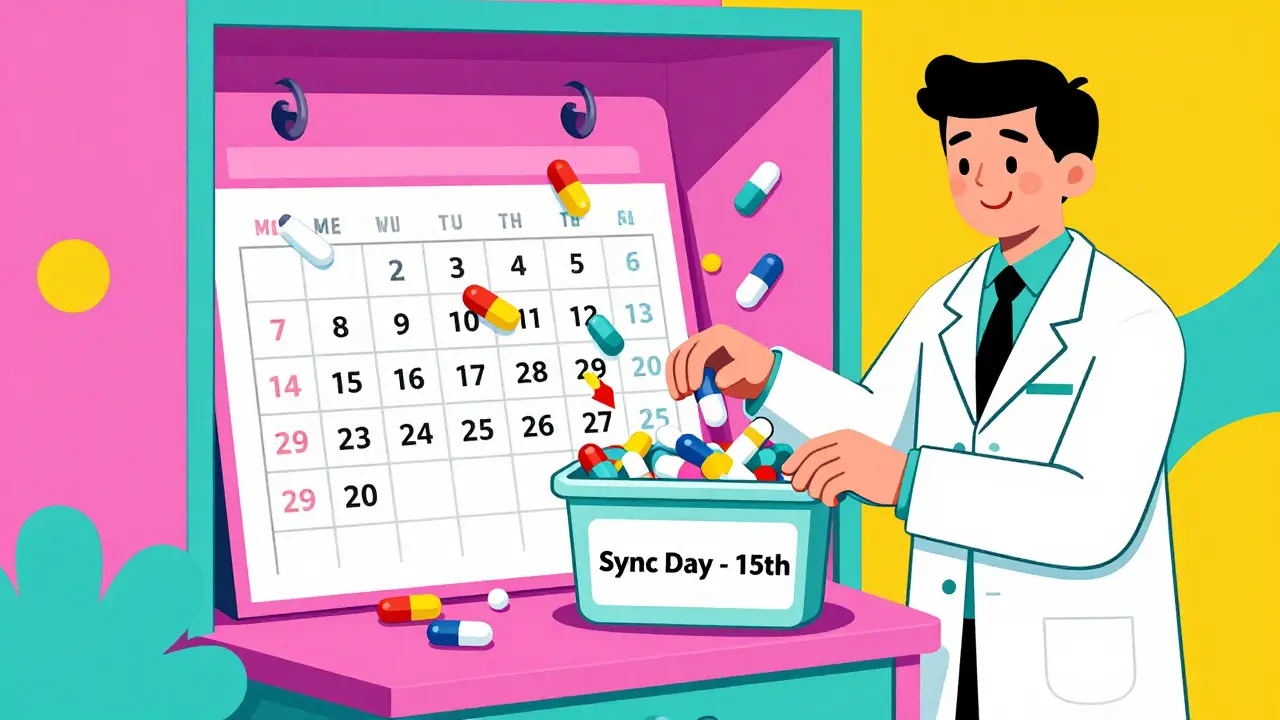
Managing five or six medications a day is overwhelming. You forget which one to take when. You run out of pills mid-month. You skip doses because it’s too much hassle. If this sounds familiar, you’re not alone. About half of all people with chronic conditions don’t take their meds as prescribed. The World Health Organization calls it one of the biggest problems in modern healthcare. But there’s a simple fix most people don’t know about: refill synchronization.
What Is Refill Synchronization?
Refill synchronization-also called med sync-is when your pharmacy lines up all your regular medications to be refilled on the same day each month. Instead of having to pick up your blood pressure pill on the 5th, your diabetes med on the 12th, your cholesterol drug on the 20th, and your antidepressant on the 28th, you pick them all up on the 15th. One trip. One time. One reminder. It sounds basic. But the impact is huge. Studies show that patients who use med sync improve their medication adherence by 3 to 11 percentage points, depending on the drug and how they get their prescriptions. That might not sound like much, but in real terms, it means fewer hospital visits, lower costs, and better health outcomes. The system works because it cuts through the chaos. When your refills are scattered across the month, your brain can’t keep track. When they’re all on one day, your routine becomes predictable. Your pharmacy also knows exactly when you’re due, so they can call or text you before you run out. No more scrambling at the last minute.How It Works: The Four-Step Process
Getting started is easier than you think. Here’s how it actually happens:- Initial consultation: You walk into your pharmacy and ask about med sync. Or your pharmacist notices you’re on three or more chronic meds and brings it up. They review every prescription you’re taking-what it’s for, how often you take it, when it’s due. They check for duplicates, interactions, or pills you might not need anymore.
- Synchronization plan: The pharmacist figures out the best single refill date for you. If your meds have different dosing schedules (once daily, twice daily, every other day), they’ll adjust the initial supply. For example, if your blood pressure pill is due in 10 days and your statin is due in 25, they might give you an extra 15 days’ worth of the blood pressure med so both are due on the same day next month. This is called “front-loading.”
- Monthly refill: Every month, on your sync date, your meds are ready. The pharmacy calls or texts you a few days before. You pick them up in 5 minutes, or they’re delivered to your door. No need to remember dates. No need to call in refills.
- Monthly check-in: Your pharmacist reviews your meds each month. Did your doctor change your dose? Did you start a new drug? Did you stop one? They catch it before it becomes a problem.
Who Benefits the Most?
Med sync isn’t for everyone. It works best for people who:- Take three or more maintenance medications for chronic conditions-like high blood pressure, diabetes, high cholesterol, asthma, or depression.
- Take meds daily or multiple times a day.
- Have trouble remembering schedules or running out of pills.
- Use a retail pharmacy (not mail-order) for most prescriptions.
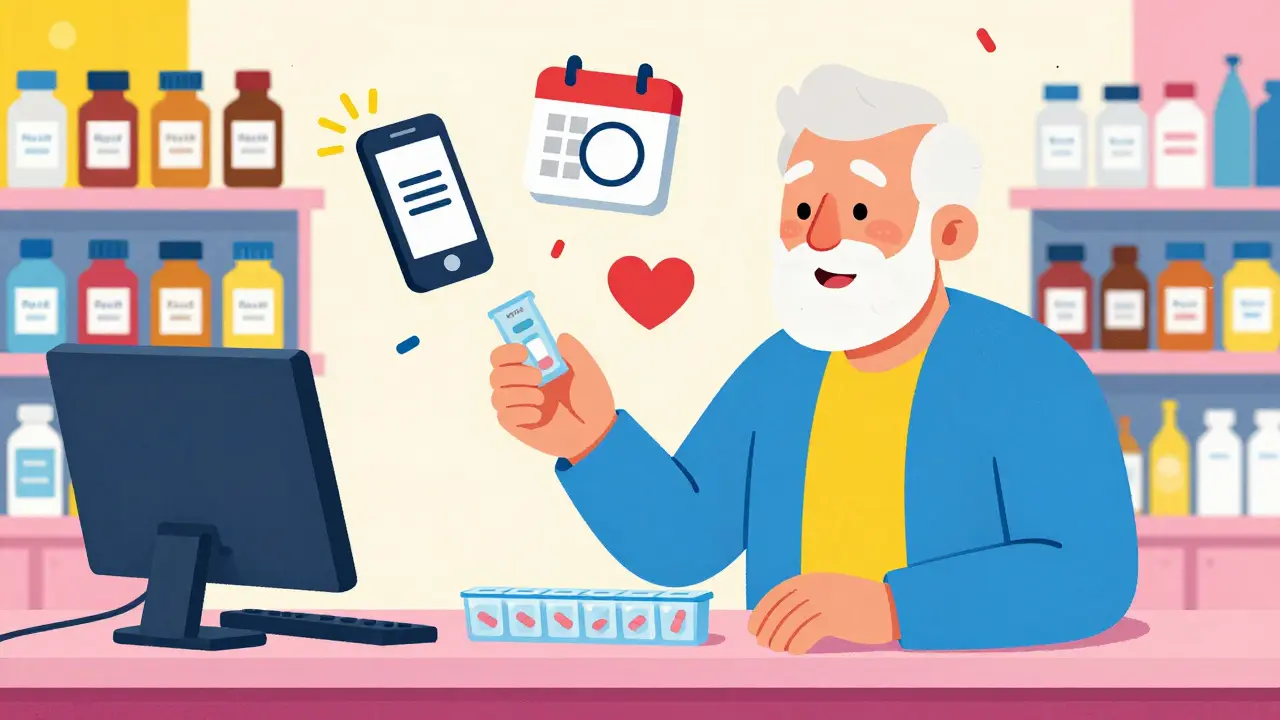
Why It Works Better Than Mail-Order
You might think, “Why not just use mail-order? They send everything automatically.” But here’s the catch: mail-order pharmacies don’t sync. They send each med on its own schedule. You still get five different delivery dates. You still have to remember when each one arrives. You still have to call if something’s late. Studies show med sync delivers bigger adherence gains for people who get their meds from a local pharmacy. One 2017 study found that patients using retail pharmacies saw a PDC (proportion of days covered) improvement of 8 to 11 percentage points with sync. Mail-order users saw only a 1 to 3 point gain. Why? Because retail pharmacies offer personal contact. They call you. They notice if you haven’t picked up your meds in two months. They ask, “Are you doing okay?” That human connection matters.What’s Holding People Back?
The biggest problem isn’t the system-it’s the system’s limitations. First, insurance. Many plans don’t allow early refills. If your pill is due in 14 days, your insurer might block the refill until day 15. That breaks the sync. Pharmacists have to call your doctor for an early refill authorization. That takes time. About 47% of pharmacists say this is their biggest hurdle. Second, complexity. Some meds can’t be synced easily. Things like insulin, which needs refrigeration, or seizure meds with strict dosing windows, are harder to adjust. If you’re on a med that’s taken every other day, syncing can get messy. Third, patient resistance. Some people don’t understand why their refill date changed. “I’ve been taking this on the 10th for five years!” they say. Pharmacists spend 20 to 30 minutes explaining the concept during the first visit. That’s a lot of time. But once people try it, 87% say they’re “very satisfied.”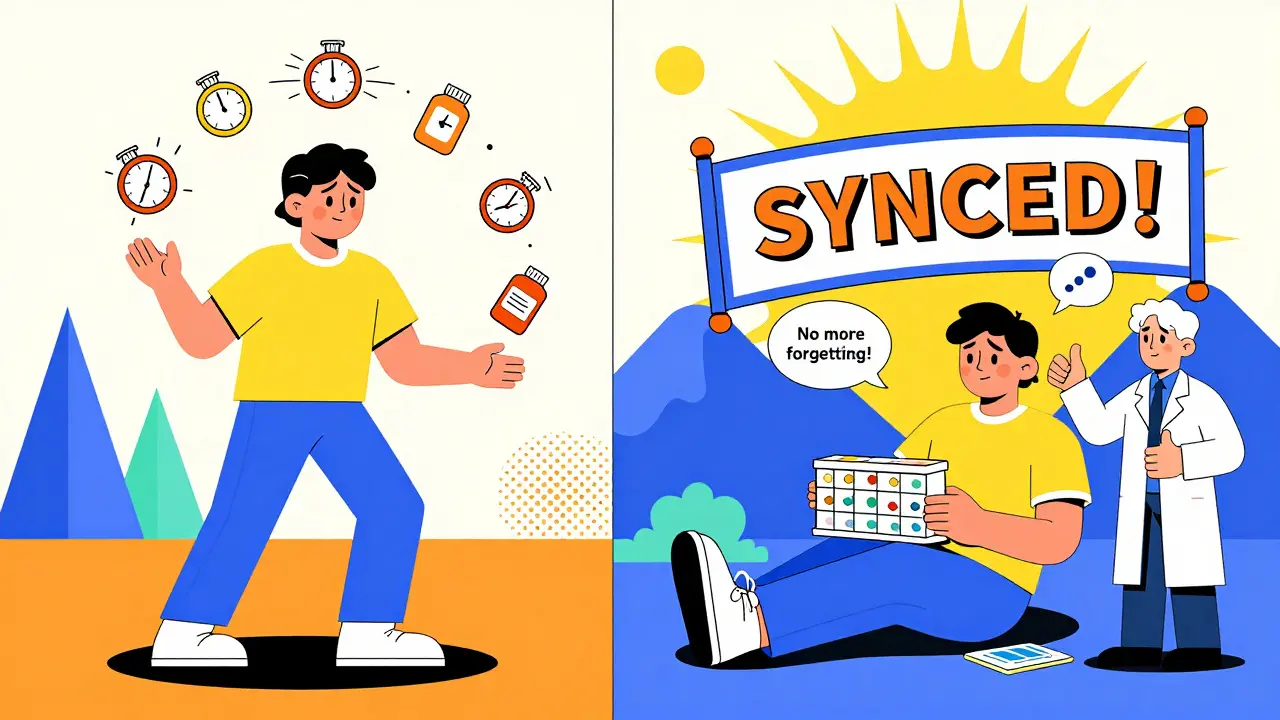
What Pharmacies Are Doing Now
Med sync is no longer a niche service. By 2022, over 12 million Americans were enrolled. CVS and Walgreens lead the pack, with 68% of all programs run by big chains. But independent pharmacies are catching up. About 45% of them now offer med sync. New features are popping up. CVS launched a digital portal that sends text reminders and tracks your adherence. Walgreens added a “Sync & Save” program that reduces copays for synced meds. Kroger Health is testing virtual pharmacist visits tied to sync pick-ups. The goal? Make it seamless. Make it smart. Make it part of your daily life.How to Get Started
If you’re on three or more chronic meds, here’s what to do:- Call your pharmacy and ask: “Do you offer medication synchronization?”
- If they say yes, schedule a 15- to 30-minute appointment with the pharmacist.
- Bring a list of all your meds-including over-the-counter drugs and supplements.
- Ask: “Can you help me get all my refills on one day?”
- Confirm your sync date and how you’ll be reminded (call, text, app).
- Give it one full cycle. See how it feels.
The Bigger Picture
Med sync isn’t magic. It won’t fix every adherence problem. But it fixes one of the biggest: complexity. When you don’t have to juggle dates, you stop forgetting. When your pharmacy remembers for you, you stop running out. When you feel supported, you start caring more. And that’s the point. Medication adherence isn’t about willpower. It’s about design. If the system makes it easy, people will do it. If it’s confusing, they won’t. Med sync is one of the few pharmacy services that’s been proven to work. It’s not expensive. It doesn’t require new tech. It just requires a pharmacist who cares enough to ask, “Are you taking your meds?” It’s time we stopped blaming patients for forgetting. We should fix the system instead.Can I sync my medications if I use mail-order pharmacies?
Mail-order pharmacies typically send each medication on its own schedule, so true synchronization isn’t possible. While you may get automatic refills, you won’t get a single refill date for all your meds. For the best adherence results, use a local retail pharmacy that offers med sync. If you must use mail-order, ask your pharmacist if they can coordinate with your mail-order provider to align refill dates.
Will my insurance cover early refills for synchronization?
Not always. Many insurance plans have rules that prevent early refills-often requiring you to wait until you’ve used 75-80% of your current supply. Your pharmacist can request an early refill authorization from your doctor, but this takes time and isn’t guaranteed. Some plans, especially Medicare Advantage, are more flexible because they’re incentivized to improve adherence. Ask your pharmacist to check your plan’s policy before enrolling.
How long does it take to set up med sync?
The initial setup usually takes 20 to 30 minutes. Your pharmacist reviews all your medications, checks for interactions, adjusts refill quantities, and picks your sync date. After that, monthly check-ins take just 5 to 10 minutes. Most patients are fully synced within one to two months, depending on insurance approvals and refill timing.
What if I start a new medication? Will it mess up my sync?
No. Your pharmacist reviews your medications every month during your refill. If you start a new drug, they’ll adjust your sync plan to include it. Sometimes they’ll give you a small supply to hold until your next sync date. You don’t need to do anything-just tell your pharmacist about the new prescription.
Is med sync only for older adults?
No. While Medicare Advantage patients make up the largest group, med sync works for anyone on multiple chronic medications-whether you’re 25 or 85. Younger adults with conditions like asthma, diabetes, or depression benefit just as much. The key is having three or more maintenance meds, not your age.
Can I sync my medications if I take them at different times of day?
Yes. Med sync only aligns your refill dates, not your dosing times. You can still take your morning blood pressure pill and your nighttime sleep aid on their usual schedules. The pharmacy just makes sure you have enough of each on your one monthly pickup day. Your pharmacist can help you create a simple daily chart if you need help remembering when to take each one.
Do I have to pick up my meds in person?
No. Many pharmacies offer delivery or drive-thru pickup for synced prescriptions. Some even ship your meds in a monthly organizer with labeled compartments. Ask your pharmacy what options they offer. The goal is convenience-not extra work.

15 Comments
Angela Stanton
January 9, 2026 AT 10:56OMG YES. 🙌 I’ve been syncing my mom’s meds for 8 months now-she went from 3 ER visits/year to ZERO. Her BP dropped 20 points, and her pharmacist actually remembers her dog’s name. That’s not healthcare-that’s family. 💊❤️
Elisha Muwanga
January 9, 2026 AT 20:27This is precisely why America’s healthcare system is failing. We outsource basic responsibility to pharmacists while patients expect magic. If you can’t manage five pills, maybe you shouldn’t be left alone with them. This isn’t a fix-it’s a crutch.
Alicia Hasö
January 11, 2026 AT 08:57Let me tell you something: this isn’t just about refills-it’s about dignity. When you’re drowning in pills, you stop feeling like a person. You feel like a spreadsheet. Med sync doesn’t just organize your meds-it restores your autonomy. I’ve seen 70-year-olds cry because they finally felt in control again. This is healthcare with heart.
Jeffrey Hu
January 11, 2026 AT 09:28Actually, the 3-11% adherence improvement is statistically insignificant in real-world terms. Most studies use PDC metrics which inflate perceived benefit. Also, the Missouri case study? N=1. You can’t generalize from a single anecdote. And don’t get me started on the Medicare Advantage incentives-this is just cost-shifting disguised as innovation.
Drew Pearlman
January 13, 2026 AT 06:26I know this sounds cheesy, but this system changed my life. I’m 32, have lupus and RA, and was taking 7 meds on 5 different schedules. I was missing doses, forgetting if I’d taken my prednisone, and feeling like a failure. After syncing? I sleep better. I don’t panic when I see a pill bottle. My doctor said my inflammation markers are the best they’ve been in years. It’s not magic. It’s just… smart design. And honestly? It made me feel like someone cared enough to help me not fail.
Matthew Maxwell
January 14, 2026 AT 02:42Let’s be clear: this is a band-aid on a gunshot wound. We’re glorifying pharmacy convenience while ignoring the root problem-pharmaceutical pricing, lack of physician coordination, and systemic neglect of chronic care. If your meds cost $500/month, no amount of syncing will fix adherence. This is performative healthcare.
Lindsey Wellmann
January 14, 2026 AT 12:21MY PHARMACIST CALLED ME AT 7 PM ON A SATURDAY BECAUSE I HADN’T PICKED UP MY ANTIDEPRESSANTS. I CRIED. 🥹 I didn’t even realize I’d missed two refills. She didn’t judge. She just said, ‘We got you.’ That’s not a pharmacy. That’s a lifeline. #MedSyncSavesLives
Jacob Paterson
January 15, 2026 AT 05:57Of course it works. People are lazy. You give them a system that does the thinking for them, and suddenly they’re ‘adherent.’ But this isn’t empowerment-it’s infantilization. What happens when the pharmacist retires? Or the pharmacy closes? You’re back to square one. This system is built on fragile human contact, not sustainable infrastructure.
Maggie Noe
January 16, 2026 AT 23:32It’s funny-this whole system is just a mirror of how we treat mental health. We expect people to manage complex, life-altering conditions alone, then blame them when they break. Med sync doesn’t fix the illness. It fixes the isolation. Maybe that’s the real medicine.
Gregory Clayton
January 18, 2026 AT 20:58Yeah, but why should I trust some pharmacist to rearrange my pills? I’ve got a PhD in engineering-I can manage my own meds. This feels like corporate medicine trying to make us feel good about being controlled. I’ll stick to my Excel sheet and my alarms, thanks.
Catherine Scutt
January 20, 2026 AT 07:19I tried this. My sync date was on a Tuesday. My insurance denied early refill for one med. Took 3 weeks to get it approved. Pharmacist had to call my doctor 4 times. I gave up. This system only works if you have time, patience, and perfect insurance. Most people don’t.
Ashley Kronenwetter
January 21, 2026 AT 19:30As a nurse practitioner, I’ve recommended med sync to over 200 patients. The adherence improvement is real. But the most profound outcome? Patients start asking better questions. They begin to engage with their care. That’s the real win-not the refill date, but the shift in agency.
Aron Veldhuizen
January 23, 2026 AT 02:29Let’s deconstruct the rhetoric: ‘refill synchronization’ is just time-based batching-a concept borrowed from industrial logistics. Applying it to human physiology ignores the nonlinear nature of biological adherence. The assumption that uniformity improves compliance is a reductionist fallacy. People don’t fail because of scheduling chaos-they fail because of systemic neglect, stigma, and economic precarity. This is techno-solutionism dressed as compassion.
Heather Wilson
January 23, 2026 AT 10:27It’s not that hard to remember. Use a pillbox. Set alarms. Call your pharmacy. Stop expecting someone else to do the work for you. This system is a luxury for people who can’t take basic responsibility. And the fact that pharmacies are incentivized to push this? That’s a red flag.
Micheal Murdoch
January 23, 2026 AT 13:03Look-I’ve been a pharmacist for 22 years. I’ve seen people die because they ran out of insulin because they forgot to refill. I’ve seen families cry because their grandma missed a dose and ended up in the hospital. This isn’t about convenience. It’s about survival. If you think this is ‘babying’ patients, you’ve never held someone’s hand while they figure out how to open a pill bottle with arthritic fingers. This is care. Plain and simple. And if you’re too cynical to see that, maybe you need to spend a day in a pharmacy.