
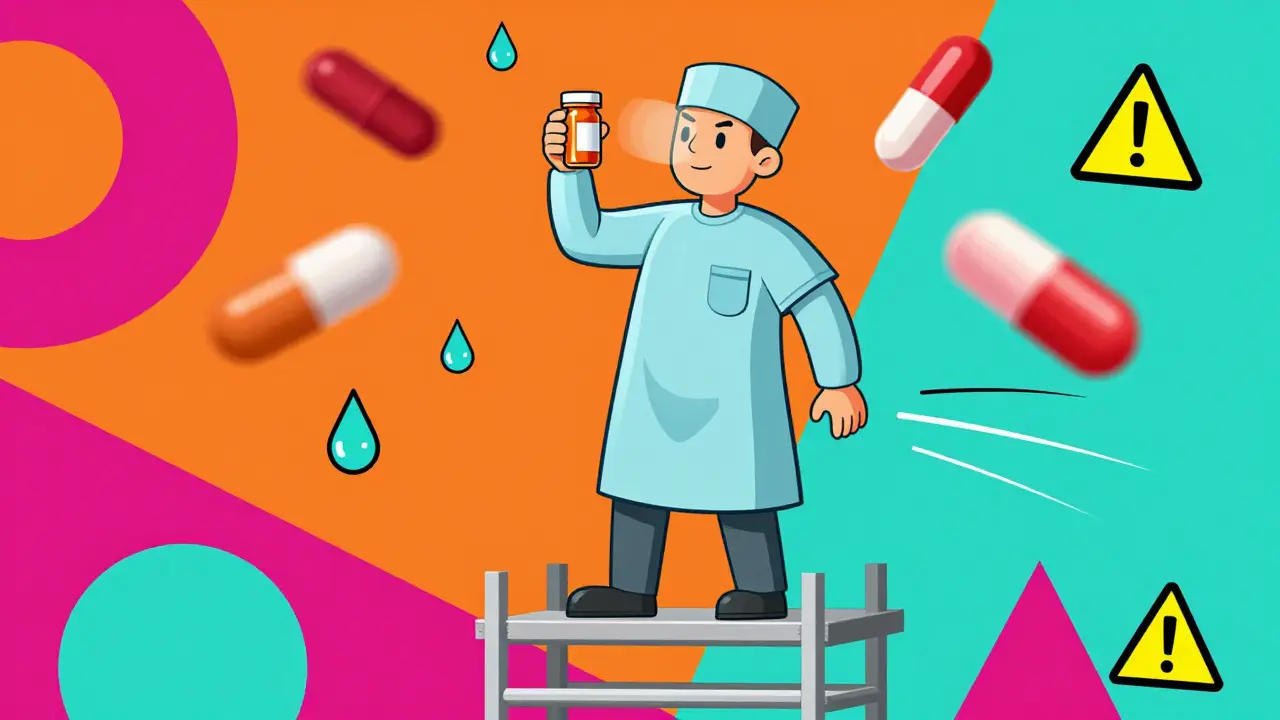
Imagine taking a prescription painkiller for a back injury, then walking into a hospital operating room or climbing onto a construction scaffold the next day. Or picture a nurse handling chemotherapy drugs all week, wearing gloves and a mask, but still waking up with unexplained rashes. These aren’t hypotheticals-they’re daily realities for millions of workers. The truth is, medications can make workplaces safer… or turn them into hidden danger zones.
Two Sides of the Same Coin
There are two very different, but equally serious, ways medications affect work safety. One side is about workers who take prescription drugs-like opioids or benzodiazepines-that slow reaction times, blur vision, or cause dizziness. The other side is about workers who handle dangerous drugs as part of their job-like nurses giving chemo, pharmacists mixing IV bags, or lab techs handling toxic chemicals. Both groups face real risks, and neither is getting enough attention.Workers on opioids are 2.1 times more likely to get injured on the job than those who aren’t. That’s not a small bump-it’s a massive spike. Benzodiazepines, often prescribed for anxiety or sleep, aren’t much better. When someone takes both opioids and benzodiazepines together, their chance of falling or having a near-miss accident jumps by 84%. These aren’t just numbers. They’re people-truck drivers dozing off at the wheel, surgeons losing focus during a procedure, factory workers missing a step on a moving line.
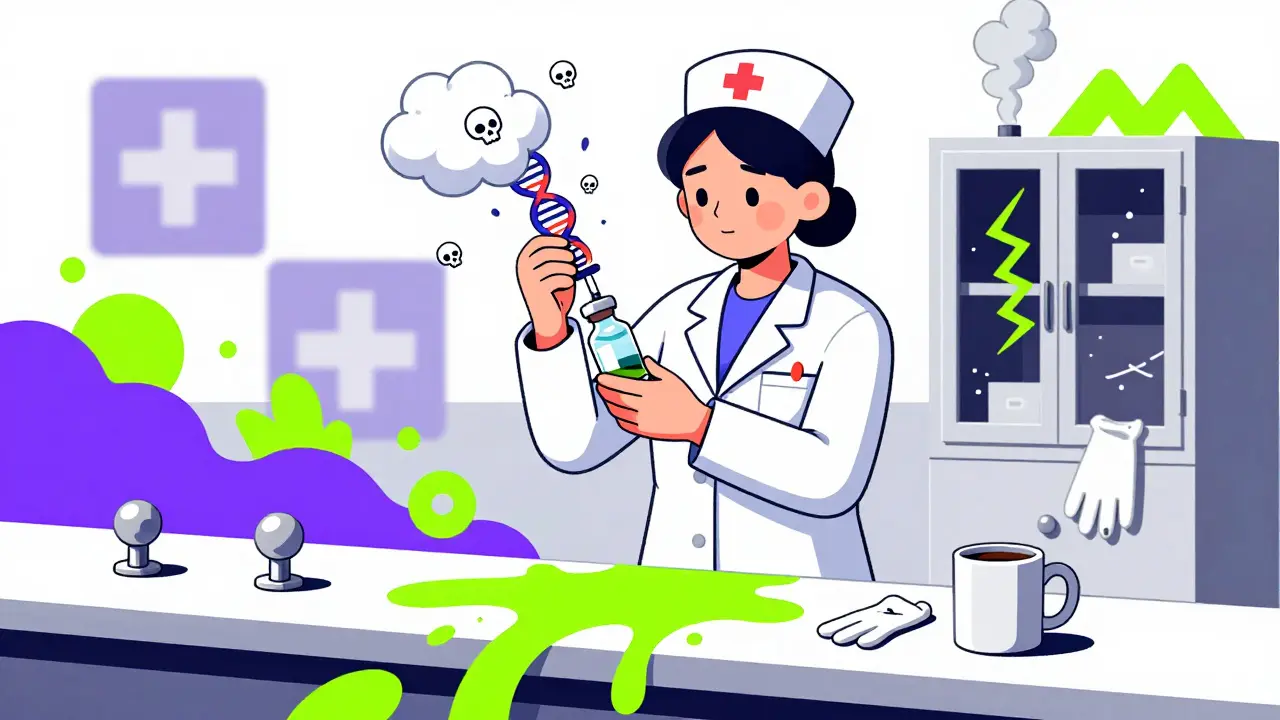
On the other side, healthcare workers handling hazardous drugs face a different kind of threat. The 2024 NIOSH list includes 370 drugs that can cause cancer, birth defects, or organ damage from tiny, invisible exposures. Antineoplastic agents-chemotherapy drugs-are the biggest group, making up 267 of those 370. A nurse might not even feel anything after handling a vial, but over months or years, those repeated exposures add up. Studies show these workers have 3.4 times higher risk of developing certain cancers. One chemotherapy nurse on Reddit shared that after three years on the job, she developed chronic skin rashes-even though she followed every protocol. Surface tests in her unit showed contamination in 68% of work areas.
How Exposure Happens (And Why It’s Hard to Stop)
You might think wearing gloves and a mask is enough. It’s not. Exposure doesn’t always come from spills or splashes. Most of the time, it’s silent and invisible.Thirty-eight percent of exposures happen through breathing in tiny aerosols or vapors-like when a drug vial is opened or a bag is hung. Twenty-nine percent come from skin or eye contact during spills or accidental drips. Another 22% happen when someone touches a contaminated surface-a countertop, a doorknob, a computer keyboard-and then rubs their eyes or eats lunch without washing their hands. Even 7% come from swallowing traces of drugs because of poor hygiene. And 4%? Those are needlestick injuries.
Here’s the kicker: many of these exposures happen because of systems, not people. A 2021 CDC study found that 43% of healthcare workers didn’t properly wear or remove PPE-not because they were careless, but because the gloves were too tight, the masks didn’t fit right, or the training was rushed. In 31% of facilities, the safety cabinets designed to contain hazardous drugs didn’t even work properly. Ventilation systems were inadequate in 27% of cases. Training might be required, but if the equipment is broken and the culture doesn’t support speaking up, workers are left guessing.
What Actually Works to Reduce Risk
Some places are getting this right. Mayo Clinic cut hazardous drug exposures by 89% in just two years-not by yelling at staff, but by fixing the environment. They installed closed-system transfer devices (CSTDs), which are special connectors that prevent drugs from escaping during mixing and transfer. They improved ventilation. They made sure every worker had the right PPE that actually fit. And they didn’t just train once-they checked in monthly, asked for feedback, and adjusted.Other solutions are simpler but just as powerful. A pharmacy technician in a small clinic in Ohio told WorkCompWire that after her facility adopted NIOSH’s 2024 guidelines, surface contamination dropped from 42% to 4.7% in six months. That’s not luck. That’s consistency.
For workers taking medications, the solution isn’t always to stop taking them. It’s to manage them better. Drug-free workplace policies that automatically fire someone for testing positive for a prescribed medication don’t help-they just push people into hiding. What works is a safety-first approach: a doctor and employer working together to adjust dosages, switch to safer alternatives, or shift job duties temporarily. One anesthesiologist who developed dizziness after taking opioids for a back injury was moved to administrative duties for six weeks while his dose was lowered. He returned to surgery without another incident.
Unionized workplaces have 22% fewer medication-related incidents than non-union ones. Why? Because workers have a voice. They can report unsafe conditions without fear. They can demand better equipment. They can push for training that actually makes sense.
The Hidden Cost of Inaction
This isn’t just about health-it’s about money. Occupational medication incidents cost the U.S. $4.7 billion every year. That’s $2.1 billion in medical bills, $1.8 billion in lost productivity, and $800 million in workers’ compensation claims. Hospitals with fewer than 50 beds are less than half as likely to have proper hazardous drug programs as large hospitals. That means smaller clinics, rural pharmacies, and outpatient centers are the most vulnerable.And the market is responding. The global market for hazardous drug safety equipment is projected to hit $3.8 billion by 2028. That’s because companies are finally realizing: ignoring this isn’t cheaper. It’s riskier.
What You Can Do Right Now
If you take prescription meds and work in a job that requires focus, coordination, or physical safety-like driving, operating machinery, or handling tools-talk to your doctor. Ask: “Could this affect my ability to do my job safely?” Don’t assume your doctor knows your job. They might not. Bring your job description. Ask about alternatives.If you handle hazardous drugs, know the NIOSH 2024 list. Don’t rely on memory. Check it. If your workplace doesn’t have closed-system transfer devices, ask why. If your PPE feels uncomfortable or doesn’t fit, report it. If you’re seeing rashes, nausea, or unexplained fatigue, tell your supervisor. Document it. You’re not overreacting-you’re protecting your future.
Employers need to do more than post signs. They need to invest in real controls: better ventilation, functional safety cabinets, proper training with hands-on practice, and a culture where workers feel safe speaking up. If your workplace doesn’t have a hazardous drug safety program, ask for one. Use the NIOSH guidelines. Cite the 2024 list. Show them the data.
What’s Changing in 2026
The rules are catching up. OSHA is expected to propose a new surface contamination limit for hazardous drugs-0.1 ng/cm²-by late 2024. That’s stricter than anything before. The FDA now requires boxed warnings on 27 chemotherapy drugs about occupational exposure risks. And AI systems are being tested at places like Johns Hopkins to predict exposure hotspots before they happen.Some drugs are being removed from the hazardous list too. Liraglutide and pertuzumab were taken off the 2024 NIOSH list because newer data showed lower risks. That’s progress. But 42% of new cancer drugs approved in 2023 still don’t have any safety guidelines for workers. That’s a gap.
Workplace safety isn’t about perfection. It’s about progress. It’s about recognizing that a pill in someone’s pocket or a drop of chemo on a counter can have life-changing consequences. The tools to fix this exist. The data is clear. The question is: who’s going to act on it?
Can I be fired for taking prescribed medication at work?
It depends on your job and your employer’s policy. Under the Americans with Disabilities Act (ADA), employers must provide reasonable accommodations for workers using prescribed medications-unless it creates a direct safety threat. If you’re taking a medication that affects your ability to perform essential job functions safely (like driving a truck or operating heavy machinery), your employer may need to adjust your duties or schedule. However, some workplaces still have zero-tolerance policies that unfairly penalize workers with legitimate medical needs. If you’re being punished for taking a prescribed medication with no safety incidents, you may have legal recourse.
Are over-the-counter meds a safety risk too?
Yes. Many OTC meds like antihistamines (Benadryl, Claritin-D), sleep aids (Unisom, Tylenol PM), and even some cough syrups can cause drowsiness, dizziness, or slowed reaction times. If you’re working in a high-risk job-construction, healthcare, transportation, or manufacturing-these can be just as dangerous as prescription drugs. Always read labels for warnings like “may cause drowsiness” or “do not operate machinery.” If in doubt, talk to your pharmacist.
How do I know if a drug is hazardous to handle at work?
Check the NIOSH 2024 List of Hazardous Drugs in Healthcare Settings. It’s updated annually and includes over 370 drugs, categorized by risk level. You can find it on the CDC’s NIOSH website. If you work in a pharmacy, oncology unit, or lab, your employer should have a copy and provide training. If they don’t, ask for it. If you’re unsure whether a drug is on the list, don’t guess-ask your safety officer or pharmacist.
What should I do if I think I’ve been exposed to a hazardous drug?
Wash the affected area immediately with soap and water. Remove contaminated clothing. Report the exposure to your supervisor and safety officer right away-even if you feel fine. Document the date, time, drug involved, and how the exposure happened. Seek medical evaluation, especially if you develop rashes, nausea, dizziness, or unusual fatigue. Many exposures have delayed effects. Early reporting helps track trends and improve safety systems.
Do I need special training to handle chemotherapy drugs?
Yes. Under USP Chapter 800, anyone handling hazardous drugs-including chemotherapy-must receive initial training of 16 to 24 hours, plus 4 to 8 hours of annual refreshers. Training should cover exposure routes, proper use of PPE, closed-system transfer devices, spill procedures, and waste handling. If your employer hasn’t provided this training, ask for it. If they refuse, contact your union or OSHA. You have the right to a safe workplace.
Are there safer alternatives to hazardous drugs in healthcare?
Sometimes. For example, some newer targeted therapies and immunotherapies have lower toxicity profiles than traditional chemotherapy. But many are still classified as hazardous because long-term exposure data isn’t complete. The key isn’t always replacing drugs-it’s improving how they’re handled. Using closed-system transfer devices, better ventilation, and automated dispensing systems reduces exposure regardless of the drug. Always ask: “Is there a safer way to administer or prepare this?”

10 Comments
Robert Way
January 14, 2026 AT 18:28so i took oxy for a herniated disc and went to work at the warehouse… yeah i dropped a pallet on my foot. not the drugs fault, i was just dumb. but now i know to not mix painkillers and heavy lifting. also my boss is a jerk and made me sign a waiver. lol.
Allison Deming
January 15, 2026 AT 13:06It is profoundly concerning that our society continues to treat workplace safety as an afterthought rather than a fundamental ethical imperative. The statistical data presented here-particularly the 2.1-fold increase in injury rates among opioid users-is not merely an occupational hazard; it is a systemic failure of corporate responsibility, medical oversight, and public policy. We have normalized the commodification of human health, reducing complex physiological responses to mere compliance metrics. Until employers are held legally accountable for inadequate safety infrastructure and until prescribers are mandated to assess occupational risk before writing prescriptions, this epidemic will persist under the guise of individual negligence.
Susie Deer
January 16, 2026 AT 07:39USA needs to stop coddling people who take meds and expect to work. if you cant do your job sober then find another line of work. no one cares about your rashes from chemo either. get a different job or deal with it. this is america not europe.
TooAfraid ToSay
January 17, 2026 AT 20:54you think this is bad wait till you find out the real reason they're pushing these meds... they're testing how long it takes for workers to die from exposure before the government admits it's intentional. i work in a lab and my boss told me to 'suck it up' when i got the rash. then he got promoted. coincidence? i think not.
Dylan Livingston
January 18, 2026 AT 15:15Oh please. Let me just sip my oat milk latte while I tell you how tragic it is that nurses-those saintly, overworked angels-are getting rashes. Meanwhile, the same people who cry about chemo exposure are the ones who think a 20-minute OSHA video counts as training. You don’t get a participation trophy for surviving a toxic workplace. You get a lawsuit. Or better yet, you get a union. But no, let’s just keep pretending that wearing gloves and sighing dramatically fixes everything. How quaint.
Andrew Freeman
January 18, 2026 AT 19:23why do we even have to talk about this like its some big mystery. if your med makes you sleepy dont drive or use machines. if your job exposes you to poison then get better gear or quit. simple. stop making it a political thing. also osha is useless. been there done that.
says haze
January 19, 2026 AT 11:50There’s an epistemological rupture here: we treat pharmaceuticals as either therapeutic agents or toxicants, but never as sociotechnical artifacts embedded in labor relations. The NIOSH list is not a scientific document-it’s a bureaucratic artifact of capitalist biopower. The fact that 42% of new cancer drugs lack safety protocols isn’t negligence-it’s the logical outcome of a system that prioritizes profit over embodied risk. The real tragedy isn’t the exposure-it’s that we’ve normalized the invisibility of worker suffering as collateral in the medical-industrial complex.
Alvin Bregman
January 21, 2026 AT 01:08i just want to say thanks to the people who wrote this. i work in a small clinic and we dont have fancy gear but we do wash our hands and check the list. its not perfect but we try. also if you take meds and feel weird at work tell someone. dont wait till you pass out. we all need to look out for each other
Sarah -Jane Vincent
January 22, 2026 AT 09:25you think this is the only thing they’re hiding? check the 2023 FDA data on AI exposure monitoring systems-they’re being used to track worker fatigue and predict when someone will ‘accidentally’ get injured. they’re building a database to fire people before they file workers’ comp. this isn’t safety. it’s surveillance capitalism with a lab coat.
Henry Sy
January 23, 2026 AT 18:00man i saw a nurse cry last week because she had to wipe down a counter with bleach after mixing chemo. she said the gloves made her palms sweat so bad she’d touch her face without realizing. and the boss? he told her to 'just be more careful.' like that's a fix. we're all just one bad day away from becoming a statistic and nobody gives a damn until someone dies. and then they slap a plaque on the wall and move on.