

Topical steroids are one of the most common treatments for eczema, psoriasis, and other inflamed skin conditions. Used right, they work fast-often clearing flares in under a week. But used wrong? They can cause skin thinning, bruising, stretch marks, and even permanent damage. The problem isn’t the medicine itself. It’s how people use it.
What Topical Steroids Actually Do
Topical corticosteroids are anti-inflammatory drugs applied directly to the skin. They calm redness, itching, and swelling by blocking the body’s immune response at the site of irritation. Unlike oral steroids, which flood your whole system, topical versions mostly stay on the skin. Your skin cells break them down before much gets into your bloodstream. That’s why they’re safer than pills for localized problems.
But that doesn’t mean they’re harmless. The stronger the steroid, the more powerful-and risky-it becomes. There are seven potency levels, from mild (like over-the-counter hydrocortisone) to super-potent (like clobetasol). Dermatologists match the strength to the condition and the body part. A thick, scaly patch on the elbow? Maybe a strong ointment. A rash on your eyelid? Only a mild cream, if any.
Why Skin Thinning Happens
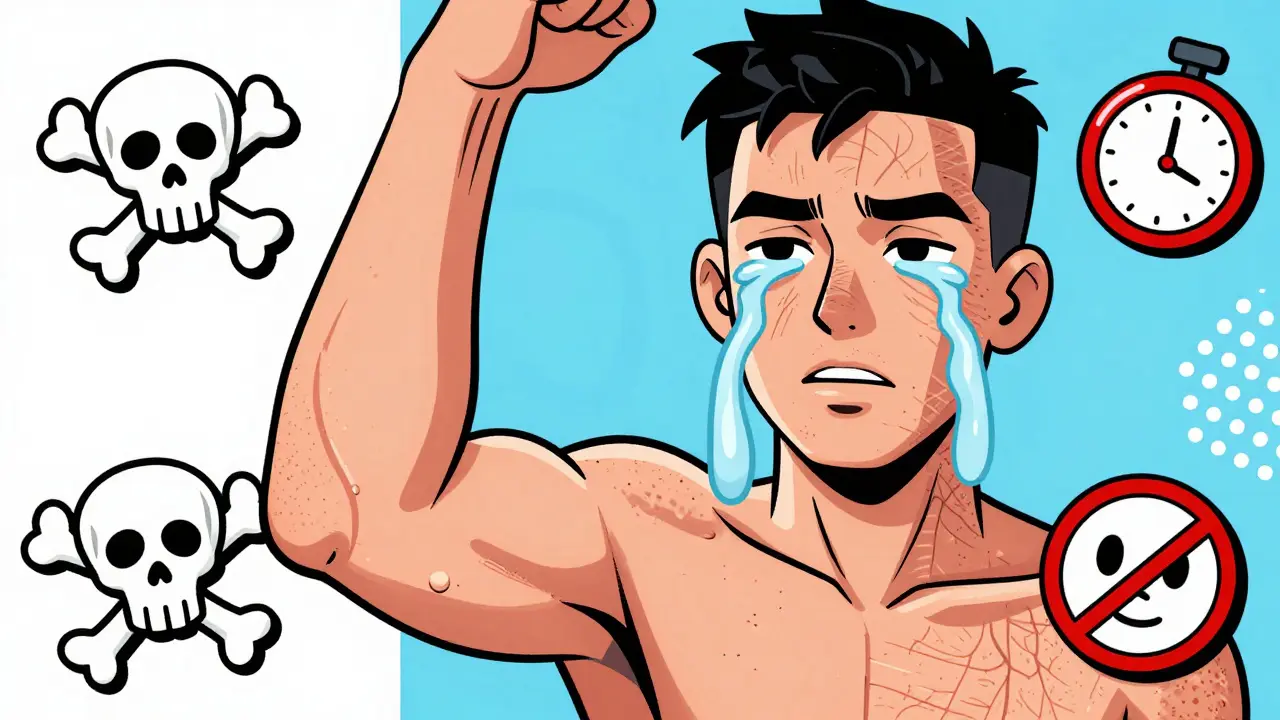
Skin thinning, or atrophy, is the most feared side effect. It doesn’t happen overnight. It builds up over weeks or months of daily use, especially on thin skin areas like the face, armpits, groin, or inner thighs. The steroid suppresses collagen production-the protein that keeps skin firm and resilient. Over time, the skin becomes paper-thin, fragile, and prone to tearing or bruising. You might see visible veins, stretch marks, or a shiny, translucent look.
It’s not just about strength. How often you apply it matters too. Applying steroid cream twice a day when once is enough doubles your risk. And using it longer than recommended? That’s how people end up with permanent damage. The National Institutes of Health warns that high-potency steroids should never be used continuously for more than two weeks. Even moderate ones shouldn’t go beyond four weeks without a break.
How Much to Use: The Fingertip Unit Rule
Most people use too little-or too much. The fix? The fingertip unit (FTU). One FTU is the amount of cream or ointment squeezed from a standard tube, from the tip of your index finger to the first crease. That’s about half a gram. It sounds small, but it covers two adult handprints.
Here’s how much you need for common areas:
- One hand (front and back): 1 FTU
- One arm (front and back): 3 FTUs
- One leg: 6 FTUs
- One foot: 2 FTUs
- Face and neck: 2-3 FTUs total
Doctors say using too little means the treatment doesn’t work well, so you end up using it longer-which increases side effect risk. Using too much? That’s how you get skin thinning. A thin, even layer is all you need. Rub it in gently until it disappears. If it’s still shiny or greasy, you’ve used too much.
Where Not to Use Strong Steroids
Not all skin is the same. The skin on your face, eyelids, genitals, and underarms is much thinner than on your palms or soles. That’s why guidelines are strict: only mild steroids should ever touch your face or sensitive areas. Even then, use them for no more than five to seven days unless your doctor says otherwise.
Using a strong steroid on your eyelids can lead to glaucoma or cataracts. On your face, it can trigger perioral dermatitis-a red, bumpy rash around the mouth. On the groin? You risk permanent discoloration or skin breakdown. The UK’s NHS and the American Academy of Dermatology both warn against using anything stronger than hydrocortisone 1% on the face without supervision.
Step-Down Therapy: The Smart Way to Use Steroids Long-Term
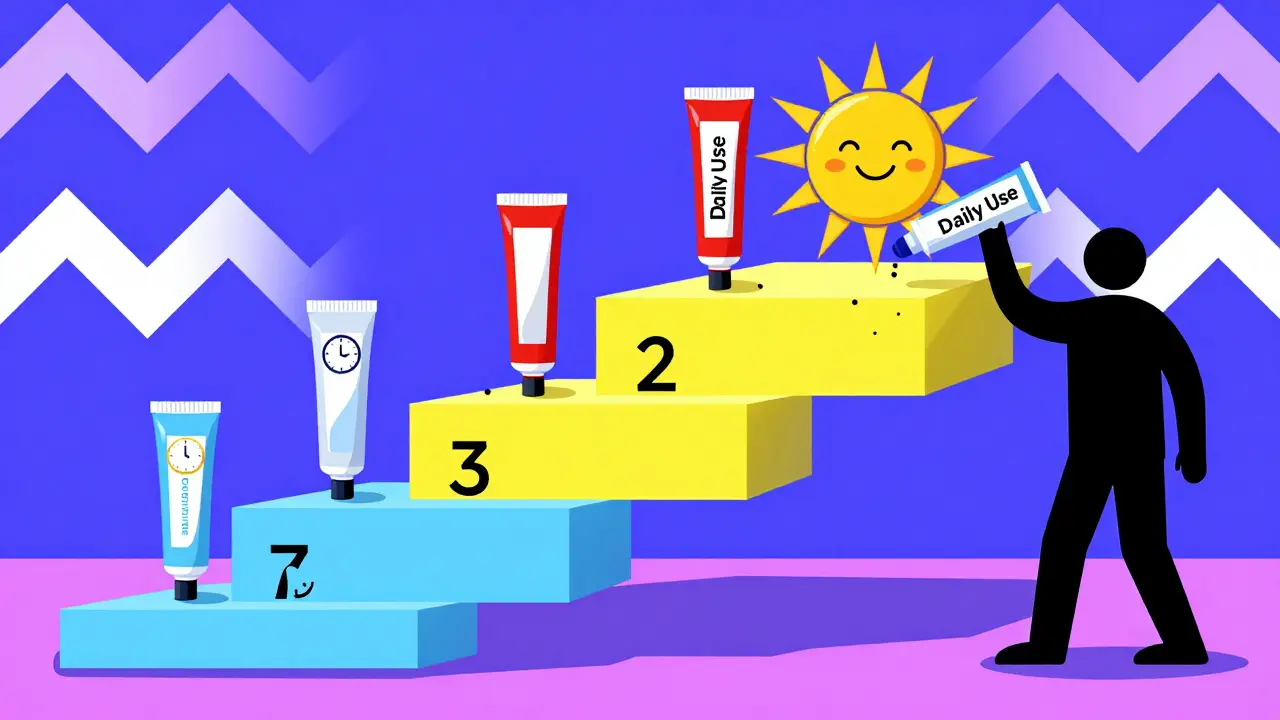
If you have chronic eczema or psoriasis, you’re not meant to use strong steroids forever. The best approach is step-down therapy: start strong, then go weak.
Example: You have a bad flare on your arms. Your doctor prescribes a medium-strength steroid cream. You use it once daily for 10-14 days until the redness clears. Then, you switch to a low-strength cream-maybe even just a moisturizer with ceramides-for maintenance. You might use the strong cream again only if another flare hits, not daily.
Studies show this method cuts side effects by more than half. The American Academy of Family Physicians says there’s no benefit to applying steroids more than once a day. Twice-daily use just raises your risk without improving results.
What to Do With Moisturizers
Moisturizers aren’t optional-they’re essential. But timing matters. If you apply moisturizer right before or after your steroid, you dilute it. That means less medicine gets absorbed, and the treatment fails.
Here’s the right order:
- Wash and gently pat skin dry.
- Apply the steroid cream or ointment to affected areas.
- Wait 20-30 minutes.
- Then apply your moisturizer over the rest of your skin.
This lets the steroid soak in fully. It also helps repair the skin barrier, which reduces future flares. Many patients skip this step-and wonder why their eczema keeps coming back.
When to Stop and Call Your Doctor
Don’t wait until your skin looks damaged. Watch for these warning signs:
- Skin looks shiny, tight, or see-through
- Easy bruising or visible veins
- Stretch marks that weren’t there before
- Worsening rash after stopping the cream
- Red, burning skin around the mouth or eyes
If you see any of these, stop using the steroid and see your doctor. You might need a non-steroidal option like tacrolimus or crisaborole. These work just as well for sensitive areas without the thinning risk. They’re more expensive, but they’re safer for long-term use.
What’s Changing in 2025
Doctors are getting smarter about steroid use. The UK’s MHRA updated guidelines in mid-2023 to stress potency matching-no more using strong creams on the face. The National Eczema Association launched a ‘Steroid Smart’ campaign with video guides on FTU dosing. Research is also testing new delivery systems that target inflammation without affecting skin structure.
But the biggest shift? Education. More dermatologists are now showing patients exactly how much to use, not just handing out prescriptions. In Australia and the UK, patient leaflets are detailed. In the U.S., they’re hit-or-miss. That’s why you need to ask: “How much should I use? How long? What if it doesn’t work?”
Bottom Line: Steroids Are Tools, Not Crutches
Topical steroids are powerful, life-changing tools when used correctly. Millions of people manage eczema and psoriasis with them safely every year. But they’re not meant to be used daily for months. They’re meant to be used briefly, precisely, and under guidance.
If you’ve been using a steroid cream for more than a month without a break, it’s time to talk to your doctor. If you’re applying it twice a day, cut it to once. If you’re using a strong one on your face, stop. And if you’re unsure how much to use? Ask for a demonstration. One FTU can make all the difference.
The goal isn’t to avoid steroids. It’s to use them smartly-so your skin heals, not thins.
Can topical steroids cause permanent skin damage?
Yes, if used incorrectly over long periods-especially strong steroids on thin skin like the face or groin. Skin thinning, stretch marks, and visible blood vessels can become permanent. The damage is often irreversible, but stopping the steroid and switching to non-steroidal treatments can prevent further harm.
Is hydrocortisone cream safe for long-term use?
Over-the-counter hydrocortisone 1% is low potency and generally safe for short-term use (up to 7 days). For chronic conditions like eczema, using it daily for months can still cause thinning, especially on sensitive skin. It’s better as a maintenance option after stronger steroids have controlled a flare, not as a daily fix.
What happens if I stop using topical steroids suddenly?
If you’ve used a strong steroid daily for weeks or months, stopping abruptly can cause rebound flares-worse than the original rash. This is called topical steroid withdrawal. The solution is to taper slowly: reduce frequency, then switch to a weaker steroid before stopping completely. Always do this under medical supervision.
Are there alternatives to topical steroids for eczema?
Yes. Non-steroidal options like crisaborole (Eucrisa) and calcineurin inhibitors (tacrolimus, pimecrolimus) are effective for facial and sensitive skin. They don’t cause skin thinning and are safe for long-term use. They’re more expensive and may cause initial burning, but they’re the preferred choice for chronic conditions needing ongoing treatment.
How do I know if my steroid cream is too strong for my skin?
If you’re using a steroid on your face, eyelids, or genitals and it’s not labeled as ‘mild’ or ‘hydrocortisone 1%’, it’s likely too strong. Also, if your skin starts looking thin, shiny, or bruised after a few weeks, stop using it. Always check with your doctor or pharmacist about potency levels-many patients don’t realize how strong their prescription is.
Can children use topical steroids safely?
Yes, but with extra caution. Children’s skin is thinner and absorbs more medication. Only mild to moderate steroids should be used, and only for short periods. Never use strong steroids on infants or toddlers unless directed by a pediatric dermatologist. Always use the fingertip unit method and avoid daily long-term use.

11 Comments
Erica Vest
December 17, 2025 AT 21:37Topical steroids are incredibly effective when used correctly, but the real issue is that most patients get handed a prescription with zero instructions. I've seen so many people use clobetasol on their face for months because the doctor said 'use as needed'-and 'as needed' became 'every morning and night.' The fingertip unit rule is non-negotiable. One FTU for the entire face. Not more. Not less. And never, ever use strong steroids on eyelids unless you want to risk glaucoma. Simple math: more potency + longer duration + thin skin = permanent damage. It's not rocket science, but it's rarely taught.
Chris Davidson
December 18, 2025 AT 15:33Steroids work but people treat them like lotion. Use them till it's gone then stop. No more no less. Skin thinning is real and its permanent. Doctors dont explain this enough. End of story
Kinnaird Lynsey
December 18, 2025 AT 20:16So… you’re telling me the same cream that made my eczema vanish for three weeks is now making my skin look like parchment paper? Thanks for the heads up, I guess. I thought the shiny glow was just… hydration. Turns out it’s just my collagen giving up. Classic.
Matt Davies
December 20, 2025 AT 10:03This is the kind of post that makes you feel like you finally found the missing puzzle piece. I’ve been using hydrocortisone daily for over a year thinking it was harmless because it’s 'over-the-counter.' Turns out even the mildest stuff can quietly sabotage your skin barrier if you treat it like a daily moisturizer. The FTU rule? Absolute game-changer. I’ve been using half a tube per week on my arms-now I know I was using six times too much. My skin’s already breathing again. Thank you for this.
mark shortus
December 22, 2025 AT 01:47OH MY GOD I JUST REALIZED I’VE BEEN USING CLOBETASOL ON MY FACE FOR 11 MONTHS. I THOUGHT THE SHINY SKIN WAS JUST ‘GLOWING.’ NOW I’M SCARED TO LOOK IN THE MIRROR. MY EYELIDS ARE TIGHT. I CAN’T EVEN BLINK WITHOUT FEELING LIKE MY SKIN IS GOING TO RIP. I’M CALLING MY DERMATOLIGIST RIGHT NOW. THIS POST SAVED ME. I HOPE I DIDN’T BREAK MY SKIN FOREVER. I’M CRYING. I’M SO STUPID. I’M SO SORRY MY SKIN.
Elaine Douglass
December 22, 2025 AT 12:55I used to use steroid cream every day for my hands and now they look like old paper and crack all the time. I didn’t know it was the cream until now. I’m going to try the moisturizer thing after 20 mins like you said. Hope it helps
Emily P
December 23, 2025 AT 13:45So if I’m using a low-potency steroid on my neck for eczema, and I’ve been doing it for six weeks straight, is that still risky? I thought if it’s not strong, it’s fine. But now I’m wondering if the duration is the real problem. I don’t have visible thinning yet, but my skin feels… different. Less springy. Is that early atrophy?
Vicki Belcher
December 24, 2025 AT 06:54THIS CHANGED MY LIFE 🙌 I used to slap on my steroid cream right after moisturizer because I thought ‘more moisture = better healing.’ Nope. I was diluting it. Now I wait 30 mins. My flare cleared in 5 days instead of 3 weeks. Also, I’m using the FTU method and I swear I’ve cut my cream usage in HALF. My dermatologist thinks I’m a wizard now 😎
Aboobakar Muhammedali
December 25, 2025 AT 19:01I live in India and here most doctors just hand out steroid creams like candy. No one tells you about FTU or duration. I used a strong cream on my inner thigh for months because it stopped the itching. Now I have white stretch marks and my skin peels every time I sweat. I wish I read this before. Thank you for writing this. I’m going to show this to my cousin who’s doing the same thing.
Laura Hamill
December 26, 2025 AT 03:22Whoa. So this whole time I thought the government and big pharma were hiding the truth about steroids? Now I’m reading that doctors are just lazy and don’t explain? But wait-what if the real danger is that they’re NOT telling you about the rebound effect? What if they WANT you to keep coming back? What if this 'step-down therapy' is just a way to keep you dependent? I’ve been reading about steroid withdrawal online. It’s a cover-up. They don’t want you to know how addictive these things are. I’m done with all of it. I’m going cold turkey. My skin will heal on its own. Nature knows best.
Alana Koerts
December 27, 2025 AT 03:55This is just common sense. If you didn’t know you shouldn’t use strong steroids on your face for months, you shouldn’t be self-treating. Also the FTU thing? Everyone knows that. This post is just restating what’s in every dermatology textbook. Stop acting like you discovered fire.